
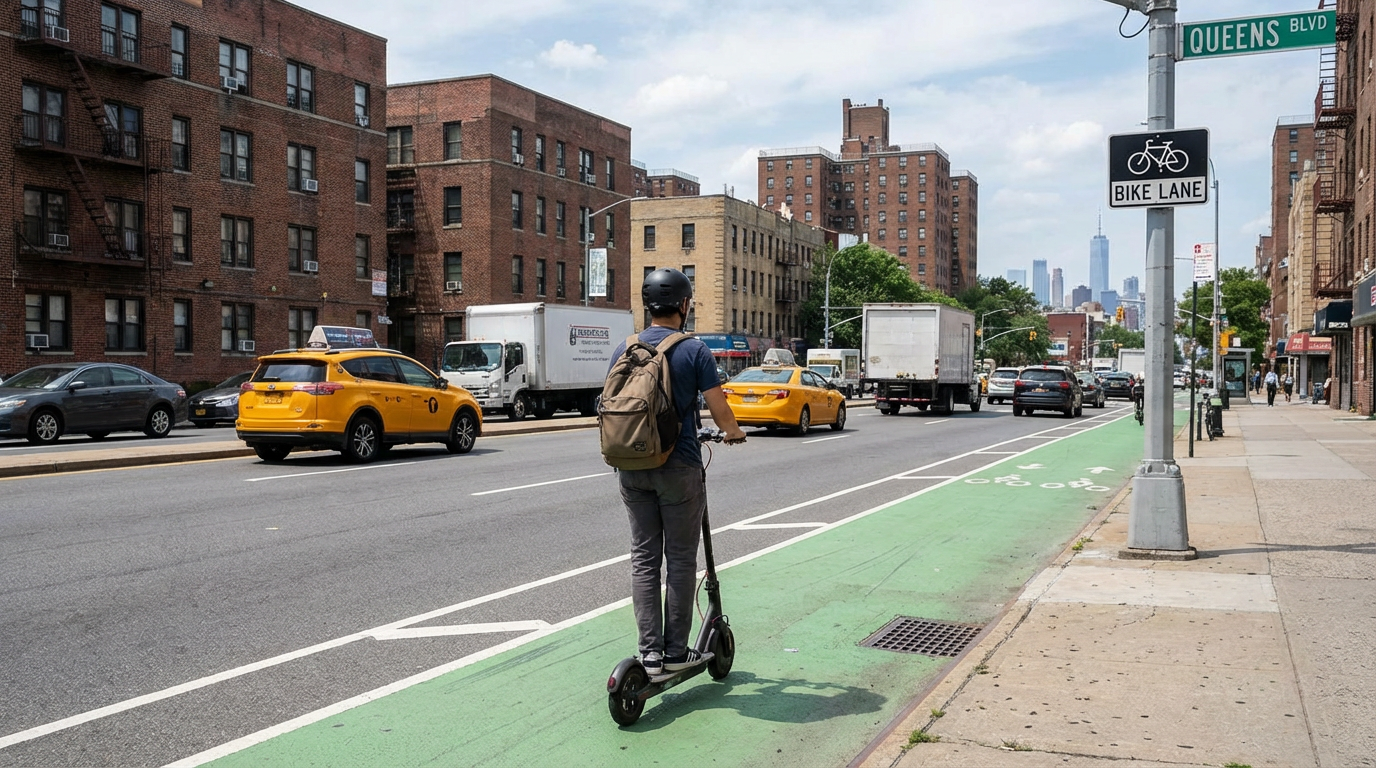
E-scooter use in New York City is rising fast. NYC’s shared program — operated by Lime, Bird, and Veo across the Bronx and Queens — recorded close to 2 million trips in 2024, and ridership continues to climb every spring. Private scooters are on city streets year-round across all five boroughs.
More riders means more crashes. And more crashes means more questions about who pays.
Liability in an NYC e-scooter accident is not simple. The rules that apply to car accidents do not apply cleanly here. The parties who can be held responsible range from individual riders to rental companies to the City of New York itself. New York’s comparative fault system adds another layer — being partly at fault does not end your claim, but it does affect what you can recover.
This article covers the current NYC e-scooter regulations, how fault is determined in the most common crash scenarios, why e-scooter claims differ from standard car accident claims, and what steps to take if you’re injured.
This article is for general informational purposes only and does not constitute legal advice. Your rights depend on the specific facts of your case and applicable law at the time of your claim. Consult a licensed New York personal injury attorney for guidance on your situation.
Dansker & Aspromonte Associates LLP is a personal injury law firm licensed in New York State, representing injured clients across the five boroughs since 1979. If you were injured in an NYC e-scooter accident and want to understand your legal options, our NYC scooter accident attorneys can evaluate your case at no cost.
NYC E-Scooter Rules: What the Law Actually Requires
NYC e-scooter riders must stay under 15 mph, use bike lanes when available, and never ride on sidewalks under New York State law.
New York Vehicle and Traffic Law Article 34-D — the statewide framework for electric scooter operation — sets the baseline rules. NYS VTL § 1282(6) prohibits operating an e-scooter above 15 mph. NYS VTL § 1282(7) bans sidewalk riding statewide (absent a specific local ordinance). NYS VTL § 1284 requires riders to use a bike lane or inline-skate lane when one is usable; if no such lane exists, they must ride on the right side of the roadway.
Under NYS VTL § 1281, a person operating an electric scooter has the same rights and duties as a motor vehicle driver or bicyclist. That means obeying traffic signals, yielding where required, signaling turns, and riding sober.
What these rules do NOT cover: Private property, greenways with separate posted rules, and geofenced slow zones within the NYC shared program may have different speed restrictions. NYC’s shared scooter program uses GPS technology to cap speeds and shut off motors in prohibited zones automatically. These tech-based restrictions do not override or replace the legal obligations under VTL.
Additional equipment requirements apply. The New York State DMV confirms that e-scooters used in low-light conditions require a front white light visible at least 500 feet ahead, a rear red light visible at least 300 feet behind, and side reflective material. As of January 7, 2025, retailers must provide operating manuals covering proper storage, charging, and usage with every scooter sold.
Violating any of these rules can be used against you in a civil liability case. It does not automatically assign you full fault — New York’s comparative fault system still applies — but it is a factor a jury or insurer will weigh.
Who Can Be Held Liable After an NYC E-Scooter Crash
In an NYC e-scooter crash, liability may fall on the rider, a motorist, a scooter rental company, the manufacturer, or the City of New York — sometimes multiple parties at once.
The liable party depends entirely on the facts of the crash. The table below maps the common scenarios.
| Party | When they may be liable | Legal theory |
|---|---|---|
| Another rider or scooter user | Riding recklessly, violating traffic laws, riding on sidewalk | Negligence |
| Motor vehicle driver | Failing to yield, distracted driving, speeding, turning without checking bike lane | Negligence; vehicle operator duty of care |
| Scooter rental company (Lime, Bird, Veo) | Mechanical defect, inadequate maintenance, failure to enforce operator requirements | Negligence; product liability; premises liability analog |
| E-scooter manufacturer | Defective brakes, battery failure, structural failure | Product liability (NYS strict liability for defective products) |
| City of New York / government entity | Defective road surface, unmarked excavation, failed signage | Negligence (with Notice of Claim prerequisite) |
| Pedestrian | Stepping into a bike lane without yielding | Comparative fault reduction only; rarely a primary defendant |
More than one party can share liability in the same crash. New York’s pure comparative fault system allows liability to be apportioned across multiple defendants.
Dooring, Intersection Crashes, and Sidewalk Collisions: How Fault Works
When a parked car door opens into an e-scooter’s path, the driver or passenger who opened the door typically bears primary fault under New York law.
Dooring. NYS VTL § 1214 prohibits opening a vehicle door on the traffic side unless it is reasonably safe to do so. When a parked car’s occupant swings a door open without checking for an approaching scooter, that act is a statutory violation. The scooter rider’s fault is also evaluated — a rider traveling above 15 mph or out of the designated lane may share some fault — but the door-opener’s negligence is established by the statutory breach.
Intersection collisions. Left-turn crashes are among the most dangerous. A driver turning left often misjudges the speed of a scooter in a bike lane or at a crosswalk. Under VTL, drivers must yield to riders lawfully in their path. If the rider had a green light or the right of way, the driver’s failure to yield is the primary cause. If the rider ran a red light, the rider’s comparative fault percentage increases substantially.
Sidewalk crashes. A scooter rider who operates on a sidewalk is violating VTL § 1282(7). If that rider strikes a pedestrian, the statutory violation is strong evidence of negligence — a jury will weigh it heavily in determining fault. The pedestrian who was struck can pursue a claim directly against the rider. This is one of the clearest liability scenarios in e-scooter law.
What this does NOT mean: Even if the other party bears primary fault, your own actions — speed, sobriety, lane position, phone use — will be scrutinized. New York’s comparative fault system reduces, but does not eliminate, recovery proportional to your share of the cause.
The No-Fault Insurance Question: Why E-Scooter Cases Are Different
E-scooters are not classified as motor vehicles under New York law, so standard no-fault PIP insurance generally does not apply to most e-scooter injury claims.
This is the most commonly misunderstood aspect of e-scooter accident law in New York — and it matters significantly.
In a standard car accident, New York’s no-fault system — governed by NYS Insurance Law Article 51 — requires injured parties to first file a PIP claim with their own auto insurer before suing. More importantly, suing another driver for pain and suffering is limited to cases meeting the “serious injury” threshold under NYS Insurance Law § 5102: fractures, significant disfigurement, permanent limitation of use, or similar qualifying injuries.
That threshold does not apply to most e-scooter claims. Under NYS VTL § 125, electric scooters are not motor vehicles if such vehicle is unable to exceed 15 mph. Because the no-fault statute applies to motor vehicle accidents, the serious injury threshold — which gates access to pain and suffering claims — generally does not govern e-scooter injury lawsuits.
What this means in practice: an e-scooter rider injured by a negligent driver may be able to file a lawsuit for any compensable injury without first meeting a threshold severity requirement if such vehicle is unable to travel at speeds greater than 15 mph. This is a meaningful legal distinction that opens claims which would be barred in a comparable car-on-car accident context.
The important constraint: If you were hit by a motor vehicle, the car driver’s no-fault PIP coverage may still apply to your medical expenses as a third-party claimant. The mechanics of how no-fault interacts with e-scooter claims are fact-specific and evolving. Do not rely on general descriptions — consult a personal injury attorney to assess coverage in your specific case.
New York’s Comparative Fault Rule and What It Means for Your Claim
New York’s pure comparative negligence rule allows injured e-scooter riders to recover damages even if they were partly at fault, though compensation is reduced by their fault percentage.
This is the legal framework that governs how damages are calculated when more than one party shares responsibility for a crash. It is also the framework insurance companies will use — often aggressively — to reduce what they pay you.
Here is the core rule: under New York’s pure comparative fault system (CPLR Article 14-A), your compensation is reduced by your percentage of fault. If a jury determines your damages are $100,000 and assigns you 30% of the fault, you recover $70,000. At 50% fault, you recover $50,000. Even at 90% fault, you can theoretically recover 10%.
The practical impact is that insurance adjusters will search for any evidence of rider negligence — speeding, sidewalk riding, riding without lights, distraction — to raise your fault percentage and reduce the payout. A well-documented claim, supported by evidence from the scene, medical records, and witness accounts, is the counter to this strategy.
What comparative fault does not affect: Criminal traffic violations are governed separately. Being assigned 40% comparative fault in a civil case does not create a defense in a traffic court proceeding, and vice versa.
To recap where we are: NYC e-scooter riders are governed by VTL Article 34-D, must ride in bike lanes and under 15 mph, cannot ride on sidewalks, and are subject to the same traffic laws as motorists. When a crash occurs, multiple parties — riders, drivers, rental companies, manufacturers, and the city — may share liability. Unlike car accident claims, most e-scooter injury claims are not gated by the serious injury threshold. New York’s pure comparative fault system means partial fault reduces but does not end a claim.
Suing Lime, Bird, or Veo: Rental Company Liability in NYC
NYC’s shared e-scooter operators — Lime, Bird, and Veo — can be held liable if a crash results from a mechanical defect, inadequate maintenance, or failure to follow required safety standards.
The NYC DOT requires all three shared program operators to maintain their fleets in safe working condition and to comply with the city’s Vision Zero safety policy. NYC DOT’s shared scooter program requirements include mandatory response to improperly parked vehicles, speed enforcement through geofencing, and daily operational oversight.
When a shared e-scooter crash is caused by brake failure, battery malfunction, or a structural defect, the rental company’s maintenance obligation creates a potential negligence claim. As of October 9, 2024, lithium batteries in micromobility devices must comply with recognized safety standards (UL 2849, UL 2271, or EN 15194) under Chapter 196 of the Laws of 2024. A battery fire or failure in a non-compliant unit may support a product liability claim against the manufacturer or the company that deployed the device.
The terms-of-service issue. Lime, Bird, and Veo include liability waivers in their user agreements. Under New York law, these clauses do not automatically extinguish all legal claims. Courts have declined to enforce broad liability waivers where a company’s own negligence caused the injury, particularly where the waiver conflicts with public policy. Whether a specific waiver bars a specific claim is a fact-specific legal question — a waiver is a factor in the analysis, not a guaranteed bar to recovery.
What rental company liability does NOT cover: A rental company is not automatically liable because you crashed while riding their scooter. Your own negligence while riding — violating traffic laws, riding on the sidewalk, ignoring speed limits — remains your responsibility. Rental company liability requires a connection between the company’s failure (defect, maintenance lapse, safety violation) and the crash.
If you were injured on a shared scooter in the Bronx or Queens, preserve the scooter if possible (or document its condition), record the vehicle ID from the app, and contact a personal injury attorney before making any statements to the rental company. The same documentation principles apply to bicycle accident claims in New York.
Steps to Take After an E-Scooter Accident in NYC
After an NYC e-scooter accident, call 911, seek medical attention, document the scene, preserve any damaged equipment, and consult a personal injury attorney before speaking with insurers.
These steps protect both your health and your legal rights.
1. Call 911. Get a police report. The report creates an official record of the crash location, the parties involved, and initial witness statements. In NYC, a crash involving injury requires law enforcement documentation. The NYS DMV notes that a crash report may be required depending on circumstances.
2. Seek medical attention immediately. Some injuries — traumatic brain injury, internal bleeding, spinal damage — do not produce obvious symptoms at the scene. A gap between the crash and your first medical visit can be used by insurers to argue your injuries were unrelated. Get evaluated the same day.
3. Document the scene. Photograph the road surface, any skid marks, the positions of vehicles or scooters, traffic signals, and your injuries. If the crash involved a shared scooter, photograph the vehicle ID number and any visible damage to the scooter. Capture weather and lighting conditions.
4. Preserve damaged equipment. If your scooter was involved in the crash due to a mechanical failure, do not repair it. Keep it in the condition it was in post-crash. Physical evidence of a defect can be critical in a product liability claim.
5. Collect witness information. Get names and contact information from bystanders who saw the crash. Surveillance cameras on nearby buildings or businesses may have captured the event — note the locations.
6. Do not give statements to insurers without an attorney. Insurance adjusters work to limit payouts. A recorded statement made before you understand the full scope of your injuries or legal rights can be used against you. This applies to your own insurer and the at-fault party’s insurer.
7. Consult a personal injury attorney. E-scooter claims involve layered liability questions, insurance coverage gaps, and procedural rules that differ from standard car accident cases. Timing matters — claims against government entities, including the City of New York, require notice filing within strict timeframes. Contact our NYC scooter accident attorneys for a free consultation.
When the City of New York or a Government Entity Is Responsible
NYC can be held liable for e-scooter accidents caused by defective road conditions, but claims against the city require special notice procedures with timing requirements.
Potholes, unmarked excavations, defective pavement, missing signage, and failed traffic controls can all contribute to e-scooter crashes. Under New York law, the city has a duty to maintain public roads in reasonably safe condition. When a dangerous road condition — not the rider’s own negligence — causes a crash, the City of New York may be a liable defendant.
The critical procedural requirement: Claims against NYC and other government entities require filing a Notice of Claim — a formal legal notice — before a lawsuit can be filed. NYS General Municipal Law § 50-e governs this requirement. The timing rules for notices and the subsequent lawsuit vary based on the specific defendant (NYC, MTA, transit authority, etc.) and the nature of the claim. Missing these deadlines can permanently bar your right to recovery.
If your crash involved any government-maintained road, intersection, or signage, treat it as a potential government entity claim from day one. Contact a personal injury attorney immediately. Our pedestrian accident cases at Dansker & Aspromonte frequently involve the same government liability framework.
What this does NOT mean: The city is not liable for every crash on a city street. You must be able to show that a specific defect existed, that the city had notice of it (or should have), and that the defect caused your crash. General road wear or weather conditions alone do not establish city liability.
About Dansker & Aspromonte Associates LLP
Dansker & Aspromonte Associates LLP is a New York City personal injury law firm at 30 Vesey Street, 16th Floor, New York, NY 10007, licensed to practice in New York State. Our attorneys have obtained significant recoveries for injured New Yorkers across a wide range of accident types, including bicycle crashes, pedestrian injuries, construction accidents, and motor vehicle collisions. Prior results do not guarantee a similar outcome. Each case is different and must be evaluated on its own facts. We handle cases on a contingency fee basis — you pay nothing unless we recover on your behalf.
If you or a family member was injured in an NYC e-scooter accident, contact us for a free consultation. Timing matters in these cases. Contact Dansker & Aspromonte Associates LLP.
Attorney advertising. This article is for general informational purposes only and does not constitute legal advice or create an attorney-client relationship. Laws change; verify current rules with a licensed attorney. Past results do not guarantee similar outcomes.