

NYC Wrongful Death Lawyer – Fight for Maximum Compensation

  • Statute: EPTL § 5-4.1 – death caused by wrongful act, neglect, or default
  • Who Files: Personal representative only (not family members directly)
  • Damages: Pecuniary loss only under current law (no grief/emotional damages for survivors)
  • Deadline: Varies by case type and circumstances—consult attorney immediately to confirm your specific deadline
  • Proposed Changes: Grieving Families Act pending (would expand damages and beneficiaries)
  • Free Consultation: (212) 732-2929

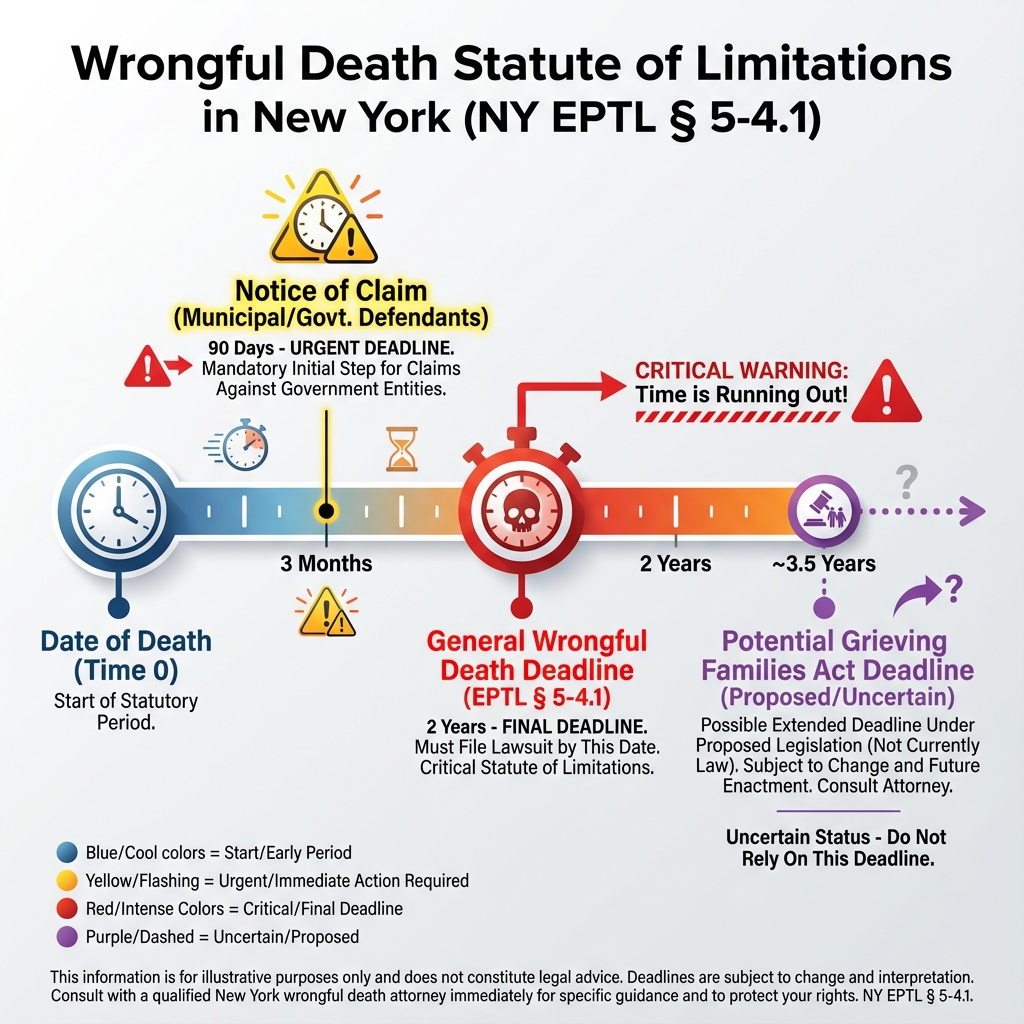
When a loved one dies due to someone else’s negligence in New York, time is critical. Under NY EPTL § 5-4.1, wrongful death claims generally must be filed within two years from the date of death, though medical malpractice deaths, municipal defendants, and other factors can alter this deadline.

DA Lawyer

Lost a loved one due to someone else’s negligence in New York

No Fees Unless We Win

Serving Manhattan, Brooklyn, Queens, Bronx, Staten Island, Nassau & Suffolk Counties.

Recover Your Life

Let Us Fight For You Free & Confidential Consultation

By submitting, you agree to be contacted about your request.

Fee Disclaimer

No Attorney's Fees Unless We Recover Money For You. Our firm works on a contingency fee basis. We only get paid if you get paid. Note: court costs and disbursements may apply regardless of outcome. Consult with your attorney for details.

Statute Disclaimer

The time to file a legal claim varies by case type, plaintiff age, whether a government entity is involved, and other factors. Do not rely on general information for your specific situation. Contact an attorney immediately to protect your rights.

Unfortunately, based on your query, we are unable to assist you at this time. Our firm specializes in serious accidents and negligence cases, such as car accidents, slips and falls, construction accidents, and other accidents that require hospitalization or ongoing treatment.

THE TIME TO SUE CAN VARY FROM CASE TO CASE – ALWAYS CONSULT AN EXPERIENCED ATTORNEY TO DETERMINE THE TIME FRAME THAT APPLIES TO YOUR CASE AS SOON AS POSSIBLE AFTER THE ACCIDENT

Any statute of limitation or condition precedent such as a notice of claim cited herein may not apply to your particular case. The time to bring a lawsuit and the conditions upon which it may be brought depend upon many factors including the age and mental capacity of the injured person, whether the party to be sued is a private person, partnership, corporation, government entity or other legal entity, the substance and type of claim that is being made, the place of the accident and other possible factors that may apply at the time of the accident or injury. You are advised to call to confirm the time limits and conditions that apply to your case as soon as possible.

At Dansker & Aspromonte Associates LLP, our NYC wrongful death lawyers have secured over $750 million in verdicts and settlements, including a landmark $21.5 million structured settlement for the family of sanitation worker Rafael C (Rafael C v. City of New York and St. Barnabas Hospital, 2023). We understand New York’s unique wrongful death statute and can help you navigate both current law and potential future changes.

Call (212) 732-2929 for a free case evaluation. Our team has handled complex wrongful death and survival claims arising from medical malpractice, construction accidents, and traffic fatalities throughout Manhattan, Brooklyn, Queens, the Bronx, and Staten Island.

What To Do Right After a Fatal Accident in NYC

If you’ve lost a loved one due to someone else’s negligence in New York, take these immediate steps to protect your legal rights:

Contact law enforcement:

Ensure police document the incident and create an official report

Preserve all evidence:

Take photos of the accident scene, vehicles, or dangerous conditions before they’re removed or altered.

Identify witnesses:

Get names and contact information from anyone who saw what happened

Request medical records

Obtain all hospital, ambulance, and emergency treatment documentation immediately

Do NOT speak to insurance adjusters:

Politely decline recorded statements until you’ve consulted an attorney—adjusters work to minimize claims

Contact a wrongful death lawyer immediately:

Filing deadlines are strict and evidence disappears quickly. Call (212) 732-2929 for a free consultation

Begin Surrogate’s Court process:

A personal representative must be appointed before filing a lawsuit, and this process takes time

Critical: The statute of limitations begins running from the date of death, NOT the date a personal representative is appointed. Don’t delay—contact us today to protect your family’s rights.

$21.5 Million Settlement – Rafael C v. City of New York

$21,500,000 Structured Settlement

Landmark wrongful death settlement for the family of Rafael C, a NYC sanitation worker killed in a workplace accident. This case represents one of the largest wrongful death settlements in New York City history for a municipal employee.

Year: 2023
Defendants: City of New York, St. Barnabas Hospital
Case Type: Workplace accident with medical malpractice complications
Claims: Wrongful death (beneficiaries’ pecuniary losses) + Survival action (decedent’s pain and suffering before death)

Our legal team established liability against multiple defendants, including the City of New York for unsafe work conditions and St. Barnabas Hospital for inadequate emergency treatment. Through expert economic testimony and aggressive litigation, we secured maximum compensation for Rafael C’s family.

Current Law vs Proposed Changes: The Grieving Families Act

New York’s wrongful death statute has remained largely unchanged since 1847, making it one of the most restrictive in the nation. The Grieving Families Act is proposed legislation that would significantly expand the law—but as of December 2025, it has not been enacted and current law still applies.

What Current Law Allows (EPTL § 5-4.1 and § 5-4.3)

  • Who Can File: Personal representative of the estate only
  • Who Benefits: Surviving spouse, children, parents, or dependents who relied on deceased for financial support
  • Damages Recoverable: Pecuniary (economic) losses only:
    • Lost earnings and benefits
    • Funeral and burial costs
    • Medical expenses before death
    • Loss of inheritance
    • Loss of household services
    • Loss of parental guidance (economic value only)
  • NOT Recoverable: Survivors’ grief, emotional distress, loss of companionship, loss of consortium
  • Statute of Limitations: Generally 2 years from date of death (varies by case type)

What the Grieving Families Act Would Change

If enacted, the Grieving Families Act would:

  • Expand Damages: Allow recovery for emotional anguish, mental suffering, loss of love, companionship, comfort, and society
  • Broaden Beneficiaries: Include domestic partners, stepchildren, stepparents, siblings, grandparents, and others with close relationships
  • Extend Filing Period: Increase statute of limitations from 2 years to 3.5 years in some cases
  • Retroactive Application: Some versions would apply to deaths occurring before enactment (though this is subject to constitutional challenges)

Current Status: Vetoed Three Times, Still Pending

Governor Kathy Hochul has vetoed the Grieving Families Act three times (2022, 2023, 2024), citing concerns about:

  • Impact on healthcare costs and medical malpractice insurance
  • Potential for excessive jury awards
  • Retroactivity concerns
  • Municipal liability implications

Despite the vetoes, the bill continues to be reintroduced with modifications. Legislative leaders have pledged to bring it back in 2025 with revisions addressing the Governor’s concerns. However, as of this publication, the law has not changed and current pecuniary loss rules remain in effect.

What This Means for Your Case: If you’re pursuing a wrongful death claim today, you are subject to current law—pecuniary losses only, no emotional damages for survivors. However, if the Grieving Families Act is enacted and includes retroactive provisions, it could potentially expand available damages even for deaths that occurred before the law changed. This is highly fact-specific and depends on when the death occurred and when the law (if ever) is enacted.

Don’t wait for potential law changes. The current statute of limitations still applies, and waiting could jeopardize your entire case. Contact our attorneys at (212) 732-2929 to discuss your options under current law.

What Is a Wrongful Death Under New York Law?

Wrongful death is defined under New York Estate Powers & Trust Law § 5-4.1 as “a death caused by a wrongful act, neglect, or default” that would have entitled the deceased to file a personal injury claim had they survived. Because the injuries were fatal, the deceased cannot bring their own claim. Instead, the estate’s personal representative can file a wrongful death claim on behalf of eligible beneficiaries.

Wrongful Death vs Survival Actions: Understanding the Difference

Wrongful Death vs. Survival Action

New York law recognizes two distinct types of claims when someone dies due to another’s negligence:

Wrongful Death Claim (EPTL § 5-4.1)

  • Who Benefits: Surviving family members (spouse, children, parents, dependents)
  • Damages: Pecuniary losses suffered by beneficiaries due to the death:
    • Lost financial support and earnings
    • Loss of inheritance
    • Loss of household services
    • Loss of parental guidance for children
    • Funeral and burial expenses
  • Purpose: Compensate the family for their economic losses

Survival Action (EPTL § 11-3.2)

  • Who Benefits: The deceased person’s estate
  • Damages: Losses the deceased personally suffered before death:
    • Conscious pain and suffering before death
    • Medical expenses incurred between injury and death
    • Lost wages from injury to death
    • Property damage
  • Purpose: Compensate for what the deceased endured before dying

In practice, both claims are typically brought together in the same lawsuit by the estate’s personal representative. However, they serve different legal purposes and compensate for different losses. Understanding this distinction is important because:

  • Survival action damages (like pain and suffering before death) go to the estate and are distributed according to the will or intestacy law
  • Wrongful death damages go to specific beneficiaries (spouse, children, etc.) regardless of the will
  • Different insurance policies and liability limits may apply to each claim

New York’s Unique “Pecuniary Loss” Standard

What Is a Wrongful Death in New York?

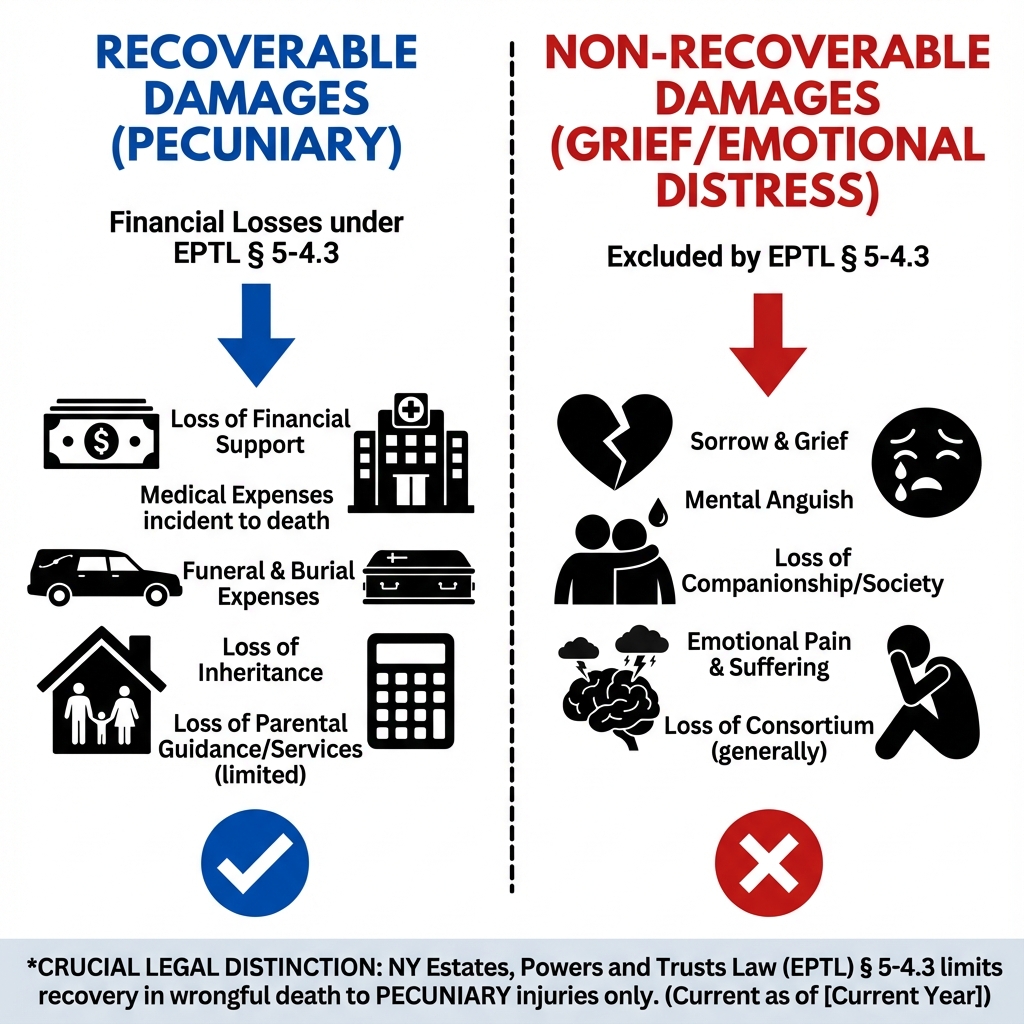
Unlike many states, New York follows a strict “pecuniary loss” standard under EPTL § 5-4.3. This means that in a wrongful death claim, families can only recover for measurable economic losses—not for emotional suffering, grief, or loss of companionship.

Recoverable in Wrongful Death Claim

Definition & NYC Application

Lost wages and employee benefits the deceased would have provided

Survivors’ grief and emotional distress

Funeral and burial costs

Loss of companionship or consortium

Medical expenses incurred before death

Punitive damages (except rare cases of intentional conduct)

Lost inheritance (assets deceased would have accumulated)

Survivors’ mental anguish or suffering

Value of household services (childcare, cooking, maintenance)

Loss of society, guidance, comfort (non-economic aspects)

Loss of parental guidance for children (economic value only)

Emotional impact on family members

Note: The deceased person’s own conscious pain and suffering before death is recoverable, but only through a survival action, not the wrongful death claim. That compensation goes to the estate, not directly to family members.

Because New York law requires proof of pecuniary (economic) loss in wrongful death claims, our attorneys work with forensic economists and financial analysts to calculate:
  • Projected lifetime earnings based on age, education, and career trajectory
  • Present value of future lost income using actuarial tables and economic models
  • Value of lost benefits (health insurance, retirement contributions, pension)
  • Household service replacement costs (market value of childcare, cooking, home maintenance, transportation)
  • Lost parental guidance value for minor children (educational, moral, practical instruction)
  • Loss of inheritance (projected estate value the deceased would have passed to heirs)
This expert economic analysis is essential to maximizing recovery under New York’s restrictive pecuniary loss statute.

Who Can File a Wrongful Death Lawsuit in New York?

Under EPTL § 5-4.1only the personal representative of the deceased person’s estate can file a wrongful death lawsuit in New York. Family members cannot file the lawsuit in their own names, even if they were financially dependent on the deceased. This differs from many other states where surviving spouses and children can file wrongful death claims directly.

How is the Personal Representative Appointed?

The personal representative (also called an executor or administrator) is determined in one of two ways:
  1. Named in the Will: If the deceased had a will, it likely names an executor. That person becomes the personal representative and has authority to file the wrongful death claim.
  2. Appointed by Surrogate’s Court: If there is no will (intestate), the Surrogate’s Court will appoint an administrator, typically a close family member such as a surviving spouse, adult child, or parent. The court follows a priority list established by New York law.

Important: The statute of limitations begins running from the date of death, not the date when a personal representative is appointed. However, the lawsuit cannot be filed until a personal representative has been appointed and has legal authority to act. This creates a timing challenge—if you wait too long to begin the Surrogate’s Court process, you may run out of time to file the lawsuit itself. Contact an attorney immediately to ensure the appointment process begins promptly.

Who Are the Beneficiaries?

While only the personal representative can file the lawsuit, they do so on behalf of the estate’s beneficiaries—the family members who actually receive the compensation. Under current New York law, beneficiaries include:
  • Surviving Spouse: The surviving spouse is typically the primary beneficiary. If the deceased was married, the spouse generally receives the largest share of any recovery.
  • Children: All children of the deceased, including biological, adopted, and (in some circumstances) stepchildren, are beneficiaries. If there are multiple children, they typically share equally.
  • Parents: If the deceased had no spouse or children, the parents may be the primary beneficiaries.
  • Other Dependents: In some cases, other individuals who were financially dependent on the deceased may qualify as beneficiaries. This could include stepchildren, adopted children, grandchildren being raised by the deceased, or other relatives who relied on the deceased for financial support.
Current Law Limitation: Under existing law, more distant relatives, domestic partners (unless legally married), siblings, and other loved ones typically cannot recover wrongful death damages unless they can prove they were financially dependent on the deceased. The proposed Grieving Families Act would expand this to include a broader range of close relationships, but that change has not yet been enacted. For detailed guidance on who can file and who benefits in your specific situation, call (212) 732-2929 for a free consultation. Learn more about filing requirements.

Time Limits for Filing Wrongful Death Claims in New York

Your time to bring a wrongful death claim is governed by a statute of limitations. Understanding and meeting these deadlines is absolutely critical—missing a deadline can permanently bar your family from receiving any compensation, regardless of how strong your case is.

General Rule: Two Years from Date of Death

Under NY EPTL § 5-4.1, wrongful death claims generally must be filed within two years from the date of death. This is true even if the injury that led to death occurred months or years earlier—the clock starts on the date the person died, not the date of the accident. THE TIME TO SUE CAN VARY FROM CASE TO CASE – ALWAYS CONSULT AN EXPERIENCED ATTORNEY TO DETERMINE THE TIME FRAME THAT APPLIES TO YOUR CASE AS SOON AS POSSIBLE AFTER THE ACCIDENT Any statute of limitation or condition precedent such as a notice of claim cited herein may not apply to your particular case. The time to bring a lawsuit and the conditions upon which it may be brought depend upon many factors including the age and mental capacity of the injured person, whether the party to be sued is a private person, partnership, corporation, government entity or other legal entity, the substance and type of claim that is being made, the place of the accident and other possible factors that may apply at the time of the accident or injury. You are advised to call to confirm the time limits and conditions that apply to your case as soon as possible.

Important Exceptions and Complexities

The two-year rule is the general guideline, but many wrongful death cases involve different or additional deadlines. The interplay between wrongful death claims, survival actions, and various statutes of limitations is complex. Here are some common scenarios where different rules may apply (see disclaimer above regarding case-specific timelines):

Medical Malpractice Deaths

If the death resulted from medical negligence, the timing rules can be more complicated. While EPTL § 5-4.1 still governs the wrongful death claim itself, related survival actions and the interaction with CPLR § 214-a (the medical malpractice statute of limitations) create nuances. In many medical malpractice-related deaths, different timelines may apply to different claims—sometimes extending to 2.5 years (30 months), but this is highly fact-specific. Do not assume you have 2.5 years without speaking to an attorney. The rules depend on when the malpractice occurred, when it was discovered, when death occurred, and what claims are being pursued. Missing a deadline is permanent—consult a lawyer immediately.

Municipal Defendants (City of New York, MTA, etc.)

Claims against government entities are subject to additional procedural requirements under New York’s General Municipal Law and Court of Claims Act. These cases typically require:
  • Notice of Claim: A formal Notice of Claim must be filed with the municipality, often within 90 days of the death or incident
  • Shortened Filing Period: The lawsuit itself often must be filed within approximately one year and 90 days of the incident (though this varies based on the specific government entity and circumstances)
The exact deadlines for municipal claims are complex and depend on which government entity is responsible, when the personal representative was appointed, whether the claim is wrongful death or survival, and when the injury occurred versus when death occurred. If a government entity may be responsible, contact an attorney within days, not months. The 90-day Notice of Claim deadline is strict, and failing to file it properly can destroy your entire case.

Criminal Proceedings Exception

If the person responsible for the death faced criminal charges, EPTL § 5-4.1 provides that the wrongful death claim may be filed within one year after the conclusion of the criminal case (or two years from death, whichever is later). “Conclusion” typically means final judgment, including appeals. This exception can extend the filing deadline, but it creates additional complexity—particularly if the criminal case is still ongoing when the two-year anniversary of the death approaches. Don’t assume the criminal proceedings exception applies. File as soon as possible to protect all potential claims.

Minor Children as Beneficiaries

In limited circumstances, if the only beneficiaries are minor children (under age 18), courts have sometimes applied tolling rules that pause the statute of limitations until the child reaches 18. However, this is rare, highly fact-specific, and should not be relied upon without explicit legal advice. The personal representative’s duty to file on behalf of minors typically means the two-year deadline still applies.

⚠️ Missing the Deadline = Losing Your Case Forever

If the statute of limitations expires before your wrongful death claim is filed, courts have no discretion to extend the deadline except in extremely rare circumstances (e.g., fraud, mental incapacity). Once the deadline passes, you lose the right to pursue compensation—permanently—regardless of how strong your case is or how much your family has suffered. The rules summarized above are simplified explanations of complex legal doctrines. Every case is different, and the deadlines that apply to your specific situation depend on many factors. Do not rely on this general information as a substitute for legal advice. Contact our wrongful death attorneys at (212) 732-2929 immediately for a case-specific deadline analysis. Our initial consultation is free.

Why You Should Act Quickly—Even Before the Deadline

Beyond legal deadlines, there are practical reasons to contact a wrongful death lawyer promptly:
  • Evidence Preservation: Surveillance footage is often deleted after 30-90 days. Witnesses’ memories fade. Accident scenes are cleaned up or modified. The sooner we begin investigating, the stronger your case will be.
  • Expert Analysis: Forensic economists, medical experts, accident reconstructionists, and other specialists need time to review records, inspect sites, and prepare detailed reports.
  • Personal Representative Appointment: The Surrogate’s Court process to appoint an executor or administrator can take weeks or months. This must be completed before the lawsuit can be filed.
  • Insurance Company Tactics: Insurers often make lowball settlement offers immediately after a death, hoping families will accept before consulting a lawyer. Early representation protects you from these tactics.
  • Financial Pressure: Families facing funeral costs, lost income, and mounting bills need legal representation to secure compensation quickly, not just before a deadline.
Call (212) 732-2929 today. Our initial consultation is free, and you pay nothing unless we win your case. We will give you a case-specific deadline analysis and begin protecting your rights immediately.

What Damages Are Recoverable in New York Wrongful Death and Survival Claims?

The compensation available in a wrongful death case depends on whether you’re pursuing a wrongful death claim (for beneficiaries’ losses), a survival action (for the deceased’s losses before death), or both. Most cases involve both claims filed together.

Wrongful Death Damages (EPTL § 5-4.3)

Under current New York law, wrongful death claims compensate beneficiaries for their pecuniary (economic) losses resulting from the death:

  • Lost Earnings and Financial Support: The income, wages, bonuses, and other compensation the deceased would have provided to the family over their expected working life. This is calculated using actuarial tables, economic models, and the deceased’s actual earning history.
  • Lost Benefits: Health insurance, retirement contributions (401k, pension), stock options, and other employment benefits the family has lost.
  • Household Services: The market value of household tasks, childcare, cooking, cleaning, home maintenance, and transportation the deceased performed. Courts calculate this using replacement cost (e.g., the cost to hire a nanny, housekeeper, handyman).
  • Loss of Inheritance: Assets and wealth the deceased would have accumulated and passed to heirs if they had lived to their expected lifespan.
  • Funeral and Burial Costs: Reasonable expenses for funeral services, burial or cremation, casket, memorial service, and burial plot.
  • Loss of Parental Guidance (for Children): Courts recognize the economic value of parental guidance, instruction, moral training, and care that minor children will now lose. This is a pecuniary loss under New York law.

Survival Action Damages (EPTL § 11-3.2)

Survival actions compensate the estate for losses the deceased personally suffered between the injury and death:

  • Conscious Pain and Suffering Before Death: If the deceased was conscious and in pain between the injury and death—even for just minutes—the estate can recover substantial damages for that suffering.
  • Medical Expenses: All costs incurred for emergency treatment, hospitalization, surgery, medication, and care between injury and death.
  • Lost Wages Before Death: If the deceased survived for any period after being injured but could not work, the estate can recover those lost wages.

What You CANNOT Recover Under Current Law

New York’s pecuniary loss statute is one of the most restrictive in the nation. Under current law, wrongful death claims do not allow recovery for:

  • Survivors’ Grief or Emotional Distress: Family members cannot recover for their own pain, suffering, or mental anguish caused by the death
  • Loss of Companionship, Comfort, or Society: Unlike many states, NY does not compensate for loss of the deceased’s love, affection, companionship, or guidance (except to the extent parental guidance has measurable economic value)
  • Loss of Consortium: Surviving spouses cannot recover for loss of their marital relationship
  • Punitive Damages: These are rarely awarded in NY wrongful death cases (only in extreme cases of intentional or reckless conduct)

Proposed Change: The Grieving Families Act would allow recovery for emotional damages, loss of companionship, and mental anguish—but as of December 2025, this law has not been enacted. Current pecuniary loss rules still apply. Learn more about proposed changes.

How Much Is a NYC Wrongful Death Case Worth?

NYC wrongful death settlements typically range from $500,000 to $5 million, but cases involving gross negligence, high earners, or young parents with multiple dependents can exceed $10 million.

Factors that determine case value include:

  • The deceased’s age and life expectancy
  • Earning capacity and career trajectory (education, skills, promotion potential)
  • Number and ages of dependents (young children = higher damages)
  • Whether death was instantaneous or involved conscious pain and suffering
  • Degree of negligence (gross negligence or intentional conduct = higher damages)
  • Available insurance policy limits and defendants’ assets
  • Strength of liability evidence

Case Example: Rafael C Settlement Breakdown

In our $21.5 million Rafael C case, we worked with forensic economists to establish:

  • Lost Lifetime Earnings: $3.2 million (NYC sanitation worker salary, benefits, pension, and 28 remaining work years)
  • Lost Household Services: $450,000 (childcare, home maintenance, transportation for 3 minor children until age 18)
  • Loss of Parental Guidance: $1.8 million (value of guidance, instruction, and care for 3 children)
  • Conscious Pain and Suffering (Survival Action): $2.1 million (deceased was conscious and in severe pain for 18 minutes before death)
  • Medical Expenses: $180,000 (emergency treatment, hospitalization before death)
  • Funeral Costs: $25,000
  • Lost Inheritance: $4.5 million (projected retirement savings and home equity deceased would have passed to family)
  • Additional Damages: Structured to account for inflation and future financial needs of surviving spouse and children

Total Settlement: $21.5 million structured settlement paid over time to maximize tax benefits and ensure long-term financial security for the family.

Notable NYC Wrongful Death & Survival Action Verdicts

With over $750 million recovered for seriously injured clients and families of wrongful death victims since 1986, Dansker & Aspromonte has the experience and track record to maximize your compensation:

$21.5 Million

Rafael C v. City of New York (2023) – NYC sanitation worker killed in workplace accident. Combined wrongful death and survival claims. Structured settlement involving multiple defendants.

$5 Million

NY Freeway Accident – Two mothers and four teenagers struck when van stopped in moving lane. Fatal injuries to multiple victims.

$5 Million

Elevator Fall – 49-year-old man fell down elevator shaft, suffered severe head injury, rendered comatose before death.

$4.2 Million

NYC Parks Department Work Injury – Married employee preparing truck for snow removal operations in Staten Island.

$3.5 Million

Pedestrian Wrongful Death – 21-year-old developmentally disabled individual struck by NYC bus making turn too close to crosswalk.

No wrongful death case is like any other. The outcome of your case depends upon a variety of unique factors. Past results do not guarantee future outcomes. We will help you understand the value of your case and seek every dollar available to you.

What Our Wrongful Death Clients Say

Common Causes of Wrongful Death in NYC

Wrongful deaths can occur in many ways, but they all share one element: another party’s negligence, recklessness, or wrongful act caused the death. Our NYC wrongful death lawyers have handled cases arising from:

Workplace Accidents

Medical Negligence

  • Medical malpractice (surgical errors, misdiagnosis, medication errors)
  • Birth injuries resulting in infant or maternal death
  • Anesthesia errors
  • Emergency room negligence
  • Failure to diagnose cancer, heart attacks, or stroke

Premises Liability

  • Dangerous premises (unsafe conditions, inadequate security)
  • Building collapses and falling debris
  • Elevator and escalator accidents
  • Swimming pool drownings
  • Fire and smoke inhalation (inadequate fire safety)

Institutional Negligence

Product Liability

  • Defective consumer products
  • Dangerous drugs and medical devices
  • Defective auto parts (airbags, tires, brakes)
  • Dangerous machinery and equipment

If you’ve lost a loved one in any of these circumstances, call (212) 732-2929 for a free case evaluation.

Determining Liability in Wrongful Death Cases

Proving who was responsible for your loved one’s death—and gathering convincing evidence—is critical to your case. This is complex work that our attorneys handle while you focus on your family.

Multiple Liable Parties

NYC wrongful death cases often involve multiple defendants. For example, a car crash may involve:

  • The driver who caused the accident
  • The trucking company (if a commercial vehicle)
  • The vehicle manufacturer (if defective parts contributed)
  • The City of New York (if dangerous road conditions played a role)
  • A bar or restaurant (if they over-served alcohol to the driver)
  • The employer (if the driver was working at the time)

Identifying all liable parties and their insurance coverage is essential to maximizing your recovery. Our firm conducts thorough investigations to ensure no responsible party escapes accountability.

New York’s Comparative Negligence Rule

New York follows “pure” comparative negligence. Even if your loved one was partially at fault for the accident, your family can still recover damages—but the recovery will be reduced by the percentage of fault.

Example: If a jury awards $3 million but finds the deceased was 30% at fault (e.g., jaywalking when struck by a speeding driver), the family recovers $2.1 million (70% of $3M).

Insurance companies often try to blame the deceased to reduce their liability. Our attorneys aggressively counter these defense tactics through accident reconstructions, expert testimony, and comprehensive evidence gathering.

How Our Wrongful Death Lawyers Can Help

At Dansker & Aspromonte Associates LLP, we provide comprehensive legal representation in wrongful death and survival claims:

Legal Expertise

Deep understanding of NY wrongful death law, including EPTL §§ 5-4.1 and 5-4.3, comparative negligence rules, and complex statute of limitations provisions.

Investigation

Thorough investigation including evidence preservation, witness interviews, accident reconstruction, and expert consultation.

Expert Economic Analysis

Work with forensic economists and financial analysts to calculate lifetime earnings, household service value, and loss of inheritance under NY’s pecuniary loss standard.

Identifying All Liable Parties

Comprehensive analysis to identify every potentially responsible party and their insurance coverage.

Aggressive Negotiation

Skilled negotiation with insurance companies to secure fair settlements. We prepare every case for trial to maximize leverage.

Trial-Ready Litigation

If settlement negotiations fail, we’re prepared to take your case to court with expert witnesses, demonstrative evidence, and persuasive advocacy.

Throughout the process, we provide compassionate support and personalized attention, guiding you through this difficult time with empathy and understanding.

Our Track Record: Over $750 Million Recovered

Since 1986, we have recovered over $750 million in verdicts and settlements for seriously injured clients and families of wrongful death victims. Our personal injury team has extensive experience handling claims for car accidentsconstruction accidentsmedical malpractice, wrongful death, and catastrophic injuries.

What Sets Us Apart

  • Proven Results: $21.5 million wrongful death settlement demonstrates our ability to secure maximum compensation
  • Trial Experience: We prepare every case for trial, giving us leverage in settlement negotiations
  • Expert Network: Relationships with leading forensic economists, medical experts, and accident reconstructionists
  • No Win, No Fee: Contingency fee basis—you pay nothing unless we recover compensation
  • Personalized Attention: Direct access to experienced attorneys, not case managers
  • NYC Focus: We serve Manhattan, Brooklyn, Queens, the Bronx, Staten Island, and surrounding counties

Frequently Asked Questions About NYC Wrongful Death Claims

How long do I have to file a wrongful death lawsuit in New York?

New York wrongful death claims must generally be filed within two years of the date of death under EPTL § 5-4.1. However, medical malpractice deaths, claims against municipal defendants, and other factors can alter this deadline. Different claims may have different filing periods, and the rules are complex.

THE TIME TO SUE CAN VARY FROM CASE TO CASE – ALWAYS CONSULT AN EXPERIENCED ATTORNEY TO DETERMINE THE TIME FRAME THAT APPLIES TO YOUR CASE AS SOON AS POSSIBLE AFTER THE ACCIDENT Any statute of limitation or condition precedent such as a notice of claim cited herein may not apply to your particular case. The time to bring a lawsuit and the conditions upon which it may be brought depend upon many factors including the age and mental capacity of the injured person, whether the party to be sued is a private person, partnership, corporation, government entity or other legal entity, the substance and type of claim that is being made, the place of the accident and other possible factors that may apply at the time of the accident or injury. You are advised to call to confirm the time limits and conditions that apply to your case as soon as possible. The two-year deadline is a general rule, but many cases involve exceptions or additional requirements:
  • Medical malpractice deaths: May involve different timelines under CPLR § 214-a, sometimes extending to 2.5 years, but this is highly fact-specific
  • Municipal defendants: Often require a Notice of Claim within 90 days and a lawsuit within approximately one year and 90 days
  • Criminal proceedings: One year from conclusion of criminal case (or two years from death, whichever is later)
Speak with an attorney immediately to confirm your specific deadline. Missing the statute of limitations permanently bars your claim. Call (212) 732-2929 for a free consultation. See detailed statute of limitations rules.

NYC wrongful death settlements typically range from $500,000 to $5 million, though cases involving gross negligence or high earners can exceed $10 million. Dansker & Aspromonte secured a $21.5 million settlement in Rafael C v. City of New York.

The value depends on several factors:
  • The deceased’s earning capacity and career trajectory
  • Age and life expectancy
  • Number and ages of dependents (young children = higher damages)
  • Whether the death involved conscious pain and suffering
  • Available insurance policy limits
  • Strength of liability evidence
New York law limits wrongful death recovery to pecuniary (economic) losses only under the current statute. This includes lost earnings, funeral costs, medical expenses, and loss of household services—but not emotional damages for survivors’ grief or loss of companionship (though the proposed Grieving Families Act would change this if enacted). For a case-specific valuation, call (212) 732-2929 for a free consultation. Learn more about recoverable damages.

Only the personal representative (executor or administrator) of the deceased person’s estate can file a wrongful death lawsuit in New York under EPTL § 5-4.1. Family members cannot file directly, even if they were financially dependent on the deceased.

The personal representative is either:
  • Named in the deceased’s will (executor), or
  • Appointed by the Surrogate’s Court if there is no will (administrator)
The personal representative files on behalf of eligible beneficiaries who will receive the compensation:
  • Surviving spouse
  • Children (biological, adopted, and sometimes stepchildren)
  • Parents (if no spouse or children)
  • Other dependents who relied on the deceased for financial support
Important timing note: The lawsuit cannot be filed until a personal representative is appointed, but the statute of limitations runs from the date of death. Contact an attorney immediately to begin the Surrogate’s Court appointment process—waiting too long can jeopardize your entire case. Call (212) 732-2929 for guidance on the appointment process and filing requirements. Read more about who can file.

A wrongful death claim compensates beneficiaries for their pecuniary losses (lost financial support, funeral costs, etc.). A survival action compensates the estate for losses the deceased personally suffered before death, including conscious pain and suffering and medical expenses.

Here’s the key distinction:
Wrongful Death Claim (EPTL § 5-4.1) Survival Action (EPTL § 11-3.2)
Compensates family/beneficiaries Compensates the deceased’s estate
Damages: Lost income, funeral costs, loss of household services, loss of parental guidance Damages: Pain and suffering before death, medical bills, lost wages before death
Money goes to spouse, children, parents, dependents Money goes to estate, distributed per will or intestacy law
Both claims are typically brought together in the same lawsuit by the estate’s personal representative. Understanding the distinction matters because different damages apply to each, and different insurance policies or liability limits may be involved. Learn more about wrongful death vs survival claims.

The Grieving Families Act is proposed legislation that would expand New York wrongful death law to allow recovery for emotional damages, broaden who can file and receive compensation, and extend the statute of limitations. It has been vetoed three times by Governor Hochul (2022, 2023, 2024) but continues to be reintroduced.

As of December 2025, the law has not changed—current pecuniary loss rules still apply. If enacted, the Grieving Families Act would:
  • Allow emotional damages: Survivors could recover for grief, mental anguish, loss of companionship, and loss of guidance (non-economic aspects)
  • Expand beneficiaries: Include domestic partners, stepchildren, stepparents, siblings, grandparents, and others with close relationships
  • Extend statute of limitations: From 2 years to 3.5 years in some cases
  • Potentially apply retroactively: Some versions would cover deaths that occurred before enactment
What this means for your case: If you’re filing today, you’re subject to current law (pecuniary losses only). However, if the Act is eventually enacted with retroactive provisions, it could potentially expand damages even for past deaths—but this is uncertain and subject to constitutional challenges. Don’t wait for potential law changes. Current filing deadlines still apply. Call (212) 732-2929 to discuss your options under current law. Read more about proposed changes.

Yes. Wrongful death cases in New York are extremely complex and virtually impossible to handle successfully without experienced legal representation. According to the Insurance Research Council, represented claimants recover approximately 3.5 times more than unrepresented claimants on average—even after paying attorney fees.

Here’s why you need a lawyer:

  • NY’s pecuniary loss standard requires expert testimony: Forensic economists and financial analysts must calculate and prove your losses
  • Insurance companies have teams of lawyers: They work to minimize or deny your claim; you need equal representation
  • Evidence must be preserved quickly: Surveillance footage is deleted, witnesses forget, scenes change—delay costs you critical proof
  • Multiple liable parties must be identified: Car accidents often involve drivers, trucking companies, vehicle manufacturers, and municipalities—all within strict deadlines
  • Complex statute of limitations rules: Medical malpractice, municipal claims, and criminal proceedings create exceptions that require legal expertise
  • Settlement negotiations require leverage: Insurers know who prepares for trial and who doesn’t; trial-ready attorneys get better settlements

Our firm works on a contingency fee basis—you pay nothing unless we win your case. The consultation is free, and there’s no risk in getting expert legal advice.

Call (212) 732-2929 today.

Settlement timelines vary based on injury severity, liability disputes, and treatment duration. Clear liability cases with fractures or surgical herniated discs often settle within 6-18 months. Disputed liability cases or injuries requiring long-term treatment (traumatic brain injury, spinal cord damage) may take 2-3 years. We don’t rush settlements—waiting until you reach Maximum Medical Improvement (MMI) ensures we capture all future medical expenses and earning losses.

Don’t Let Insurance Companies Undervalue Your Case

Related Practice Areas

Get a Free Case Evaluation Today

If you’ve lost a loved one due to someone else’s negligence in New York, time is critical. Contact an attorney immediately to confirm your specific filing deadline and preserve evidence.

Call us today at (212) 732-2929 for a free case evaluation. We will explain your rights under current law, analyze your specific filing deadline, and help you pursue maximum compensation.

  • ✓ Free, confidential consultation
  • ✓ No fees unless we win your case
  • ✓ $750M+ recovered since 1986
  • ✓ Landmark $21.5M wrongful death settlement
  • ✓ Serving all five NYC boroughs

Schedule Your Free Consultation

Or call (212) 732-2929 now

We Serve Wrongful Death Victims Throughout NYC

Our wrongful death attorneys handle cases throughout the New York City Metropolitan area, including:

  • Manhattan
  • Brooklyn
  • Queens
  • The Bronx
  • Staten Island
  • Nassau County
  • Suffolk County
  • Westchester County
Disclaimer: No wrongful death case is like any other. The outcome of your case depends upon a variety of unique factors, including the specific circumstances of the death, available evidence, insurance policy limits, applicable statutes of limitations, and the skill of your legal representation. Past results do not guarantee future outcomes. The case results listed on this page are based on actual cases and represent the results achieved in those particular matters, but do not constitute a guarantee, warranty, or prediction of the outcome of any other legal matter. Every case is different and must be evaluated on its own merits. This page is for informational purposes only and does not constitute legal advice. For case-specific guidance, contact our attorneys for a consultation.