

You’ve been injured in a New York City car accident. The at-fault driver ran a red light—fault is obvious. Your medical bills are piling up, you’ve missed weeks of work, and you’re in constant pain. Naturally, you assume you can sue for compensation. But in New York, the answer isn’t straightforward.
New York’s serious injury threshold creates a legal barrier that can prevent many motor vehicle accident victims from suing for pain and suffering, regardless of who caused the crash. It is called the No Fault Law. Under NY Insurance Law § 5102(d), your injuries must fall into one of nine specific categories before you can step outside the no-fault insurance system and pursue a lawsuit against the at-fault driver.
This guide provides explanations of all nine threshold categories, and the specific medical documentation required to prove your case.
What Is No-Fault Insurance in New York?
New York operates under a no-fault insurance system, established in 1973 to reduce the amount personal injury lawsuits and speed up compensation for accident victims. Under this system, your own insurance company pays your medical bills and a portion of your lost wages regardless of who caused the accident—up to a limit of $50,000 per person. This coverage is called Personal Injury Protection, commonly known as PIP or no-fault benefits.
The trade-off? You generally cannot sue the at-fault driver for pain and suffering damages unless your injuries qualify under one of the nine categories of the the serious injury threshold law or your economic losses exceed $50,000. According to the New York Department of Financial Services, this system was designed to restore injured people to health and productivity as swiftly as possible while keeping insurance premiums manageable.
No-fault benefits cover medical expenses (doctor visits, hospital stays, physical therapy, prescription medications), lost earnings from work up to $2,000 per month for three years, and other reasonable expenses up to $25 per day for one year. However, these benefits do NOT pay you for pain and suffering, permanent injuries or loss of enjoyment of life. To recover those non-economic damages, you must meet the serious injury threshold.
What Is The Serious Injury Threshold?
The serious injury threshold is a legal test that determines whether a car or motor vehicle accident victim can sue the at-fault driver for pain and suffering damages. Defined in NY Insurance Law § 5102(d) and enforced through § 5104(a), this threshold limits lawsuits to nine specific injury categories. Even if the other driver was clearly negligent—driving drunk, texting, speeding—your case will be dismissed if your injuries don’t qualify under one of these categories.
Courts require objective medical evidence to prove threshold qualification. Subjective pain complaints alone are insufficient. As the New York Court of Appeals held in Toure v. Avis Rent A Car Systems, 98 N.Y.2d 345 (2002), plaintiffs must present contemporaneous medical proof—diagnostic test results, physician evaluations, and treatment records—showing the injury’s severity and causation.
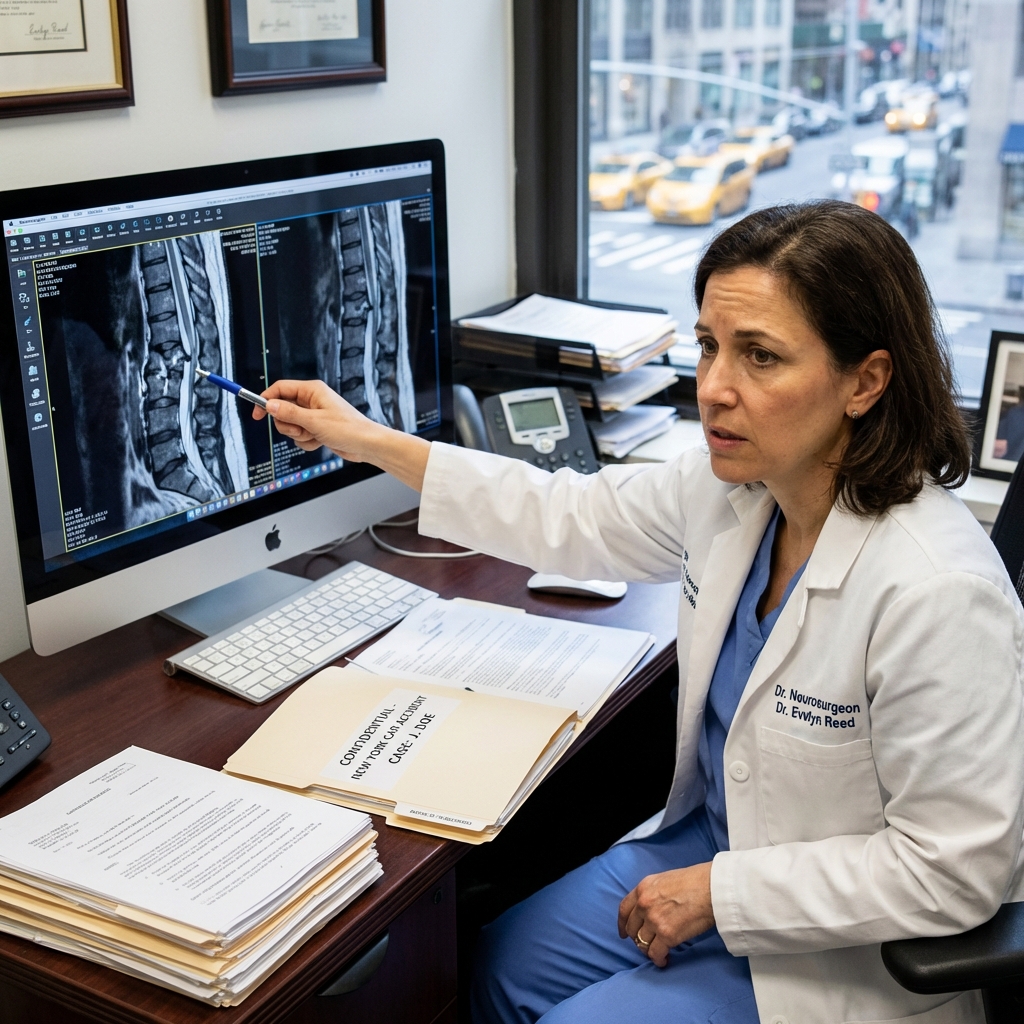
Meeting just one of the nine categories qualifies you to sue for ALL your injuries, even those that wouldn’t individually meet the threshold. For example, if you have a qualifying fracture (Category 4) plus soft tissue injuries that don’t qualify on their own, you can recover pain and suffering damages for both the fracture and the soft tissue injuries. This is established law in New York (Kapassakis v. Metropolitan Transportation Authority, 193 A.D.3d 835).
The burden of proof is on you, the plaintiff. Insurance defense attorneys will aggressively challenge your threshold claim by arguing pre-existing conditions, questioning treatment gaps, or attacking your medical expert’s credentials. In our 40+ years of handling motor vehicle cases, we’ve seen insurance companies deny claims that ultimately won at trial—but only because the plaintiff had solid medical documentation to support the claims.
Nine Categories of Serious Injury (Interactive Flowchart)
NY Insurance Law § 5102(d) enumerates nine injury categories as “serious.” Some are objective and rarely disputed (death, fracture), while others require extensive medical proof and generate significant litigation (permanent consequential limitation, 90/180 day rule). You need to meet just ONE category to qualify, but proving it requires category-specific evidence.
The nine categories, in order as listed in the statute:
Category 1: Death
Statutory Definition: “Death” – NY Insurance Law § 5102(d)(i)
If the accident results in the victim’s death, their estate or surviving family members can pursue a wrongful death claim. This category is self-explanatory and cannot be challenged on threshold grounds. The issue argued by the defense becomes causation: did the accident cause the injured person’s death.
Who Can Sue: The personal representative of the deceased’s estate files the lawsuit on behalf of statutory distributees (spouse, children, parents, siblings in order of priority under NY EPTL § 5-4.4).
Medical Proof Required: Death certificate listing the accident as cause or contributing factor, autopsy report if performed, and medical records showing the causal link between the accident and death.
Category 2: Dismemberment
Statutory Definition: “Dismemberment” – NY Insurance Law § 5102(d)(ii)
Dismemberment means the loss or amputation of a limb or body part. This includes surgical amputation necessitated by accident injuries (traumatic amputation of a leg after crush injury) and loss of organs (spleen removal following abdominal trauma).
Medical Proof Required: Surgical records documenting the amputation, pre-operative imaging showing the injury severity, and physician notes explaining why amputation was medically necessary. For organ loss, operative reports and pathology records are critical.
Common Defense Challenges: Defendants may argue the amputation was related to a prior condition unrelated to the accident such as a pre-existing condition such as diabetes or vascular disease. This is refuted with clear medical documentation showing the accident as the direct cause.
Category 3: Significant Disfigurement
Statutory Definition: “Significant disfigurement” – NY Insurance Law § 5102(d)(iii)
Significant disfigurement requires a permanent, visible scar or deformity that reasonable people would find unattractive, objectionable, or that would subject the victim to pity or scorn. This is a subjective standard typically decided by a jury. As the Court of Appeals explained, the scar must be visible and noticeable—not merely a minor mark.
Examples That May Qualify: Extensive facial scarring from glass lacerations, burn injuries causing permanent discoloration, disfiguring scars on arms or legs, surgical scars from multiple operations.
Examples That Typically Don’t Qualify: Small scars easily covered by makeup, surgical scars from unrelated procedures such as an appendectomy, unnoticeable hairline scars.
Medical Proof Required: Photographs taken at multiple intervals (immediately post-accident, 3 months, 6 months, 1 year), plastic surgeon evaluation stating the scar is permanent and not improvable with further surgery, dermatologist opinions on scar permanency.
Category 4: Fracture
Statutory Definition: “A fracture” – NY Insurance Law § 5102(d)(iv)
Any broken bone qualifies as a fracture under the threshold, regardless of severity. This includes hairline fractures, simple fractures, compound fractures, comminuted fractures, and even broken teeth. The 1977 amendment to § 5102(d) removed language requiring fractures to be “compound or comminuted,” making ANY bone break sufficient.
Medical Proof Required: X-ray or CT scan clearly showing the fracture, orthopedist evaluation, emergency room records and follow-up records showing treatment (casting, surgical repair, physical therapy).
Common Defense Challenge: Pre-existing fracture (defendants claim an old break, not a new one).
Examples of Common Fractures From Motor Vehicle Accidents: Fractured arm or leg bones (femur, tibia, radius, ulna), fractured ribs, fractured vertebrae (spine), fractured pelvis, fractured skull, broken nose, fractured jaw, broken teeth, fractured eye socket (orbital fracture), fractured hand or foot bones.
Category 5: Loss of a Fetus
Statutory Definition: “Loss of a fetus” – NY Insurance Law § 5102(d)(v)
Loss of a fetus means miscarriage or stillbirth caused by the trauma of a motor vehicle accident. This does NOT include premature birth of a living child. The key requirement is medical causation—proving the accident directly caused the pregnancy loss.
Medical Proof Required: Obstetric records documenting the viable pregnancy before the accident, emergency room records showing trauma to the abdomen or pelvic area, ultrasound or fetal monitoring showing fetal distress post-accident, pathology reports, and OB/GYN opinion letter explaining how the accident caused the loss.
Timing Considerations: The closer in time the pregnancy loss occurs to the accident, the stronger the causation argument. Losses within hours or days of the accident are more easily proven than losses weeks later.
Category 6: Permanent Loss of Use of a Body Organ, Member, Function or System
Statutory Definition: “Permanent loss of use of a body organ, member, function or system” – NY Insurance Law § 5102(d)(vi)
This category requires COMPLETE and PERMANENT loss of use—100% loss of function. Partial loss does not qualify under Category 6 (it may qualify under Categories 7 or 8). Courts interpret this strictly: blindness in one eye qualifies, reduced vision does not. Total deafness qualifies, partial hearing loss does not. Paralysis qualifies, weakness or limited range of motion does not.
Examples That Qualify: Total blindness in one or both eyes, complete deafness, paralysis of a limb (no movement or sensation), total loss of kidney function requiring dialysis, complete loss of bladder or bowel control, total loss of sexual function.
Medical Proof Required: Multiple examinations by specialists showing zero function, objective testing (EMG showing no nerve conduction, visual field testing showing no vision, audiometry showing no hearing), expert opinions from board-certified specialists stating the loss is permanent with no possibility of recovery.
Common Defense Challenges: Arguing the loss is partial, not total (even 5% function defeats this category), or that the loss is temporary with possibility of improvement. Strong medical opinions on permanence are essential.
Category 7: Permanent Consequential Limitation of Use of a Body Organ or Member
Statutory Definition: “A permanent consequential limitation of use of a body organ or member” – NY Insurance Law § 5102(d)(vii)
Category 7 covers PERMANENT limitations that are “more than minor” but less than total loss. This is one of the most litigated categories because it requires proving both permanence and significance. Herniated discs, torn rotator cuffs, and knee ligament tears often fall into this category if they result in lasting functional impairment.
Medical Proof Required: MRI or CT scan showing structural damage (herniated disc, torn ligament, cartilage tear), range of motion testing by orthopedist showing quantified limitations compared to normal, EMG nerve conduction studies for spine injuries, orthopedic surgeon opinion that the limitation is permanent despite maximum medical improvement, and physical therapy records documenting ongoing functional limitations.
Key Case Law: The landmark case Toure v. Avis Rent A Car Systems, 98 N.Y.2d 345 (2002) requires objective medical findings—not just subjective pain complaints. MRI evidence of structural damage is essential.
Examples That May Qualify: Herniated disc causing permanent nerve impingement, torn rotator cuff limiting shoulder movement by 40%, ACL tear causing knee instability, meniscus tear preventing squatting or kneeling, permanent back injury limiting lifting capacity.
Category 8: Significant Limitation of Use of a Body Function or System
Statutory Definition: “A significant limitation of use of a body function or system” – NY Insurance Law § 5102(d)(viii)
Category 8 differs from Category 7 in that it does NOT require permanence—the limitation can be temporary—but it must still be “significant” (more than minor). This category often overlaps with Category 7 when plaintiffs can’t prove permanence but can demonstrate substantial limitation during the treatment period.
Medical Proof Required: Objective range of motion testing showing quantified limitations, comparison to uninjured side or normal baseline, specialist examinations (orthopedist, neurologist) documenting the functional impairment, diagnostic imaging showing structural cause of limitation, and treatment records spanning the limitation period.
Common Defense Challenges: Insurance companies argue the limitation is “minor” rather than “significant,” or that subjective pain complaints without objective findings are insufficient. Courts have held that limitations lasting only a few weeks or months may not qualify as “significant.”
Examples That May Qualify: Cervical spine injury limiting neck rotation by 50%, lumbar injury preventing bending or lifting, shoulder injury preventing overhead reaching, knee injury causing limp and gait abnormality.
Category 9: The 90/180 Day Rule (Non-Permanent Injury Preventing Daily Activities)
Statutory Definition: “A medically determined injury or impairment of a non-permanent nature which prevents the injured person from performing substantially all of the material acts which constitute such person’s usual and customary daily activities for not less than ninety days during the one hundred eighty days immediately following the occurrence of the injury or impairment” – NY Insurance Law § 5102(d)(ix)
The 90/180 day rule requires proving you were unable to perform “substantially all” of your usual activities for at least 90 days during the first 180 days post-accident. This is NOT just inability to work—it includes household chores, childcare, personal hygiene, recreational activities, and all daily tasks.
What “Substantially All” Means: Courts interpret “substantially all” strictly. In Pommells v. Perez, 4 N.Y.3d 566 (2005), the Court of Appeals held that plaintiffs must prove the curtailment of substantially all material acts of daily living, not merely some activities.
Common Calculation Error: The 90 days must fall within the FIRST 180 days after the accident. Days of limitation after day 180 don’t count. The days need not be consecutive—90 total days within the 180-day window qualifies.
How Do You Prove The 90/180 Day Rule?
Proving the 90/180 day rule requires meticulous documentation during the critical first 180 days post-accident. This is where many cases fail—victims wait months before seeing attorneys, treatment records show gaps, or physicians don’t document specific activity limitations in contemporaneous notes.
The statute’s language is strict: Licari v. Elliott, 57 N.Y.2d 230 (1982) held that the 90/180 requirement is a “necessary condition” that must be proven with evidence specific to the 180-day time period. Medical reports created years later describing your condition “around the time of the accident” are insufficient—courts demand contemporaneous proof.
Step 1: Mark Your Calendar – Identify the exact accident date (Day 0) and count 180 days forward. Day 180 is your deadline. Any inability to perform activities after day 180 doesn’t count toward the 90-day requirement.
Step 2: Document Daily Limitations – Keep a written log noting each day you cannot perform substantial daily activities. Be specific: “Could not lift child (age 3, 30 lbs) due to back pain,” “Could not climb stairs to bedroom, slept on couch,” “Could not drive to work, required rides from spouse.”
Step 3: Get Physician Certifications – At every doctor visit within the 180-day window, ask your physician to document in writing the specific activities you cannot perform. Generic statements like “patient complains of pain” are useless. You need: “Patient cannot sit for more than 20 minutes, cannot lift more than 5 pounds, cannot bend at waist, cannot perform household chores.”
Step 4: Gather Corroborating Evidence – Employer letters stating days missed and work restrictions, physical therapy notes showing functional limitations during each session, prescription records showing pain medication usage, and family member statements describing your inability to perform household tasks or childcare.
What Medical Records Do You Need To Prove Injuries In A Motor Vehicle Accident Case?
Objective medical evidence—not just subjective pain complaints—are necessary to prove your case. As New York courts have consistently held, you cannot meet the serious injury threshold based solely on your testimony about pain. You need diagnostic test results showing structural damage or functional impairment, contemporaneous physician evaluations, and treatment records demonstrating the severity of the injury.
Different injury types require different proof. Fractures need X-rays, herniated discs need MRIs, nerve damage needs EMG studies. Gathering the right documentation is critical.
Timing Is Critical: Medical proof must be contemporaneous—meaning diagnostic tests and evaluations performed close in time to the accident and during the course of all the treatment after the date of the accident.
Emergency Room Records: Your ER visit immediately after the accident establishes baseline injuries and causation. The ER report should record initial complaints, and preliminary diagnoses. Request a complete copy of all ER records, including ambulance records upon your discharge from the hospital.
Diagnostic Imaging: X-rays for fractures, MRI for soft tissue injuries (herniated discs, torn ligaments, cartilage damage), CT scans for complex fractures or head injuries, and EMG/nerve conduction studies for nerve damage claims.
Specialist Evaluations and Reports: Orthopedists for bone and joint injuries, neurologists for nerve damage and brain injuries, neurosurgeons for spine injuries requiring surgical consideration, and physiatrists (PM&R doctors) for functional capacity evaluations.
Physical Therapy Records: PT notes documenting your functional limitations at each session, progress (or lack of progress) toward recovery, objective measurements of range of motion, and specific activities you cannot perform.
Common Defense Tactics Insurance Companies And Their Attorneys Use
Tactic 1: Pre-Existing Condition Argument – Defense claims your injury existed before the accident, so the accident didn’t cause it. They’ll scour your medical history for any prior complaints—even old back pain from ten years ago—and argue the current injury is merely aggravation of a pre-existing condition.
Tactic 2: Treatment Gap Attacks – Defense points to any periods where you didn’t see doctors or attend physical therapy, arguing if you were really injured, you would have sought continuous treatment.
Tactic 3: Independent Medical Examination (IME) Contradictions – Defense sends you to their hired doctor who performs a cursory examination and usually writes a report that minimizes your complaints and refutes your injury.
Tactic 4: Comparative Imaging Manipulation – For spine injury cases, defense obtains imaging from years before the accident showing mild degenerative changes, then argues your current herniation is merely progression of degenerative disease, not accident-caused injury.
Tactic 5: Social Media Surveillance – Defense investigators review your Facebook, Instagram, X, TikTok, LinkedIn and other on-line accounts for photos or posts showing activities inconsistent with claimed limitations. A single photo of you lifting a child, playing sports, or traveling can destroy your credibility.
Do You Have A Case That Meets The Criteria Of Serious Injury – Call Us For A Free Evaluation
If you’re unsure after reviewing the categories, the next step is a comprehensive legal evaluation.
Free Case Evaluation – No Fees Unless We Win
Call (212) 732-2929 or complete our contact form
- ✓ 40+ years of litigating Motor Vehicle Accident Cases
- ✓ $750M+ recovered for injured clients across all practice areas*
- ✓ Super Lawyers selection 2015-2024
- ✓ Martindale-Hubbell AV Preeminent Rated
- ✓ Free consultation with no obligation
*This aggregate figure represents total recoveries across all case types and settlements. Individual case results vary. Past outcomes do not guarantee similar results.
We handle cases on contingency—you pay nothing unless we recover compensation for you. All consultations are confidential and protected by attorney-client privilege.
Frequently Asked Questions
Q: What if I have a herniated disc but didn’t need surgery?
A: Surgery is NOT required to meet the threshold. Many herniated disc cases qualify based on MRI findings, range of motion limitations, and conservative treatment (physical therapy, injections, medication). The critical factors are: MRI clearly showing the herniation, orthopedist or neurologist documenting quantified range of motion deficits, EMG studies if you have nerve symptoms, and consistent treatment showing the injury didn’t resolve.
Q: Does a hairline fracture count as a serious injury?
A: Yes. The statute says “a fracture” without qualification. Courts have held that ANY bone break qualifies, including hairline (non-displaced) fractures, stress fractures, and even fractured teeth. The 1977 amendment specifically removed language requiring fractures to be “compound or comminuted,” making all fractures qualifying injuries.
Q: Can pre-existing conditions completely disqualify me?
A: No. New York law recognizes that trauma can aggravate pre-existing conditions or cause new injuries in people with degenerative disease. The standard is whether the accident caused a significant worsening of your condition compared to your pre-accident baseline. If you had mild arthritis but were fully functional before the crash, and the accident caused a herniated disc that left you with permanent limitations, you can qualify. The key is proving that the accident caused a distinct, new injury or material aggravation beyond normal disease progression.
Q: What if there are gaps in my medical treatment?
A: Treatment gaps may weaken your case but aren’t automatically disqualifying. There may be legitimate reasons for treatment interruptions—financial hardship, insurance claim denials, family emergencies, and others.
Q: How long do I have to file a lawsuit in New York?
A: The time limits to file a lawsuit vary depending on the type of case and who you’re suing. For example, you have three years from the accident date to file a motor vehicle accident case against a private defendant under NY CPLR § 214. For wrongful death cases, you have two years from the date of death under NY EPTL § 5-4.1. However, if you’re suing a governmental entity such as the City of New York, you must file a Notice of Claim within 90 days of the accident and commence your lawsuit within one year and 90 days under NY General Municipal Law § 50-e and § 50-i.
Q: How long do I have to file a no-fault claim?
A: You must file a no-fault claim with the correct insurance company within 30 days of the accident to preserve your right to no-fault benefits. Which insurance company depends on your role in the accident:
- If you were the driver, file with your own insurance company
- If you were a passenger in another person’s vehicle, file with their insurance company
- If you were a pedestrian, file with the insurance company of the vehicle that struck you
There are other scenarios as well, which is another reason you should speak with an experienced motor vehicle accident attorney as soon as possible after your accident.
Q: What if the at-fault driver has no insurance?
A: You may have several options. First, if you own and insure a motor vehicle in New York State you can file a claim under your own uninsured motorist coverage in your insurance policy. Second, if you do not own a motor vehicle but somebody in your household does you can file with their insurance company. Third, if there is no motor vehicle in your household you may qualify for compensation through the New York Motor Vehicle Accident Indemnification Corporation (MVAIC), a state fund that compensates victims injured by uninsured or hit-and-run drivers.
Conclusion
New York’s serious injury threshold is complex, strictly enforced, and heavily litigated. Insurance companies have experienced legal teams and hired medical experts working to deny your claim. Without proper medical documentation gathered at the right time, even legitimately severe injury cases can be lost.
If you’ve been injured in a motor vehicle accident in New York City, don’t wait to assess your legal options. Contact Dansker & Aspromonte Associates LLP at (212) 732-2929 for a free, confidential case evaluation.
References
- New York State Senate. (2025). Insurance Law § 5102: Definitions. Retrieved January 15, 2026.
- New York State Senate. (2025). Insurance Law § 5104: Causes of Action for Personal Injury. Retrieved January 15, 2026.
- New York Department of Financial Services. (2025). Understanding No-Fault Insurance. Retrieved January 15, 2026.
- Toure v. Avis Rent A Car Systems, Inc., 98 N.Y.2d 345 (2002). New York Court of Appeals decision establishing objective evidence requirement.
- Pommells v. Perez, 4 N.Y.3d 566 (2005). Court of Appeals decision defining “substantially all” standard for 90/180 rule.
- Licari v. Elliott, 57 N.Y.2d 230 (1982). Court of Appeals establishing 90/180 day rule as strict requirement.
- Kapassakis v. Metropolitan Transportation Authority, 193 A.D.3d 835 (2d Dept. 2021). Appellate Division decision holding that qualifying injury allows recovery for all injuries.
- New York State Senate. (2025). Civil Practice Law and Rules § 214: Actions to Be Commenced Within Three Years. Retrieved January 15, 2026.
- New York State Senate. (2025). Estates, Powers and Trusts Law § 5-4.4: Distributees. Retrieved January 15, 2026.
Attorney Advertising. Prior results do not guarantee a similar outcome. This article is for informational purposes only and does not constitute legal advice. Reading this content does not create an attorney-client relationship. Every case is unique and must be evaluated on its own facts. Qualification rates cited are based on firm case data and may not reflect outcomes in your specific case. Contact Dansker & Aspromonte Associates LLP for a case-specific evaluation.