
New York School Injury Lawyer
Dansker & Aspromonte Associates LLP represents families whose children suffered serious injuries due to school negligence in New York City. Our attorneys have recovered over $750 million for injured clients, including a $1.2 million verdict for a playground injury at an NYC school. We handle cases on a contingency basis—no fees unless we win.
Your Child Injured at School?
Free consultation. Call (212) 732-2929 or contact us online.
Critical Deadlines at a Glance
| School Type | Notice of Claim Deadline | Lawsuit Filing Deadline | Governing Statute | Key Difference |
|---|---|---|---|---|
| NYC Public Schools | 90 days from injury | 1 year + 90 days from injury | GML §§ 50-e, 50-i | Strict government claim procedures — missing the 90-day deadline typically bars your claim forever |
| Charter Schools (DOE-Authorized) | 90 days (if DOE entity) | Varies by governance structure | Education Law § 2853, GML § 50-e | May follow public or private rules depending on whether the charter is considered a government entity |
| Charter Schools (SUNY-Authorized) | 90 days (if SUNY entity) | Varies by governance | Education Law § 2853, GML § 50-e | SUNY charter schools may require a Notice of Claim, like other state entities |
| Private Schools | None required | 3 years from injury | CPLR § 214(5) | Standard personal injury rules apply — no government claim procedures |
⚠️ Critical: These deadlines can be extended or shortened depending on factors like the child’s age, mental capacity, defendant type, claim nature, and whether tolling provisions apply. Always consult an attorney immediately to confirm the exact deadlines for your specific case.
The “90-Day Danger Zone” Timeline
title NYC Public School Injury Claim Process
section Critical Phase
Day 0 : Injury Occurs
Day 1-10 : Seek Medical Care & Evidence
Day 30 : Request School Records
section The Deadline
Day 80 : Attorney Review Finalization
Day 90 : DEADLINE – Notice of Claim Filed
section Litigation
Month 4 : 50-h Hearing (Oral Exam)
1 Year + 90 Days : DEADLINE – File Lawsuit
*Failure to file Notice of Claim by Day 90 typically bars recovery.
What To Do Right After a School Injury in New York City
According to the NYC Department of Education safety reports, thousands of student injuries occur annually in city schools. If your child was injured, take these immediate steps:
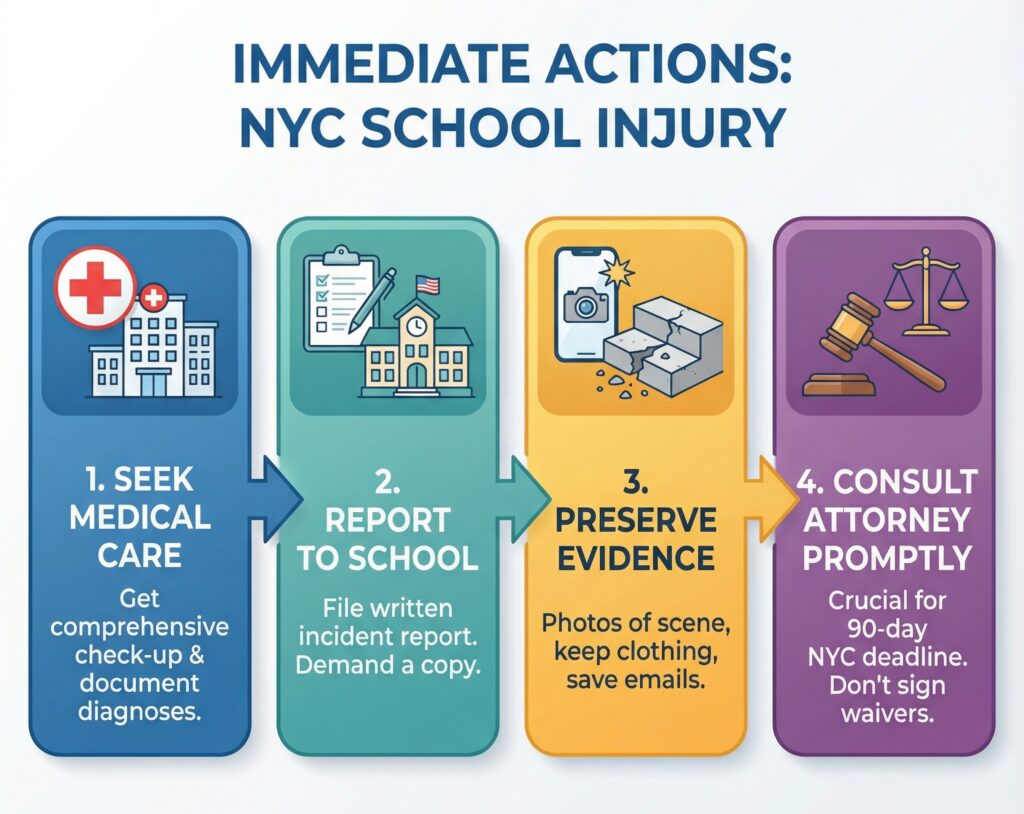
- Seek immediate medical care – Even if injuries seem minor, get your child examined by a medical professional and document all diagnoses and treatment recommendations
- Report the incident to school administrators – File a written incident report with the principal, nurse, or appropriate school officials and request a copy for your records
- Document the scene – Take photographs of where the injury occurred, including hazardous conditions, broken equipment, or inadequate supervision areas
- Preserve all evidence – Keep your child’s clothing, damaged property, medical records, school communications, and any witness contact information
- Request complete school records – Obtain incident reports, surveillance footage (request immediately as it may be deleted after 30-90 days), staff schedules, safety inspection logs, and maintenance records from the school district
- Do not sign waivers or settlements – Schools may ask you to sign liability waivers or accept quick settlements—consult an attorney before signing anything
- Document ongoing impacts – Keep detailed notes about your child’s pain, emotional distress, missed school days, therapy needs, and how injuries affect daily activities
- Contact a New York school injury attorney promptly – Public schools have strict notice requirements (90 days for government claims under General Municipal Law § 50-e) that can bar your claim if missed. Charter school deadlines vary. Private schools allow three years under CPLR § 214(5).
Key Legal Terms in New York School Injury Cases
| Term | Definition | Why This Matters to Your Case |
|---|---|---|
| Duty of Care | Schools and staff members have a legal obligation to supervise students and maintain safe premises. New York courts have established that schools must exercise the same degree of care as a reasonably prudent parent would under similar circumstances. | This is the foundation of your claim. To win, you must prove the school owed your child a duty of care, which they almost always do during school hours and school-sponsored activities. |
| In Loco Parentis | Latin for “in place of a parent”—schools act in the parents’ role during school hours and have a heightened duty to protect children from foreseeable harm, including injuries from inadequate supervision, dangerous conditions, or bullying. | This legal doctrine raises the bar for schools. They’re not just property owners—they stand in your shoes as protectors of your child’s safety. |
| Negligent Supervision | A school’s failure to adequately monitor, oversee, or control students in areas where supervision is required. This includes playgrounds, hallways, lunchrooms, field trips, and anywhere students are under school authority. | Many school injury cases turn on supervision failures. If staff were absent, distracted, or failed to intervene in dangerous situations, this establishes breach of duty. |
| Actual Notice | The school had direct knowledge of a dangerous condition through complaints, incident reports, staff observations, or previous injuries at the same location. | Proves the school knew about the hazard but failed to fix it. This strengthens your case significantly because they had a clear opportunity to prevent the injury. |
| Constructive Notice | The dangerous condition existed long enough that the school should have discovered it through reasonable inspections and maintenance. A hazard doesn’t need to be reported—if it was obvious or longstanding, the school is deemed to have known about it. | Defeats the school’s defense that “we didn’t know about it.” If the broken equipment, cracked pavement, or unsafe condition existed for weeks or months, the school is liable regardless of formal complaints. |
| Proximate Cause | A direct causal connection between the school’s negligence and your child’s injuries. The negligent act must be a substantial factor in causing the harm, not just a remote or coincidental link. | Schools often try to blame the child’s own actions. You must prove that the school’s breach directly led to the injuries—for example, inadequate supervision allowed a known bully to attack your child. |
| Notice of Claim | For injuries at public schools, you must file a Notice of Claim with the appropriate public entity (often the City of New York and/or the NYC Department of Education or Board of Education) within 90 days of the incident under General Municipal Law § 50-e. After filing, you must wait at least 30 days before filing a lawsuit, and the lawsuit must be filed within 1 year and 90 days from the date of injury under General Municipal Law § 50-i. Missing these deadlines typically bars your claim permanently. | This is the most dangerous procedural trap in public school cases. The 90-day clock starts immediately on the injury date. Missing this deadline means you lose all legal rights to compensation, regardless of how severe your child’s injuries are. |
| Statute of Limitations (Private Schools) | For private schools, the general personal injury statute of limitations is three years from the date of injury under CPLR § 214(5). However, tolling provisions may apply for minors, effectively extending this deadline in certain circumstances. | Private school cases have more flexibility than public school claims, but you should still act quickly. Evidence disappears, witnesses’ memories fade, and surveillance footage is typically deleted after 30-90 days. |
⚠️ Critical: The time to file a Notice of Claim or lawsuit varies significantly based on your child’s age, the defendant’s identity (city agency, charter school, private institution), the nature of the claim, and other case-specific factors. Minors may have extended deadlines through tolling, but these rules are complex. Contact an attorney immediately after any school injury to preserve your rights.
Common Types of School Injuries in New York City
Children suffer injuries in New York City schools for many preventable reasons. Our firm has represented families across Manhattan, Brooklyn, Queens, the Bronx, and Staten Island in cases involving:
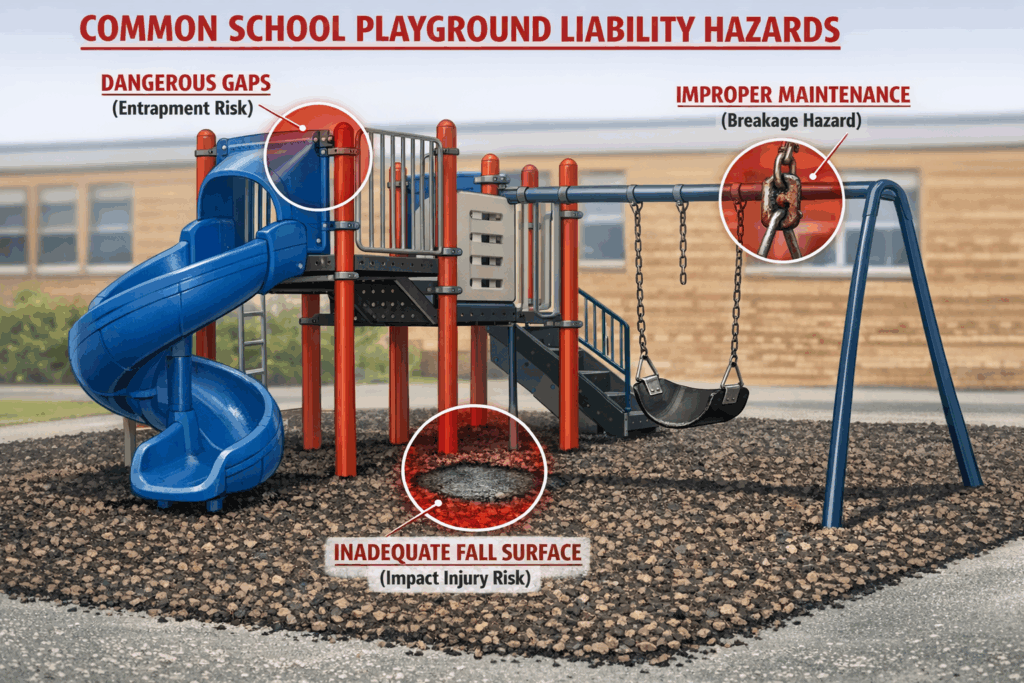
- Playground equipment accidents – Defective slides, broken swings, improperly maintained climbing structures, inadequate fall surfaces, or equipment with dangerous gaps (like the $1.2 million playground case we won for a young girl whose finger was amputated on a defective slide). Our playground injury attorneys investigate equipment maintenance records and inspect defects that schools failed to repair.
- Inadequate supervision injuries – Children are injured when teachers, aides, or staff fail to monitor hallways, playgrounds, lunchrooms, or field trips, leading to falls, collisions, or assaults by other students
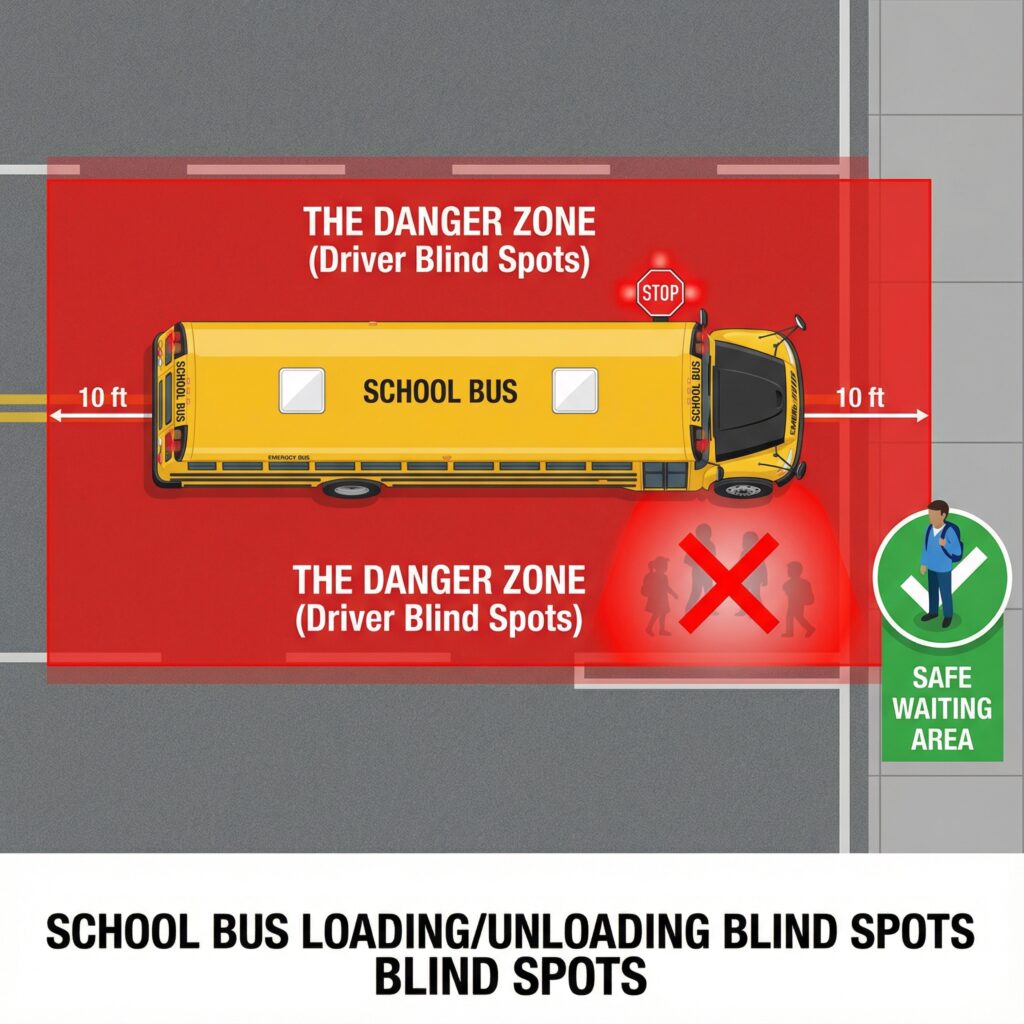
- School bus accidents – Crashes caused by negligent bus drivers, improper maintenance, or failures to follow safety protocols when loading or unloading students. These cases often involve the NYC Office of Pupil Transportation, private bus contractors, and other motorists. Our bus accident lawyers handle both public and private school transportation claims.
- Sports and physical education injuries – Concussions, fractures, or ligament damage from unsafe gym equipment, inadequate coaching, forcing injured students to continue playing, or failure to have proper medical staff on site. When injuries result in permanent brain damage, these may qualify as traumatic brain injury cases requiring specialized life care planning.
- Slip, trip, and fall accidents – Injuries from wet floors, broken stairs, uneven pavement, snow and ice accumulation, or debris in hallways and classrooms
- Bullying and assault injuries – Physical injuries from known bullies when schools ignore warning signs, fail to intervene, or inadequately supervise students with documented aggressive behavior
- Chemical exposure and science lab accidents – Burns, respiratory injuries, or toxic exposures from improperly stored chemicals, lack of safety equipment, or inadequate instruction on handling hazardous materials
- Cafeteria injuries – Choking incidents, food allergies not properly accommodated, burns from hot equipment, or slip-and-fall accidents on spilled food or liquids
- Classroom accidents – Injuries from unsafe furniture, falling objects from storage areas, door and window defects, or lack of safety measures in workshops or technical classes
- Special needs student injuries – Children with disabilities who suffer preventable injuries when schools fail to provide required accommodations, individualized supervision, or specialized equipment mandated by Individualized Education Programs (IEPs)
If your child’s injury resulted from a school’s failure to meet basic safety standards or provide adequate supervision, you may have a valid negligence claim. Our children’s injury attorneys can evaluate whether the school breached its duty of care.
Who Can Be Held Liable for School Injuries in NYC
Multiple parties may share responsibility for your child’s injuries depending on the circumstances. In New York City school injury cases, potentially liable parties include:
- The NYC Department of Education – For public schools, the DOE oversees safety standards, maintenance, staffing levels, and training requirements across all five boroughs
- The Board of Education – District-level decisions about budget allocations, safety policies, and administrative oversight can create liability when systemic failures lead to injuries
- Individual schools and principals – School administrators who fail to implement safety protocols, maintain adequate supervision ratios, or address known hazards
- Teachers and staff members – Individual employees who breach their duty of care through negligent supervision, failure to intervene in dangerous situations, or improper instruction
- School bus companies and drivers – Both the NYC Office of Pupil Transportation and private bus contractors can be liable for driver negligence, inadequate vehicle maintenance, or violations of student transportation regulations
- Charter schools and private schools – Independent educational institutions that fail to maintain safe premises or provide adequate supervision
- Athletic coaches and program directors – Staff responsible for sports programs who fail to follow concussion protocols, push injured students to play, or allow unsafe practice conditions
- Property owners and maintenance contractors – Entities responsible for building upkeep who fail to repair known hazards like broken stairs, defective equipment, or structural defects
- Equipment manufacturers – Companies that produce defective playground equipment, sports gear, lab equipment, or furniture that causes injuries
- Third-party vendors – Cafeteria operators, janitorial services, security firms, or field trip organizers whose negligence contributes to student injuries
New York law recognizes that schools stand “in loco parentis”—in place of parents—during school hours. This legal doctrine creates a heightened duty for schools to exercise reasonable care to protect students from foreseeable harm. When schools breach this duty and children suffer injuries, multiple parties may share liability.
In cases involving serious injuries like traumatic brain damage or permanent disabilities, we also handle related wrongful death claims and catastrophic injury cases requiring specialized legal strategies and lifetime care planning.
How NYC Schools Are Legally Required to Protect Students
New York City public schools operate under comprehensive safety regulations designed to prevent injuries. When schools violate these requirements and children are hurt, liability follows. Key legal obligations include:
What Are NYC School Supervision Requirements?
New York Education Law and NYC Department of Education regulations mandate specific supervision standards:
- Adequate adult-to-child ratios – Age-appropriate supervision levels must be maintained in classrooms, playgrounds, cafeterias, and during transitions between activities
- Continuous monitoring – Staff cannot leave children unsupervised in areas where foreseeable harm could occur, including playgrounds, bathrooms, hallways, and field trips
- Trained supervision – Staff supervising children must be trained in age-appropriate behavior management, safety protocols, and emergency response
- High-risk activity oversight – Swimming, science labs, shop classes, and sports require specialized supervision with staff trained in the specific risks and safety measures for those activities
What Are School Premises Safety Standards?
Schools must maintain safe physical environments under NYC building codes and Department of Education safety standards:
- Regular safety inspections – Systematic checks of playgrounds, equipment, stairs, railings, windows, and all areas accessible to students
- Prompt hazard remediation – Known dangers must be repaired immediately, or the area must be closed off with clear warnings until repairs are completed
- Proper equipment maintenance – Playground equipment, gym apparatus, desks, chairs, and all student-accessible items must meet safety standards and be maintained in good working condition
- Adequate lighting and visibility – All student areas require proper lighting, and supervision sight lines cannot be obstructed by poor facility design
- Snow and ice removal – Under NYC Administrative Code § 7-210 and § 16-123, schools must clear walkways, stairs, and play areas after storms to prevent slip-and-fall accidents
How Do Schools Handle Emergency Response?
NYC schools must have emergency medical procedures in place:
- Trained staff – School nurses or designated personnel trained in first aid and CPR must be available during school hours
- Emergency action plans – Written protocols for responding to various types of injuries and medical emergencies, including when to call 911
- Medication administration – Proper procedures for storing and administering medications, including EpiPens for students with severe allergies. You can report unsafe medication storage to 311, but this does not constitute a legal Notice of Claim under GML § 50-e.
- Parent notification – Immediate contact with parents when children are injured, and documentation of all incidents in official records
What Protections Apply to Special Education Students?
Students with disabilities are entitled to additional safeguards under federal and state law:
- IEP implementation – Schools must follow all safety-related provisions in students’ Individualized Education Programs, including specialized equipment, one-on-one aides, or modified activities
- Behavioral intervention plans – For students with behavioral challenges, schools must implement positive behavior supports and crisis intervention protocols
- Accessibility compliance – Physical accommodations required by the Americans with Disabilities Act and Section 504 to prevent injuries from inaccessible facilities
When NYC public schools fail to meet these requirements and children are injured, families must follow strict government claim procedures. Our attorneys help families navigate the 90-day Notice of Claim requirement under General Municipal Law § 50-e and the subsequent 1-year and 90-day filing deadline under GML § 50-i.
Dansker & Aspromonte School Injury Case Results
Our firm has successfully represented families throughout New York City in school injury cases. While every case is unique and results depend on specific facts, these examples demonstrate our commitment to holding schools accountable:
$1.2 Million — Playground Equipment Injury (NYC School)
A young girl was injured while using a slide at a New York City school playground. The slide had a dangerous gap between metal panels that should have been sealed during installation. As she slid down, her ring finger caught in the gap, and the tip was severed. The NYC Department of Education argued that since it was “just the tip of her finger,” the injury was not significant. At trial, we presented compelling evidence that the injury had a devastating emotional and psychological impact on the child, affecting every aspect of her life and self-esteem. The jury disagreed with the city’s minimization of her suffering and awarded $1.2 million.
$1.1 Million — School Bus Supervision Failure (Manhattan)
A 16-year-old student with special needs attended a psychiatric hospital school operated by the NYC Board of Education in Manhattan. School policy required staff to escort him safely onto the school bus due to his documented impulse control challenges. One day after school, the staff failed to follow this protocol, and he ran after his departing bus. He slipped and was run over by the rear wheels, sustaining bilateral hip fractures and severe soft tissue injuries requiring multiple surgeries. Both the Board of Education (for failing to supervise) and the NYC Transit Authority (whose bus driver saw him running but made no effort to stop) denied liability. At trial, we proved both entities shared responsibility for violating established safety protocols designed specifically to protect vulnerable students.
These cases illustrate that New York juries take school safety seriously. When schools and government entities fail to meet their duty of care, our attorneys hold them accountable through thorough investigation and aggressive trial advocacy.
Compensation Available in NYC School Injury Claims
Children injured at school deserve full compensation for both immediate and long-term consequences of their injuries. Unlike adults, children often face decades of ongoing impacts from injuries suffered in their youth. New York law allows recovery for:
Economic Damages
- Past and future medical expenses – Hospital bills, surgeries, medications, physical therapy, occupational therapy, mental health counseling, and any ongoing treatment needs
- Medical equipment and assistive devices – Wheelchairs, prosthetics, orthotics, home modifications for accessibility, specialized educational tools
- Future earning capacity loss – For severe injuries that impair a child’s ability to pursue certain careers or limit lifetime earnings potential
- Special education and tutoring costs – Additional educational support needed if injuries cause cognitive impairment or extended absences from school
Non-Economic Damages
- Pain and suffering – Physical pain endured from the injury itself and during treatment and recovery
- Emotional distress and psychological trauma – Anxiety, depression, post-traumatic stress, or fear of returning to school
- Loss of enjoyment of life – Inability to participate in childhood activities, sports, hobbies, or social events due to injuries
- Scarring and disfigurement – Permanent visible scars or disfigurement that affect self-esteem and social development
- Loss of normal childhood development – Disruption to critical developmental milestones and normal childhood experiences
New York does not cap non-economic damages in personal injury cases, allowing juries to award appropriate compensation based on the specific impacts on each child’s life. In cases of severe permanent injuries, verdicts and settlements can reach into the millions of dollars.
What Families Say About Our School Injury Representation
“I feel so grateful to have this firm Dansker & Aspromonte to help with my case. Everyone in the law firm is so helpful and professional. They will walk you through all the steps, what’s happening next, explain everything thoroughly. I really appreciate their work. If you were suffered in personal injury, I would suggest this team.”
“Choosing the office of Dansker & Aspromonte Associates was one of the best decisions my parents made. Each and every person I came across at this office was respectful and caring. Doug Hoffer made sure to check in with me many times throughout my case to see how I was doing and keep me up to date with my case. He made sure that he got me the best settlement. If you’re reading this review, allow this office to handle your case you won’t regret it.”
“They represented my autistic son and were thorough, responsive, patient, and courteous. We couldn’t have been happier with Dansker & Aspromonte!!”
Frequently Asked Questions About School Injury Claims
Can I sue a private school for my child’s injuries?
Yes. New York law allows you to seek compensation from private schools when they fail to meet their duty of care. Private schools must maintain safe premises and provide adequate supervision, just like public schools. The key difference is that private school claims follow the standard three-year statute of limitations under CPLR § 214(5) rather than the strict government claim procedures that apply to public schools.
Important: While private schools generally allow three years to file, critical evidence like surveillance footage is often deleted within 30-90 days, and witness memories fade quickly. Consult an attorney promptly to preserve evidence, even though your deadline is longer than public school cases. Age, defendant type, and claim nature can affect timing — contact us immediately to confirm your specific deadline.
Can I sue a public school for my child’s injuries?
Yes, but public school claims have very strict deadlines. You must file a Notice of Claim with the appropriate public entity (often the City of New York and/or the NYC Department of Education or Board of Education) within 90 days of the injury under General Municipal Law § 50-e. After filing the Notice of Claim and waiting the required 30 days, you must file a lawsuit within 1 year and 90 days from the date of the incident under GML § 50-i. Missing these deadlines typically bars your claim permanently, regardless of how serious your child’s injuries are.
Critical: The 90-day clock starts immediately on the injury date. However, factors like your child’s age, mental capacity, or special circumstances may affect these deadlines. Late filings are sometimes allowed with court permission in limited situations. Don’t assume you’ve lost your rights — contact an attorney immediately, even if the 90 days have passed.
What proof do I need when taking legal action against a school?
Strong school injury claims require tangible evidence of negligence or hazardous conditions. Critical evidence includes:
- Official school incident reports documenting when and how the injury occurred
- Photographs or videos of the accident scene, hazardous conditions, or defective equipment
- Medical records showing the extent of injuries and treatment required
- Witness statements from other students, teachers, or parents who saw the incident
- School maintenance logs, inspection reports, and prior complaints about the same hazard
- Surveillance footage from school security cameras (request this immediately, as it may be deleted within 30-90 days)
- Records showing similar incidents at the school, establishing notice of the dangerous condition
- Expert testimony from safety professionals about how schools should have prevented the injury
Our investigative team helps families obtain evidence, including documentsthat schools may be reluctant to provide voluntarily. Early involvement of an attorney helps preserve critical evidence before it disappears.
When is a school NOT liable for my child’s injury?
Schools are not insurers of student safety—they are liable only when negligence causes injuries. A school may avoid liability if:
- The injury was unforeseeable – Truly unexpected incidents that no reasonable precaution could have prevented
- The student’s own actions were the sole cause – when a student deliberately engages in dangerous behavior that staff could not have prevented despite adequate supervision. For example, if a student is dared to jump down stairs and injures themselves in an area with multiple staff present, the school might successfully argue there was no time to intervene
- The school took reasonable precautions – Adequate supervision was present, equipment was properly maintained, and rules were enforced, but the injury still occurred
- The injury resulted from an inherent risk – Contact sports involve some unavoidable injury risk, though schools must still follow safety protocols, provide proper equipment, and have medical staff available
However, even when students engage in risky behavior, schools may still share liability if inadequate supervision created the opportunity for dangerous conduct, especially with younger children or students with special needs who require closer monitoring.
Are there limits to how much compensation I can receive in a school injury claim?
New York does not impose damage caps on personal injury cases, including school injuries. Juries can award whatever amount they determine is appropriate based on the severity of injuries and their impact on the child’s life. However, some practical considerations affect settlement values:
- For public school cases – The NYC Law Department and Board of Education defend these claims aggressively, but large verdicts are possible when liability is clear and injuries are severe
- Insurance coverage – Private schools typically carry liability insurance with policy limits ranging from $1 million to $5 million or more
- Multiple liable parties – Cases involving equipment manufacturers, bus companies, or property owners may have additional sources of recovery beyond the school itself
Our firm has recovered millions of dollars for injured children, including six-figure and seven-figure settlements and verdicts. Each case is valued based on its specific facts, the strength of evidence, and the extent of injuries.
What if someone other than the school caused my child’s injury?
Schools can still be liable when third parties cause injuries if the school failed to meet its supervision duties. For example:
- Student-on-student assaults – If the school knew or should have known a student posed a danger (through prior incidents, reports from teachers, or complaints from other parents) but failed to provide adequate supervision or intervention
- Bullying situations – Schools that ignore reports of ongoing bullying or fail to implement required anti-bullying protocols can be held liable for resulting injuries
- Visitor or trespasser injuries – Schools that fail to secure campuses properly may be liable when unauthorized persons gain access and harm students
The legal question is whether the school could reasonably have prevented the harm through appropriate supervision, intervention, or security measures. New York courts have consistently held that schools must take steps to protect students from foreseeable risks of harm from other students.
What if my child was in a school bus accident?
School bus accident cases may involve multiple liable parties:
- The bus company or NYC Office of Pupil Transportation – For driver negligence, inadequate maintenance, or violations of student transportation regulations
- The school or Board of Education – For failing to properly vet bus companies, ignoring known safety issues, or inadequate supervision of bus stops
- Other drivers – Motorists who crash into school buses through reckless or negligent driving
- Manufacturers – When defective bus equipment contributes to injuries
Like other school injury claims, public school bus cases are subject to the 90-day Notice of Claim requirement under General Municipal Law § 50-e. Private school buses may follow different procedural rules.
Who pays for medical treatment if a child is hurt at school?
Initially, your health insurance covers emergency and ongoing medical treatment. However, the liable party should ultimately be responsible for all medical expenses through settlement or judgment. Important considerations:
- Use your health insurance – Don’t delay treatment, waiting for the school to accept liability. Get your child treated immediately and document everything
- Preserve all medical billing records – These become evidence of your economic damages in the case
- Health insurance liens – If you recover compensation, your insurer may have a right to reimbursement for benefits paid. We negotiate these liens to maximize your net recovery
- No-fault insurance – If the injury involves a motor vehicle (like a school bus crash), New York’s No-Fault insurance may cover initial medical bills regardless of fault
Never let financial concerns prevent your child from receiving necessary medical care. Treatment creates both the medical record needed to prove your case and ensures your child’s health and recovery come first.
Can a school make me sign a waiver giving up my right to sue?
Schools cannot completely waive their duty to provide basic supervision and maintain safe premises. While waivers for certain activities may be enforceable in limited circumstances, New York courts generally do not allow schools to contract away their fundamental responsibility to protect children from foreseeable harm.
- Public schools – Waivers signed for public school activities are often unenforceable as against public policy. Government entities cannot require families to give up rights to sue for negligence as a condition of attending public school
- Private schools – Private school waivers may be more enforceable, but courts scrutinize them, especially for young children. Waivers must be clear, specific, and cannot excuse gross negligence or reckless conduct
- Athletic activities – While courts recognize inherent risks in sports (bruises, sprains from normal play), waivers cannot protect schools from liability for providing defective equipment, inadequate coaching, or forcing injured students to continue playing
Never sign any waiver or settlement document presented by a school after an injury without consulting an attorney first. Schools may pressure families to sign releases or accept minimal payments in exchange for giving up valuable legal rights.
What if my child was injured before or after regular school hours?
Schools’ duty of care extends beyond regular classroom hours when they exercise control over students:
- Before-school programs – Supervised breakfast programs, early drop-off, and morning care create the same duty of care as regular school hours
- After-school programs – Extended day care, homework help, sports practice, and other school-sponsored activities maintain the school’s supervision obligation
- School buses – The duty of care applies during all bus transportation, including morning pickup and afternoon drop-off. Schools must ensure safe loading/unloading procedures
- Field trips and school events – Any school-sponsored activity, including weekend trips, sporting events, and field trips, requires the same standard of care
- Drop-off and pickup times – Some courts have found schools liable for injuries during the transition period when parents are dropping off or picking up students, particularly for young children
The key question is whether the school exercised control over the student at the time of injury. If the school operated a program, transported the student, or maintained supervision responsibility, the duty of care applies regardless of the time of day.
How We Help Families After School Injuries
Dansker & Aspromonte Associates LLP provides comprehensive representation for school injury cases throughout New York City. Our approach includes:
Immediate Investigation and Evidence Preservation
We act promptly to secure critical evidence before it disappears:
- Sending preservation letters to schools demanding they retain surveillance footage, incident reports, maintenance logs, and staff schedules
- Photographing and documenting hazardous conditions before repairs eliminates evidence
- Interviewing witnesses while memories are fresh
- Obtaining school records through formal discovery or Freedom of Information Law (FOIL) requests
- Engaging safety experts to inspect premises, equipment, and supervision practices
Navigating Government Claim Procedures
For public school cases, we handle all procedural requirements:
- Filing the Notice of Claim within the 90-day deadline under General Municipal Law § 50-e
- Preparing you and your child for the 50-h hearing (examination under oath required by GML § 50-h)
- Responding to the city’s investigation and discovery demands
- Meeting all technical requirements to preserve your right to sue
- Filing the lawsuit within the 1 year and 90-day deadline under GML § 50-i
Building the Strongest Possible Case
We prepare every case for trial from day one:
- Conducting a thorough discovery to obtain all school records, policies, training materials, and prior incident reports
- Retaining medical experts to document the full extent of your child’s injuries and future needs
- Engaging education and safety experts to establish the standard of care and prove how the school breached it
- Calculating comprehensive damages, including future medical costs, educational needs, and diminished earning capacity
- Developing compelling trial presentations that demonstrate the real-world impact on your child’s life
Aggressive Trial Advocacy
When schools and insurance companies refuse fair settlements, we take cases to trial:
- Our attorneys have successfully tried school injury cases before New York City juries, securing multi-million dollar verdicts
- We present powerful evidence showing how schools failed to protect your child
- We challenge the defense’s attempts to minimize injuries or blame the child
- We hold schools accountable for their negligence through persistent advocacy
We work on a contingency fee basis—you pay no attorney fees unless we recover compensation for your family.
Related Practice Areas
Our firm handles all types of child injury cases in New York City:
- Children’s Accidents & Injuries – Comprehensive representation for all types of child injury claims beyond school settings
- Playground Injuries – Defective equipment, inadequate fall surfaces, and maintenance failures at schools, parks, and daycares
- Bus Accidents – School bus crashes, inadequate supervision during transportation, and loading/unloading injuries
- Traumatic Brain Injuries – Concussions, skull fractures, and permanent brain damage from school accidents or sports injuries
- Catastrophic Injuries – Paralysis, amputations, severe burns, and other life-altering injuries requiring lifetime care
Time is Critical in School Injury Cases
Public schools have a 90-day Notice of Claim deadline. Don’t wait. Call (212) 732-2929 or contact us online for a free consultation.