
New York Construction Accident Lawyer

Dansker & Aspromonte Associates LLP represents construction workers injured on NYC job sites under Labor Law §§ 240 and 241. With over $500 million recovered since 1986, we handle falls, scaffold collapses, and wrongful death throughout Manhattan, Brooklyn, Queens, the Bronx, Staten Island, Nassau County, and Suffolk County.

No Fees Unless We Win | Free Consultation.

Serving Manhattan, Brooklyn, Queens, Bronx, Staten Island, Nassau County, and Suffolk County.

NYC Construction Sites: Among America’s Most Dangerous Workplaces

New York City construction sites—regulated by the NYC Department of Buildings (DOB) and OSHA Region 2—experience hundreds of serious injuries annually. Construction accident cases are litigated in New York State Supreme Court venues across the five boroughs: New York County (Manhattan), Kings County (Brooklyn), Queens County, Bronx County, and Richmond County (Staten Island).

Under New York Labor Law § 240 and Labor Law § 241(6), injured workers may have strong claims against site owners and general contractors not found in most other states. If you were injured on a NYC construction site, you may be entitled to compensation far beyond workers’ compensation benefits.

Quick Summary: New York construction workers can sue site owners and contractors under Labor Law § 240 and other applicable statutes, usually have 3 years to file a personal injury lawsuit, and for many government claims must serve a Notice of Claim within 90 days. Recovery depends on the facts and severity of the injury.

Key Takeaways for NYC Construction Accident Victims

Topic

Key Information

Your Legal Rights

You can sue site owners, general contractors, and equipment manufacturers—even while receiving workers’ compensation. Labor Law § 240 can provide strict liability protection for certain gravity-related construction injuries, and Labor Law § 241(6) may apply where a sufficiently specific Industrial Code rule was violated.

Strict Liability Law

Under Labor Law § 240 (the “Scaffold Law”), contractors and site owners are strictly liable for gravity-related injuries, and your partial fault does not reduce your recovery. The one narrow exception is when a worker’s own conduct is the sole cause of the accident, such as refusing to use adequate safety equipment that was provided and required.

Statute of Limitations

3 years from date of injury (CPLR § 214). Government entity claims require Notice of Claim within 90 days (GML § 50-e) and lawsuit within 1 year + 90 days (GML § 50-i).

Construction Fatality Rate

In 2024, 1,034 construction workers died on the job, roughly one in five U.S. workplace deaths. The construction fatality rate was 9.2 per 100,000 full-time workers, nearly three times the all-industry average of 3.3. Source: BLS Census of Fatal Occupational Injuries (2024 data).

Most Common Causes

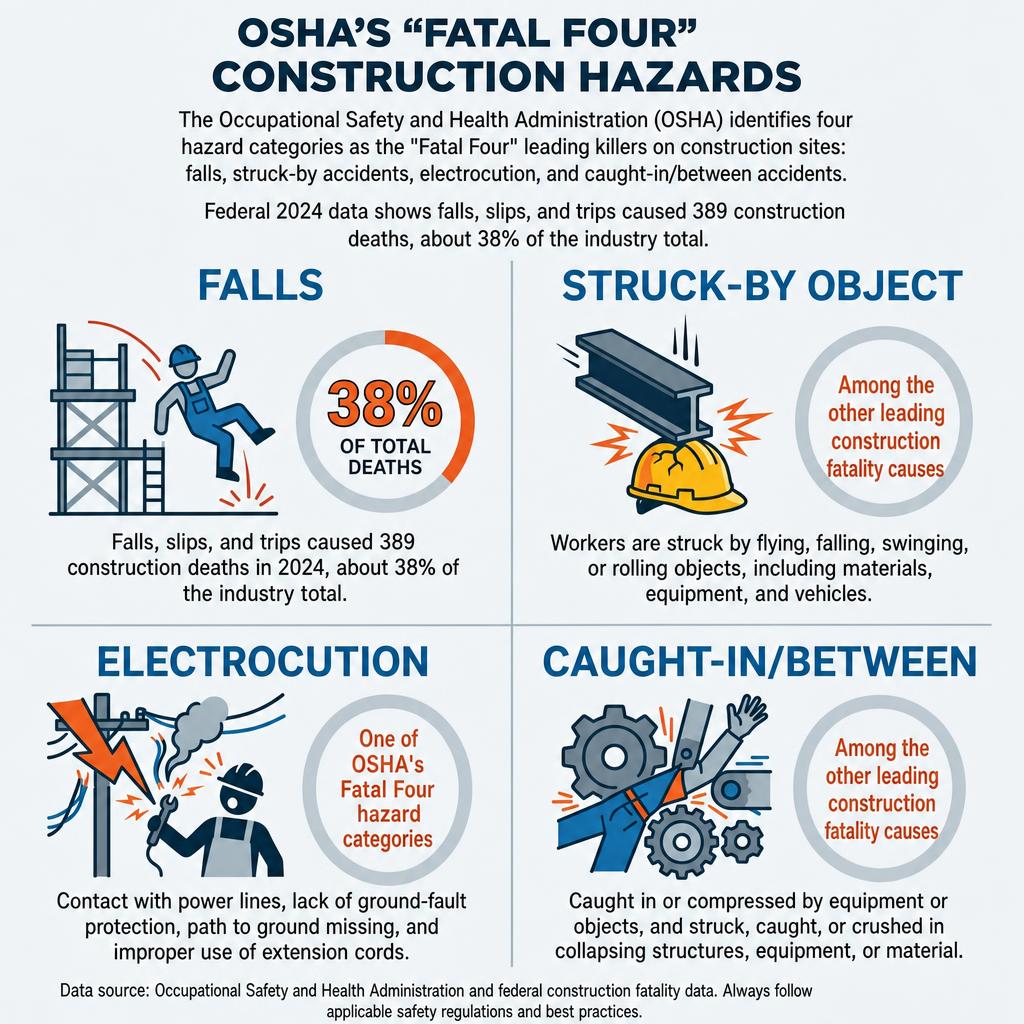
Falls, slips, and trips remain the leading cause of construction deaths: 389 in 2024, about 38% of the industry total. Transportation incidents caused 244 deaths (about 24%), followed by exposure to harmful substances or environments (187) and being struck by objects or equipment (161).

Average Compensation

Multimillion-dollar recoveries are common in serious injury cases. Our firm has recovered over $500 million for injured workers since 1986, including settlements ranging from $2.25 million to $5.5 million for construction accident victims.

THE TIME TO SUE CAN VARY FROM CASE TO CASE – ALWAYS CONSULT AN EXPERIENCED ATTORNEY TO DETERMINE THE TIME FRAME THAT APPLIES TO YOUR CASE AS SOON AS POSSIBLE AFTER THE ACCIDENT

Any statute of limitation or condition precedent such as a notice of claim cited herein may not apply to your particular case. The time to bring a lawsuit and the conditions upon which it may be brought depend upon many factors including the age and mental capacity of the injured person, whether the party to be sued is a private person, partnership, corporation, government entity or other legal entity, the substance and type of claim that is being made, the place of the accident and other possible factors that may apply at the time of the accident or injury. You are advised to call to confirm the time limits and conditions that apply to your case as soon as possible.

What To Do Right After a Construction Accident in NYC

If you were injured on a construction site, take these steps immediately to protect your health and legal rights:

Legal Term

Definition & NYC Application

Seek Medical Attention Immediately:

Call 911 or have someone transport you to the nearest emergency room. Common NYC trauma centers include Bellevue Hospital, NewYork-Presbyterian, and Elmhurst Hospital. Do not refuse medical treatment at the scene, even if you feel your injuries are minor.

Report the Accident to Your Supervisor:

Notify your foreman, site manager, or employer immediately. New York workers’ compensation law requires prompt reporting. Ask for a written incident report and keep a copy.

Document the Scene:

If physically able, take photos or videos of the accident location, equipment involved, safety hazards, and your injuries. Photograph warning signs (or their absence), broken equipment, and hazardous conditions.

Preserve Evidence:

Keep all safety equipment you were wearing (hard hat, harness, gloves, boots). Do not allow your employer to “repair” or remove defective equipment or dangerous conditions before they are documented.

File a Workers’ Compensation Claim:

You must file a workers’ compensation claim (Form C-3) within 2 years of the accident. Your employer’s workers’ comp carrier should provide this form. Workers’ comp provides medical benefits and partial wage replacement regardless of fault.

Do Not Sign Any Settlement or Release:

Insurance adjusters may contact you quickly offering a “quick settlement.” Do not sign anything or give recorded statements without consulting an attorney. These early offers are almost always far below the true value of your claim.

Contact a Construction Accident Attorney:

Consult with an experienced New York construction accident lawyer before giving any recorded statements to insurance companies. An attorney can investigate third-party liability (general contractors, site owners, equipment manufacturers) and pursue compensation beyond workers’ compensation benefits.

Construction Injury Banner Bg

Questions About Your Construction Accident? We're Here to Help.

Call (212) 732-2929 or contact us online for a free, confidential consultation. No fees unless we recover compensation for you.

Key Legal Terms in NYC Construction Accident Cases

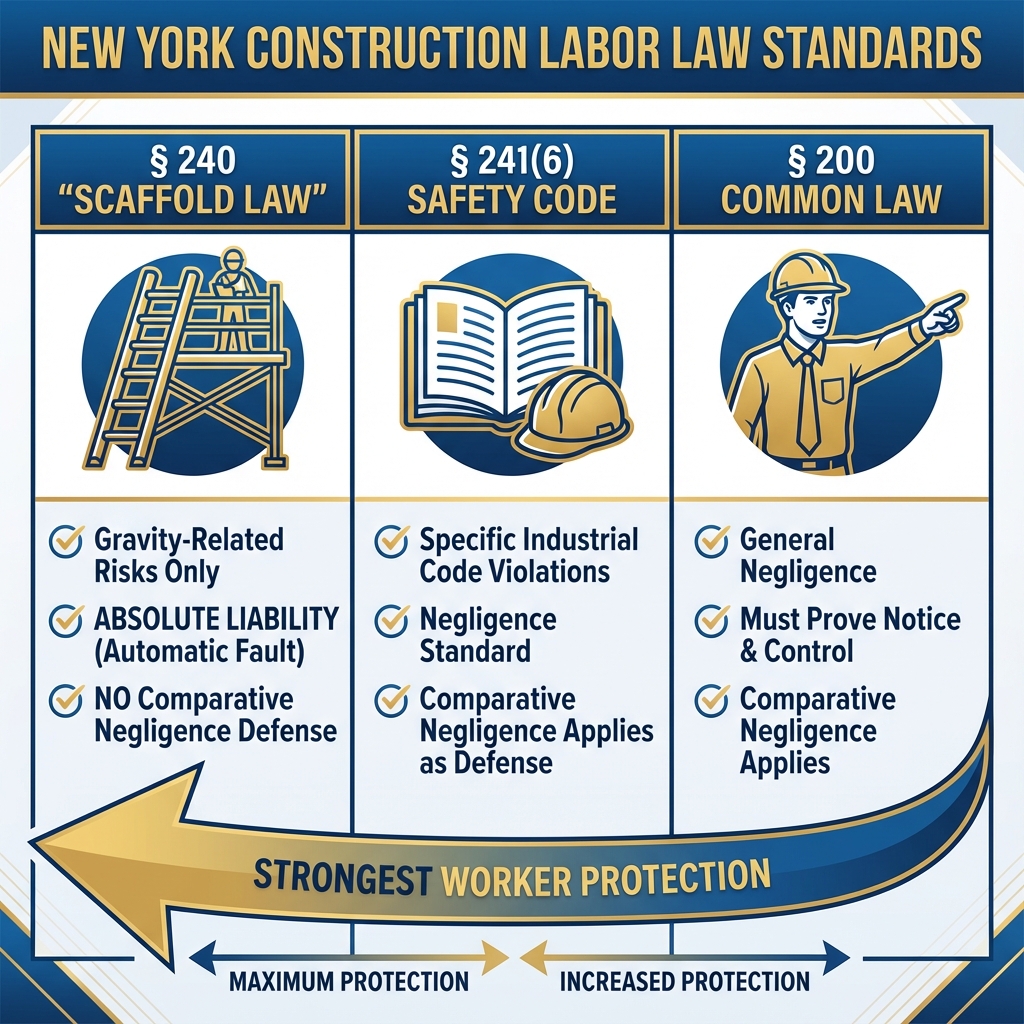
Quick Summary: Labor Law § 240 can impose strict liability in qualifying gravity-related cases. Labor Law § 241(6) can apply where a sufficiently specific Industrial Code rule was violated. Labor Law § 200 applies common-law negligence standards. Understanding these distinctions determines your legal strategy.
Understanding New York Construction Accident Law

Legal Term

Definition

Labor Law § 240 (Scaffold Law)

Imposes strict liability on contractors and property owners for gravity-related injuries (falls from heights, falling objects). Applies to construction, demolition, repair, alteration, and painting work. Injured workers do not need to prove negligence, and comparative negligence is NOT a defense. See Labor Law § 240.

Labor Law § 241(6)

Requires contractors and owners to provide reasonable and adequate protection and safety for workers. Violations of “sufficiently specific” provisions of the Industrial Code (12 NYCRR Part 23) create liability. Unlike § 240, comparative negligence IS a defense under § 241(6). See Labor Law § 241.

Labor Law § 200

Imposes common-law negligence duty on contractors and owners to provide a safe workplace. Requires proof that the defendant had notice of the dangerous condition and authority to control the work. Comparative negligence applies.

Industrial Code Part 23

Detailed safety regulations (12 NYCRR Part 23) covering excavation, scaffolding, fall protection, demolition, and other construction activities. Violations of “sufficiently specific” provisions support Labor Law § 241(6) claims.

Strict Liability

The injured worker’s partial fault does not reduce the defendant’s liability. The only complete defense is that the worker’s own conduct was the sole cause of the accident, for example where adequate safety devices were provided and required, the worker knew they were available, and unreasonably chose not to use them.

Third-Party Liability

While you cannot sue your direct employer for negligence (workers’ compensation is your exclusive remedy), you CAN sue general contractors, site owners, subcontractors, equipment manufacturers, and other third parties whose negligence contributed to your injuries.

Comparative Negligence

Under CPLR § 1411, if you are found partially at fault for your injuries (in Labor Law § 241(6) or § 200 claims), your recovery is reduced by your percentage of fault. However, you can still recover damages even if you are 99% at fault. This does NOT apply to Labor Law § 240 claims.

Statute of Limitations

Under CPLR § 214, you have 3 years from the date of injury to file a personal injury lawsuit. For government entities (NYC, State of NY, MTA, etc.), you must file a Notice of Claim within 90 days (GML § 50-e) and a lawsuit within 1 year + 90 days (GML § 50-i). Missing these deadlines usually bars your claim permanently.

THE TIME TO SUE CAN VARY FROM CASE TO CASE – ALWAYS CONSULT AN EXPERIENCED ATTORNEY TO DETERMINE THE TIME FRAME THAT APPLIES TO YOUR CASE AS SOON AS POSSIBLE AFTER THE ACCIDENT

Any statute of limitation or condition precedent such as a notice of claim cited herein may not apply to your particular case. The time to bring a lawsuit and the conditions upon which it may be brought depend upon many factors including the age and mental capacity of the injured person, whether the party to be sued is a private person, partnership, corporation, government entity or other legal entity, the substance and type of claim that is being made, the place of the accident and other possible factors that may apply at the time of the accident or injury. You are advised to call to confirm the time limits and conditions that apply to your case as soon as possible.

Construction Accidents in New York: By the Numbers

Construction work is one of the most hazardous occupations in the United States. According to the U.S. Bureau of Labor Statistics Census of Fatal Occupational Injuries, in 2024:

  • 5,070 workers died in workplace accidents across all industries nationwide, a rate of 3.3 deaths per 100,000 full-time equivalent (FTE) workers.
  • 1,034 construction workers died on the job—roughly one in five U.S. workplace deaths, and the second-highest death toll of any individual private industry.
  • The construction industry fatality rate was 9.2 deaths per 100,000 FTE workers—nearly three times the all-industry average.
  • 389 construction workers died from falls, slips, and trips in 2024—about 38% of all construction deaths and the leading cause of death on job sites.

The Occupational Safety and Health Administration (OSHA) has long identified four hazard categories—falls, struck-by accidents, electrocution, and caught-in/between accidents—as the “Fatal Four” leading killers on construction sites. The most recent federal data confirms the pattern: falls, slips, and trips alone caused 389 construction deaths in 2024, about 38% of the industry total, with struck-by and caught-in/between events among the other leading causes.

How NYC Courts Handle Construction Accident Cases

Construction accident cases in New York City are litigated in New York State Supreme Court, the trial-level court of general jurisdiction. Depending on where the accident occurred, your case will be heard in:

  • New York County Supreme Court (Manhattan): 60 Centre Street
  • Kings County Supreme Court (Brooklyn): 360 Adams Street
  • Queens County Supreme Court: 88-11 Sutphin Boulevard, Jamaica
  • Bronx County Supreme Court: 851 Grand Concourse
  • Richmond County Supreme Court (Staten Island): 18 Richmond Terrace

Labor Law § 240 vs. § 241(6) vs. § 200: Critical Distinctions

New York judges and juries apply different legal standards depending on which Labor Law section applies to your case:

Labor Law § 240 (Scaffold Law):

  • Strict liability standard: You do not need to prove negligence. If you were injured by a gravity-related hazard (falling from a height or being struck by a falling object), and the site owner or general contractor failed to provide adequate safety devices, they are liable regardless of their level of care.
  • No comparative negligence defense: Partial fault does not reduce your recovery under § 240. Defendants can escape liability only by proving your conduct was the sole cause of the accident, meaning adequate safety devices were provided and required, you knew they were available, and you unreasonably chose not to use them. Courts apply this exception narrowly.
  • Applies to: Falls from heights, falling objects, inadequate scaffolds, defective ladders, lack of safety harnesses, collapsing structures.

Labor Law § 241(6):

  • Negligence standard: You must prove the defendant violated a “sufficiently specific” provision of the Industrial Code (12 NYCRR Part 23). Not all Industrial Code violations are “sufficiently specific”—courts have developed extensive case law on which provisions qualify.
  • Comparative negligence applies: If the jury finds you were partially at fault, your recovery will be reduced by your percentage of fault under CPLR § 1411.
  • Applies to: Wide range of safety code violations including excavation, trenching, demolition, equipment operation, and workplace conditions.

Labor Law § 200 (Common Law Negligence):

  • Common-law negligence standard: You must prove the defendant had notice of the dangerous condition and authority to control or supervise the work that caused your injuries.
  • Comparative negligence applies: Your recovery can be reduced based on your own percentage of fault.
  • Applies to: Premises defects, unsafe work methods, inadequate supervision, equipment defects not covered by Labor Law §§ 240 or 241(6).

Attorney Insight: Many construction accident cases involve claims under multiple Labor Law sections. For example, a worker who falls from a defective scaffold may have a strict liability claim under Labor Law § 240 (gravity-related hazard) as well as claims under § 241(6) (Industrial Code violations regarding scaffold construction) and § 200 (inadequate supervision or premises defects). Our strategy is to pursue all applicable legal theories to maximize your recovery and account for any potential defenses.

Pattern Jury Instructions and Trial Strategy

New York courts use standardized Pattern Jury Instructions (PJI) for construction accident cases. These instructions guide juries on how to apply Labor Law §§ 240, 241(6), and 200. Understanding these instructions is critical to trial strategy.

For Labor Law § 240 cases, PJI 2:190 instructs juries that the plaintiff must prove:

  1. The plaintiff was employed to perform construction, demolition, repair, alteration, or painting work;
  2. The work site was not “safe” for the plaintiff;
  3. The plaintiff was injured as a direct result of the failure to provide proper safety devices; and
  4. The defendant was an owner, contractor, or agent responsible for the work.

Critically, PJI 2:190 also instructs juries that comparative negligence is NOT a defense—the plaintiff’s own conduct in failing to use safety equipment does not reduce the defendant’s liability.

What Happens Next: The Timeline of a NYC Construction Accident Case

Quick Summary: Construction accident cases typically progress from initial consultation through investigation, filing, discovery, settlement negotiations, and (if necessary) trial over 12-36 months, depending on case complexity and defendant cooperation.

Stage

Timeline

What Happens

1. Free Consultation

Day 1

We meet with you to discuss your injuries, the accident circumstances, and potential legal claims. We review medical records, employment documents, and accident reports. If we believe you have a viable case, we offer representation on a contingency fee basis (no upfront costs).

2. Investigation

Weeks 1-8

We immediately send preservation letters to all potentially liable parties (general contractor, site owner, equipment manufacturers, staffing agencies) demanding they preserve evidence including: site inspection reports, safety meeting logs, equipment maintenance records, surveillance footage, and incident reports. We conduct site visits, photograph conditions, interview witnesses, and consult with experts.

3. Filing the Lawsuit

Weeks 8-16

We file a Summons and Complaint in New York State Supreme Court naming all responsible parties. For government entities (NYC, State of NY, MTA), we file a Notice of Claim within 90 days and a lawsuit within 1 year + 90 days. We simultaneously pursue your workers’ compensation claim.

4. Discovery

Months 4-12

Both sides exchange evidence through depositions (sworn testimony), interrogatories (written questions), and document requests. We depose site managers, safety coordinators, and corporate representatives. Defendants will depose you and any witnesses. We compile expert reports from engineers, safety specialists, and economists.

5. Settlement Negotiations

Months 8-18

We engage in settlement discussions with defendants and their insurers. Many construction accident cases settle during this phase, particularly after key depositions reveal liability. We negotiate to maximize your recovery, accounting for medical expenses, lost wages, future care needs, and pain and suffering.

6. Pre-Trial Proceedings

Months 12-24

If settlement negotiations fail, we file motions for summary judgment (arguing the law is clearly on your side), participate in court-ordered mediation, and prepare for trial. We finalize expert witnesses, prepare trial exhibits, and develop our courtroom strategy.

7. Trial

Months 18-36

If your case proceeds to trial, we present evidence to a jury in New York State Supreme Court. Construction accident trials typically last 5-15 days depending on complexity. The jury determines liability and damages. Labor Law § 240 cases have high success rates at trial due to the strict liability standard.

8. Post-Trial / Appeal

Months 24-48

If we win at trial, defendants may appeal to the Appellate Division. If defendants win, we may appeal. Appeals typically take 12-24 months. Many cases settle during the appeal process. Once all appeals are exhausted, you receive your compensation (minus legal fees and case expenses).

Attorney Insight: Immediately after being retained, we send litigation hold letters to all potential defendants, demanding preservation of critical evidence: ECM data from equipment, GPS tracking logs, Electronic Logging Device (ELD) records, safety inspection reports, OSHA 300 logs, incident reports, site photos, and surveillance footage. Construction companies often claim evidence was “overwritten,” “lost,” or “destroyed in the ordinary course of business.” Our immediate preservation demands create a paper trail and establish potential spoliation claims if evidence disappears.

Types of Construction Accidents in NYC

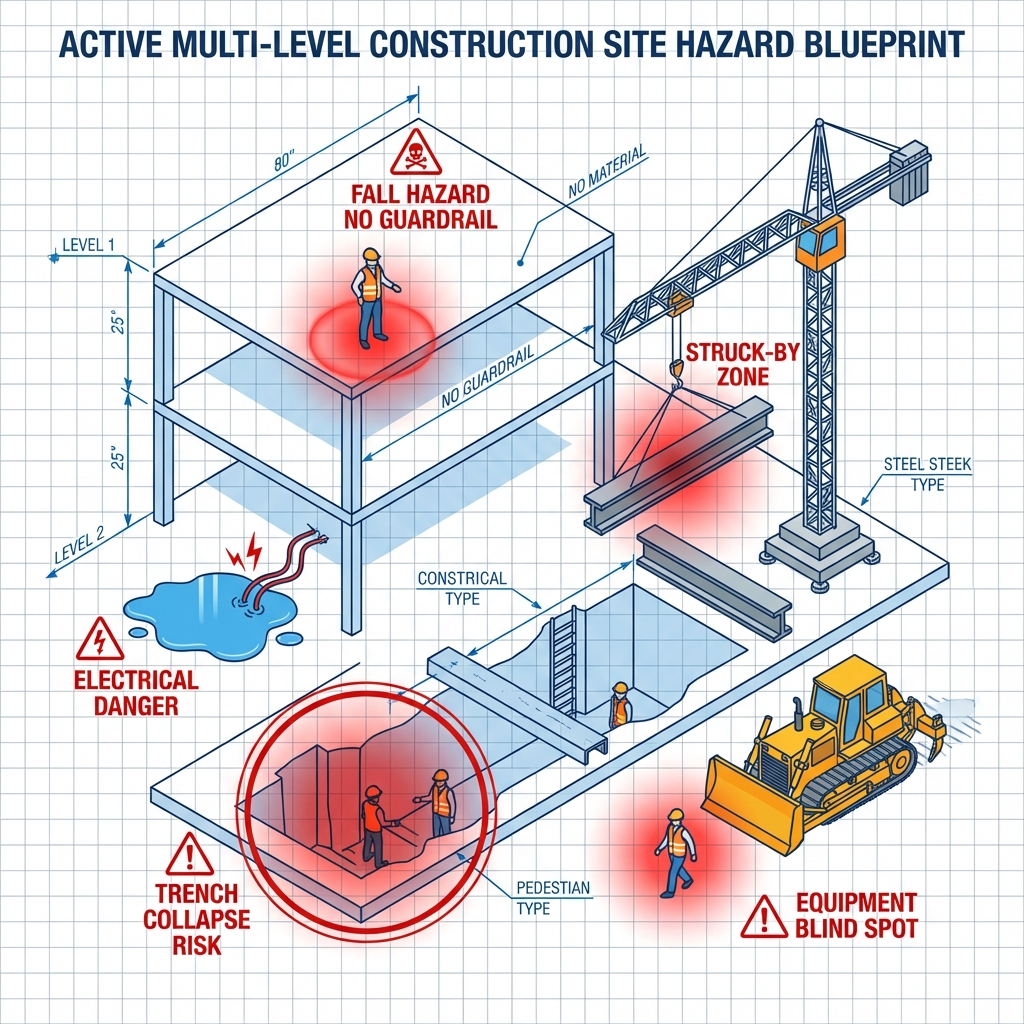
Construction sites present numerous hazards. Common accident types include:

Fall-Related Accidents

  • Falls from scaffolds: Collapsing scaffolds, missing guardrails, inadequate planking, defective scaffold construction
  • Falls from ladders: Defective ladders, improperly secured ladders, inadequate ladder height, lack of stabilization
  • Falls from roofs: Lack of safety harnesses, missing guardrails, inadequate fall protection systems, improper roof access
  • Falls through openings: Unguarded floor openings, elevator shafts, skylights, stairwells, missing protective covers
  • Falls into excavations: Unguarded excavation sites, collapsing trenches, inadequate shoring systems

Struck-By Accidents

  • Falling objects: Tools, materials, or equipment falling from heights due to inadequate toe boards, debris nets, or tool lanyards
  • Crane accidents: Crane collapses, dropped loads, load swing accidents, inadequate rigging
  • Vehicle accidents: Struck by trucks, forklifts, bulldozers, excavators, or other heavy equipment on site
  • Demolition debris: Collapsing walls, falling concrete, structural failures during demolition

Caught-In/Between Accidents

  • Trench collapses: Cave-ins during excavation, inadequate shoring or benching, water infiltration
  • Equipment entanglement: Clothing or body parts caught in machinery, augers, conveyors, mixers
  • Crush injuries: Pinned between equipment and walls, caught between moving and stationary objects
  • Structural collapses: Building collapses during construction, demolition, or renovation

Electrocution

  • Power line contact: Cranes, scaffolds, or equipment contacting overhead power lines
  • Defective electrical systems: Exposed wiring, inadequate grounding, faulty temporary power systems
  • Defective tools: Electrocution from power tools with damaged insulation or missing ground fault circuit interrupters (GFCIs)
  • Water contact: Working with electricity near water, wet conditions, inadequate protection

Explosion, Fire, and Chemical Exposure

  • Gas explosions: Natural gas leaks, propane tank explosions, inadequate ventilation
  • Chemical burns: Contact with acids, solvents, concrete, or other hazardous materials
  • Fires: Welding accidents, electrical fires, flammable material ignition
  • Toxic exposure: Asbestos, silica dust, lead paint, chemical fumes, carbon monoxide

Additional Construction Hazards

  • Repetitive stress injuries: Back injuries from lifting, carpal tunnel syndrome, joint damage
  • Heat-related illness: Heat exhaustion, heat stroke from working in summer conditions without adequate breaks or hydration
  • Slip and fall accidents: Wet surfaces, ice, uneven surfaces, construction debris, inadequate lighting
  • Confined space accidents: Suffocation, toxic gas exposure, engulfment in silos or tanks

Common Injuries in NYC Construction Accidents

Construction accidents often result in catastrophic, life-altering injuries requiring extensive medical treatment, rehabilitation, and long-term care. Common injuries include:

Traumatic Brain Injuries (TBI)

Falls from heights or being struck by falling objects can cause concussions, skull fractures, brain contusions, diffuse axonal injury, and permanent cognitive impairment. TBI victims may experience memory loss, personality changes, seizures, and difficulty with basic tasks. Long-term care costs can exceed millions of dollars. Learn more about traumatic brain injury compensation in New York.

Spinal Cord Injuries

Falls, crush injuries, and vehicle accidents can cause complete or incomplete spinal cord injuries resulting in paraplegia (paralysis of the lower body) or quadriplegia (paralysis of all four limbs). Spinal cord injury victims require lifetime care including adaptive equipment, home modifications, attendant care, and ongoing medical treatment. See our page on spinal cord injury cases in New York.

Fractures and Broken Bones

Construction workers commonly suffer fractures of the spine, pelvis, legs, arms, ribs, skull, and facial bones. Complex fractures may require multiple surgeries, hardware implantation, bone grafting, and extended physical therapy. Some fractures result in permanent limitations, chronic pain, and inability to return to construction work. For more information, visit our bone fracture injury page.

Internal Organ Damage

Crush injuries, falls, and struck-by accidents can cause internal bleeding, ruptured organs, lacerations to the liver, spleen, kidneys, or lungs, and abdominal trauma requiring emergency surgery.

Amputations

Caught-in machinery, electrocution, and crush injuries can result in traumatic amputations or injuries so severe that surgical amputation is required. Amputees face lifetime challenges including prosthetic costs, phantom limb pain, psychological trauma, and vocational retraining.

Burn Injuries

Electrical burns, chemical burns, and fire-related injuries can cause second-degree, third-degree, or fourth-degree burns requiring skin grafting, reconstructive surgery, and long-term rehabilitation. Severe burns often result in permanent scarring and disfigurement.

Electrocution Injuries

Contact with power lines or defective electrical systems can cause cardiac arrest, neurological damage, severe burns, and internal organ damage. Electrocution victims may experience long-term cardiac issues, nerve damage, and cognitive impairment.

Respiratory Conditions

Toxic exposure to asbestos, silica dust, concrete dust, chemical fumes, and other airborne hazards can cause chronic respiratory diseases including asbestosis, silicosis, chronic obstructive pulmonary disease (COPD), and occupational asthma. These conditions may not manifest for years or decades after exposure. See our toxic exposure page for more information.

Who Can Be Held Liable for Your Construction Accident?

New York Labor Law allows injured construction workers to sue multiple parties whose negligence contributed to the accident. While you cannot sue your direct employer (workers’ compensation is your exclusive remedy against employers), you can pursue claims against:

General Contractors

Under Labor Law § 240, general contractors may be strictly liable for gravity-related injuries. Under Labor Law § 241(6), liability may arise from violations of sufficiently specific Industrial Code provisions, regardless of whether they directly supervised your work. General contractors have a non-delegable duty to provide a safe work site.

Property Owners

Site owners may be liable under Labor Law § 240 and may also be liable under Labor Law § 241(6) where a sufficiently specific Industrial Code provision was violated, even if they hired a general contractor to manage the project. Owners cannot avoid these statutory duties by delegating site safety responsibilities to contractors.

Subcontractors

If your employer was a subcontractor and another subcontractor’s negligence caused your injuries, you can sue that subcontractor. Common scenarios include defective scaffolding erected by one subcontractor that injures workers employed by a different subcontractor.

Architects and Engineers

Design professionals who specify unsafe construction methods, fail to account for known hazards in their designs, or negligently supervise construction can be held liable for resulting injuries.

Equipment Manufacturers

Defective ladders, scaffolds, safety harnesses, power tools, and other equipment may support product liability claims against manufacturers, distributors, and retailers. Product defects include design defects, manufacturing defects, and failure to warn. Learn more about product liability in construction accidents.

Crane and Equipment Rental Companies

Companies that rent cranes, lifts, scaffolding, and other equipment have a duty to provide safe, well-maintained equipment with proper safety instructions. Defective rental equipment can create liability for rental companies even if they did not operate the equipment.

Staffing Agencies

If you were placed at the construction site through a staffing agency or labor broker, that agency may share liability for failing to verify site safety, provide adequate training, or ensure proper supervision.

Government Entities

If the project involved government-owned property (city, state, or federal), the government entity may be liable. However, claims against government entities have shorter deadlines: Notice of Claim within 90 days (GML § 50-e) and lawsuit within 1 year + 90 days (GML § 50-i).

Attorney Insight: We pursue multiple defendants to maximize recovery. In a typical construction accident case, we may sue the general contractor, site owner, equipment manufacturer, and multiple subcontractors. Each defendant has separate insurance coverage, and pursuing all responsible parties increases the total compensation available. Our investigation includes corporate structure analysis—many construction companies use complex corporate arrangements to shield assets. We identify parent companies, holding companies, and alter ego entities to ensure defendants cannot hide behind corporate veils.

Proven Results: Construction Accident Case Examples

Our attorneys have recovered over $500 million for injured workers since 1986. Below are examples of construction accident cases successfully resolved by our firm:

$5.5 Million – Four-Story Fall (Manhattan)

A construction worker suffered fractures of his shoulder, clavicle, ribs, and hip, as well as internal injuries requiring multiple surgeries, after falling four stories at a Manhattan construction site. The case settled during litigation after we demonstrated the general contractor failed to provide adequate fall protection in violation of Labor Law § 240. The defendant initially claimed our client was provided safety equipment but failed to use it—however, our investigation revealed the site had no fall protection system in place and no safety training had been provided.

$3.5 Million – Scaffold Collapse (Brooklyn)

An undocumented construction worker fell 30 feet when a scaffold collapsed at a Brooklyn worksite, landing on cement and sustaining fractures, internal injuries, and permanent disabilities. Under New York law, undocumented workers have the same legal rights as U.S. citizens to sue for construction injuries. We pursued claims under Labor Law § 240 (strict liability for scaffold failures) and Labor Law § 241(6) (Industrial Code violations). The case settled after we obtained expert testimony that the scaffold was improperly constructed and failed to meet basic engineering standards.

$3.25 Million – Ladder Fall (Queens)

A 30-year-old carpenter fell from a ladder onto both feet at a retail construction site in Queens, suffering fractures, chronic pain, and permanent limitations that prevented him from returning to construction work. The ladder was not properly secured, and no spotter was present to stabilize it. We pursued claims under Labor Law § 240 (inadequate safety devices), Labor Law § 241(6) (Industrial Code violations regarding ladder use), and product liability (defective ladder design). The case resolved favorably during settlement negotiations.

$2.25 Million – Unsecured Ladder (Manhattan)

A 46-year-old carpenter was working on a straight ladder that slipped away from the wall, causing him to fall and sustain serious injuries. We established the general contractor’s liability under Labor Law § 240 for failing to provide a properly secured ladder or alternative fall protection. The case demonstrates the strict liability standard under the Scaffold Law—even if a worker is experienced and knew the ladder was not ideally positioned, the law places absolute responsibility on contractors and owners to provide safe working conditions.

Case results depend on individual facts and circumstances. Prior results do not guarantee similar outcomes. These case descriptions are provided for informational purposes and do not constitute legal advice.

What Our Clients Say

Compensation Available in NYC Construction Accident Cases

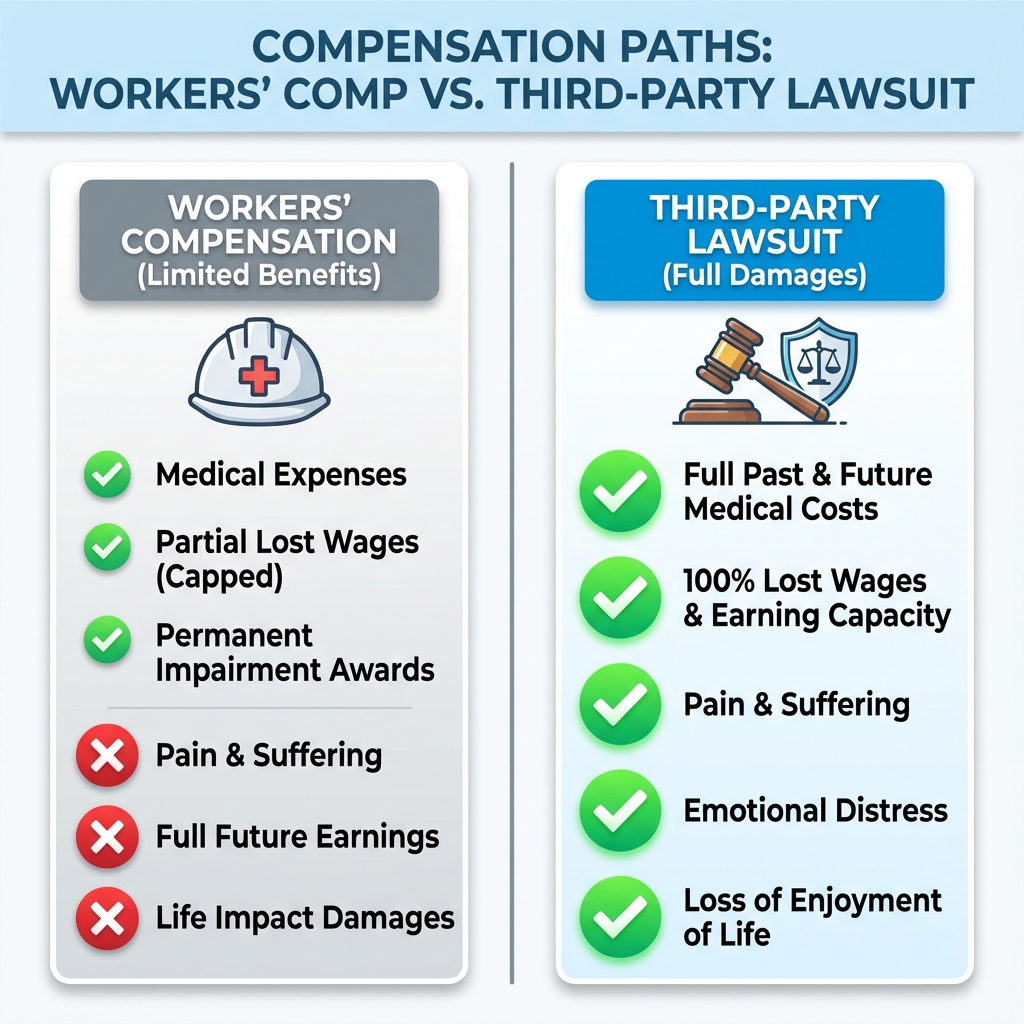
Construction accident victims in New York may recover compensation through two separate systems:

Workers’ Compensation Benefits

All construction workers in New York are covered by workers’ compensation insurance, regardless of immigration status. Workers’ comp provides:

Medical benefits:

100% of reasonable and necessary medical treatment, including emergency care, surgery, hospitalization, physical therapy, prescription medications, and durable medical equipment

Wage replacement:

Two-thirds of your average weekly wage, capped by a state maximum tied to your injury date. The cap is $1,222.42 per week for injuries from July 1, 2025 through June 30, 2026, and was $1,171.46 per week for injuries from July 1, 2024 through June 30, 2025. The maximum resets every July 1.

Permanent disability benefits:

Lump sum or ongoing payments for permanent partial or total disability based on schedule of loss

Vocational rehabilitation:

If you cannot return to construction work, workers’ comp may provide vocational retraining

Important: Workers’ compensation benefits are your exclusive remedy against your direct employer. You cannot sue your employer for additional damages (except in extremely rare cases of intentional harm). However, you can pursue a third-party lawsuit against contractors, site owners, and equipment manufacturers while simultaneously receiving workers’ compensation benefits.

Third-Party Lawsuit Damages

If you sue general contractors, site owners, or other third parties under Labor Law §§ 240, 241, or 200, you may recover:

Economic Damages

  • Past medical expenses: All medical bills related to your injuries, including emergency care, hospitalization, surgery, physical therapy, prescription medications, medical equipment, and home health care
  • Future medical expenses: Estimated lifetime cost of future medical treatment, surgeries, rehabilitation, assistive devices, home modifications, and attendant care
  • Lost wages: Compensation for all income lost from the date of injury through trial or settlement
  • Loss of earning capacity: If you cannot return to construction work or must accept lower-paying work due to permanent disabilities, you can recover the present value of your lost future earnings over your work-life expectancy
  • Loss of benefits: Lost pension contributions, 401(k) matching, health insurance, union benefits, and other employment benefits

Non-Economic Damages

  • Pain and suffering: Compensation for physical pain, discomfort, and suffering caused by your injuries
  • Mental anguish: Emotional distress, anxiety, depression, PTSD, and psychological trauma
  • Loss of enjoyment of life: Inability to participate in hobbies, sports, activities, and daily pleasures you enjoyed before the accident
  • Disfigurement and scarring: Permanent visible scars, burn injuries, amputations, or disfigurement
  • Loss of consortium: Compensation to your spouse for loss of companionship, affection, and sexual relations (this is a separate claim brought by the spouse)

Punitive Damages (Rare)

In limited, egregious circumstances where the defendant’s conduct was intentional, reckless, or demonstrated a wanton disregard for worker safety, New York courts may award punitive damages to punish the defendant and deter future misconduct. Punitive damages are rare in construction accident cases and require clear and convincing evidence of willful or wanton conduct.

Wrongful Death Claims

If a construction worker is killed on the job, the decedent’s estate (through a personal representative) may file a wrongful death lawsuit under EPTL § 5-4.1. Under New York law, wrongful death damages are limited to pecuniary (economic) losses suffered by the decedent’s distributees (spouse, children, parents), including:

  • Loss of financial support: Present value of income the deceased would have contributed to the household over his or her life expectancy
  • Loss of services: Value of household services, childcare, home maintenance, and other contributions the deceased provided
  • Loss of parental guidance: For surviving children, the value of nurture, guidance, and support the deceased parent would have provided
  • Funeral and burial expenses: Reasonable costs of funeral and burial services
  • Medical expenses: Medical bills incurred between the accident and death

Note on New York Wrongful Death Law: Unlike personal injury claims, wrongful death damages in New York do not include compensation for the decedent’s pain and suffering (unless a separate survival action is filed) or for the family’s emotional grief. Recovery is limited to financial losses. However, construction worker wrongful death cases often involve substantial economic damages given that many victims are young workers with decades of remaining work-life expectancy. For more information, see our wrongful death page.

Deadline for wrongful death claims: a wrongful death lawsuit must generally be started within two years of the date of death. This is shorter than the three-year window for personal injury claims, and claims involving government entities carry even shorter notice requirements. Families should consult an attorney as soon as possible after a fatal construction accident.

Ready to Discuss Your Construction Accident Case?

Contact Dansker & Aspromonte Associates LLP today for a free, confidential consultation. Call (212) 732-2929 or fill out our online form. We work on contingency—no fees unless we recover compensation for you.

Why Hire Dansker & Aspromonte for Your NYC Construction Accident Case?

Decades of Experience with New York Labor Law

Since 1986, our attorneys have represented hundreds of injured construction workers in cases involving Labor Law §§ 240, 241, and 200. We understand the nuances of strict liability standards, Industrial Code violations, and comparative negligence defenses. Our track record includes over $500 million recovered for injured workers, with numerous multimillion-dollar settlements and verdicts.

Proven Trial Skills

While many construction accident cases settle before trial, defendants and their insurers know we are prepared to take cases to verdict if necessary. Our trial experience includes successful verdicts in New York State Supreme Court across all five boroughs. Insurance companies take our cases seriously because they know we have the resources and skill to win at trial.

Thorough Investigation and Evidence Preservation

We immediately send preservation letters to all potential defendants, demanding they preserve critical evidence including site inspection reports, safety training logs, equipment maintenance records, surveillance footage, and incident reports. Our investigators visit accident sites, photograph conditions, interview witnesses, and work with forensic experts to reconstruct how the accident occurred.

Network of Expert Witnesses

Construction accident cases require expert testimony from safety engineers, structural engineers, equipment specialists, vocational experts, economists, and life care planners. We maintain relationships with leading experts who can explain complex technical issues to juries and quantify your damages with precision.

No Upfront Fees—Contingency Representation

We represent construction accident victims on a contingency fee basis. You pay no attorney fees unless we recover compensation for you. We advance all case expenses including expert fees, deposition costs, court filing fees, and investigation expenses. If we don’t win your case, you owe us nothing.

We Understand Multiple Recovery Sources

Our attorneys coordinate workers’ compensation benefits, third-party lawsuits, union benefits, Social Security Disability Insurance (SSDI), and other potential recovery sources to maximize your total compensation. We ensure you receive all benefits to which you are entitled without jeopardizing any claim.

Frequently Asked Questions About NYC Construction Accidents

1. Can I sue my employer for a construction site injury?
In almost all cases, no. New York workers’ compensation law provides your exclusive remedy against your direct employer. However, you can sue third parties such as general contractors, site owners, equipment manufacturers, and other subcontractors whose negligence caused your injuries. Workers’ compensation provides limited benefits (medical expenses and partial wage replacement), while third-party lawsuits can recover full damages including pain and suffering, loss of enjoyment of life, and complete wage loss.

Your ability to recover depends on which Labor Law section applies:

  • Labor Law § 240: Comparative negligence is NOT a defense, so partial fault does not reduce your recovery. The exception is narrow: if adequate safety devices were provided and required, you knew they were available, and you unreasonably chose not to use them, a court can find your conduct was the sole cause of the accident and deny recovery. An experienced attorney evaluates this issue early in every § 240 case.
  • Labor Law § 241(6) or § 200: Comparative negligence applies under CPLR § 1411. If the jury finds you were partially at fault, your recovery is reduced by your percentage of fault. However, you can still recover damages even if you are found 99% at fault—New York follows pure comparative negligence.

Under CPLR § 214, you have 3 years from the date of injury to file a personal injury lawsuit. For government entities (City of New York, State of New York, MTA, public authorities), you must file a Notice of Claim within 90 days (GML § 50-e) and a lawsuit within 1 year + 90 days from the date of injury (GML § 50-i). Missing these deadlines usually bars your claim permanently. It is critical to consult an attorney as soon as possible after your accident.

THE TIME TO SUE CAN VARY FROM CASE TO CASE – ALWAYS CONSULT AN EXPERIENCED ATTORNEY TO DETERMINE THE TIME FRAME THAT APPLIES TO YOUR CASE AS SOON AS POSSIBLE AFTER THE ACCIDENT

Any statute of limitation or condition precedent such as a notice of claim cited herein may not apply to your particular case. The time to bring a lawsuit and the conditions upon which it may be brought depend upon many factors including the age and mental capacity of the injured person, whether the party to be sued is a private person, partnership, corporation, government entity or other legal entity, the substance and type of claim that is being made, the place of the accident and other possible factors that may apply at the time of the accident or injury. You are advised to call to confirm the time limits and conditions that apply to your case as soon as possible.

Labor Law § 240, commonly known as the “Scaffold Law,” is a New York statute that imposes strict liability on contractors and property owners for gravity-related injuries to construction workers. The law applies to falls from heights (scaffolds, ladders, roofs) and injuries from falling objects. Under § 240, injured workers do not need to prove negligence—they need only prove that adequate safety devices were not provided and that the lack of safety devices caused the injury. Critically, comparative negligence is not a defense under § 240: a worker’s partial fault does not reduce the defendant’s liability. The only complete defense courts recognize is that the worker’s own conduct was the sole cause of the accident, such as refusing to use adequate safety devices that were provided, known, and required. This standard makes New York one of the most worker-protective states in the nation.

Yes. Undocumented workers have the same legal rights as U.S. citizens to file construction accident lawsuits under New York Labor Law §§ 240, 241, and 200. Immigration status is irrelevant to your right to compensation. You are also entitled to workers’ compensation benefits regardless of immigration status. Defendants and their attorneys are prohibited from disclosing your immigration status to ICE or other government authorities during litigation. Many of our clients are undocumented workers, and we have successfully recovered multimillion-dollar settlements for them.

No. Under New York law, contractors and property owners cannot avoid liability by requiring workers to sign liability waivers, indemnification agreements, or releases. These waivers are generally unenforceable as against public policy. The statutory protections of Labor Law §§ 240 and 241(6) cannot be signed away.

Case value depends on many factors including:

  • Severity and permanency of injuries
  • Total medical expenses (past and future)
  • Lost wages and loss of earning capacity
  • Pain and suffering
  • Your age and life expectancy
  • Whether you can return to any gainful employment
  • Strength of liability evidence
  • Defendants’ available insurance coverage

Minor injuries with full recovery may settle for $50,000–$250,000. Serious permanent injuries (spinal cord injuries, traumatic brain injuries, amputations, severe fractures) often result in multimillion-dollar recoveries. Catastrophic injuries requiring lifetime care can exceed $10 million. During your free consultation, we will review your medical records, employment history, and accident circumstances to provide a realistic assessment of your case value.

Most construction accident cases settle before trial, so the majority of clients never testify in court. However, you will be required to give a deposition (sworn testimony before a court reporter in an attorney’s office) during the discovery phase. If your case proceeds to trial, you will testify before a jury about the accident, your injuries, and how they have affected your life. Our attorneys prepare you thoroughly for both depositions and trial testimony. We conduct mock examinations to ensure you are comfortable and confident.

No. New York Workers’ Compensation Law § 120 makes it unlawful for an employer to fire, demote, or otherwise discriminate against an employee for claiming or attempting to claim workers’ compensation benefits, or for testifying in a workers’ compensation proceeding. Labor Law § 215 separately protects employees who complain about violations of the Labor Law. Retaliation includes termination, demotion, reduction in hours, harassment, or other adverse employment actions. If your employer retaliates against you for filing a construction accident lawsuit or workers’ comp claim, you may have a separate claim for retaliatory discharge and violation of public policy. Contact us immediately if you experience retaliation.

Construction companies often carry substantial liability insurance coverage. Even if the contractor declares bankruptcy, their insurance policies remain available to pay claims. In fact, insurance companies cannot discharge their obligations through bankruptcy. Additionally, we pursue claims against all potentially liable parties including general contractors, property owners, and equipment manufacturers. Multiple defendants mean multiple insurance policies, which increases the likelihood of full recovery even if one defendant is insolvent. Our attorneys have extensive experience navigating bankruptcy proceedings and protecting clients’ rights in complex insolvency situations.

Related Practice Areas

Dansker & Aspromonte Associates LLP handles a wide range of personal injury cases in New York City. If your construction accident resulted in specific injuries or involved other legal issues, you may find these practice area pages helpful:

Sources & Legal References

This page cites authoritative legal and statistical sources to ensure accuracy:

  1. U.S. Bureau of Labor Statistics, National Census of Fatal Occupational Injuries in 2024 (released February 19, 2026). Available at: https://www.bls.gov/iif/oshwc/cfoi/cfch0020.pdf
  2. Occupational Safety and Health Administration (OSHA), Construction Industry. Available at: https://www.osha.gov/construction
  3. New York Labor Law § 240 (Scaffold Law). Available at: https://codes.findlaw.com/ny/labor-law/lab-sect-240/
  4. New York Labor Law § 241 (Construction site safety regulations). Available at: https://codes.findlaw.com/ny/labor-law/lab-sect-241/
  5. New York CPLR § 214 (Three-year statute of limitations for personal injury). Available at: https://codes.findlaw.com/ny/civil-practice-law-and-rules/cvp-sect-214/
  6. New York General Municipal Law § 50-e (Notice of Claim requirement). Available at: https://codes.findlaw.com/ny/general-municipal-law/gmu-sect-50-e/
  7. New York General Municipal Law § 50-i (Lawsuit filing deadline for government entities). Available at: https://codes.findlaw.com/ny/general-municipal-law/gmu-sect-50-i/
  8. New York CPLR § 1411 (Comparative negligence). Available at: https://codes.findlaw.com/ny/civil-practice-law-and-rules/cvp-sect-1411/
  9. New York Estates, Powers and Trusts Law (EPTL) § 5-4.1 (Wrongful death). Available at: https://codes.findlaw.com/ny/estates-powers-and-trusts-law/ept-sect-5-4-1/
  10. New York Pattern Jury Instructions (PJI) 2:190 (Labor Law § 240 instruction).
  11. New York Workers’ Compensation Law § 120 (Discrimination against employees). Available at: https://www.nysenate.gov/legislation/laws/WKC/120
  12. New York State Workers’ Compensation Board, Subject No. 046-1754, New Maximum Weekly Benefit Rate Effective July 1, 2025. Available at: https://www.wcb.ny.gov/content/main/SubjectNos/sn046_1754.jsp

Contact Dansker & Aspromonte for a Free Construction Accident Consultation.

If you were injured on a New York City construction site, contact Dansker & Aspromonte Associates LLP today. We offer free, confidential consultations to injured workers and their families. During your consultation, we will:

  • Review the circumstances of your accident
  • Explain your legal rights under New York Labor Law
  • Identify all potentially liable parties
  • Assess the value of your case
  • Answer your questions about the legal process
  • Discuss our contingency fee arrangement (no fees unless we win)

Call us at (212) 732-2929 or contact us online to schedule your free consultation. We serve injured construction workers throughout Manhattan, Brooklyn, Queens, the Bronx, Staten Island, Nassau County, and Suffolk County.

Dansker & Aspromonte Associates LLP

(212) 732-2929

30 Vesey Street, New York, NY 10007

Serving Manhattan, Brooklyn, Queens, Bronx, Staten Island, Nassau County, and Suffolk County.

Free Consultation | No Fees Unless We Win

Attorney advertising. Prior results do not guarantee a similar outcome. The information on this website is for general informational purposes only and does not constitute legal advice. Consult an attorney for advice regarding your individual situation. This website is not intended to create, and viewing it does not constitute, an attorney-client relationship.