
New York City Traumatic Brain Injury Lawyers
- NYC Brain Injury Lawyers: Nearly a Billion Recovered Since 1986
- Service

Suffered a Head Injury? Call Now for Free Legal Review
No Fees Unless We Win
Serving Manhattan, Brooklyn, Queens, Bronx, Staten Island
Recover Your Life
Let Us Fight For You Free & Confidential Consultation
Unfortunately, based on your query, we are unable to assist you at this time. Our firm specializes in serious accidents and negligence cases, such as car accidents, slips and falls, construction accidents, and other accidents that require hospitalization or ongoing treatment.
- Brain Injuries
NYC Traumatic Brain Injuries: Medical and Legal Complexity
- New York City hospitals—including Bellevue Hospital Center, Jacobi Medical Center, Kings County Hospital Center, Elmhurst Hospital Center, and Richmond University Medical Center—treat traumatic brain injury victims daily. NYC construction sites regulated by the NYC Department of Buildings (DOB) and OSHA Region 2 experience frequent head injuries from falls and struck-by accidents. TBI cases are litigated in New York State Supreme Court venues across the five boroughs: New York County (Manhattan), Kings County (Brooklyn), Queens County, Bronx County, and Richmond County (Staten Island).
- Under New York negligence law, CPLR § 214(5), and Labor Law §§ 240 and 241, property owners, general contractors, drivers, medical providers and other responsible parties can be held liable for brain injuries. If you suffered a traumatic brain injury in NYC, you may be entitled to compensation far beyond workers’ compensation or auto no-fault benefits.
- This information applies to traumatic brain injury cases in Manhattan, Brooklyn, the Bronx, Queens, and Staten Island. New York law governs these claims.

Nearly A Billion Dollars Recovered
Including $50M brain damage settlement, $31M NYPD officer verdict
Serving All Five NYC Boroughs
Over 35 years of New York litigation experience
No Fees Unless We Win
Free consultation, contingency-based representation
Do This Right Now If You’ve Suffered a Head Injury
Legal Term
Definition & NYC Application
Get emergency medical care immediately
Even “minor” concussions can have delayed complications. Go to Bellevue, Jacobi, Kings County, Elmhurst, or Richmond University Medical Center or any hospital near you.
Document everything
Take photos of the scene, get witness names and contact information, preserve clothing/helmets.
Do NOT give recorded statements to insurance companies
They will use your words against you to minimize your claim.
Contact a NYC brain injury attorney immediately – if a government entity is involved
NYCTA, MTA, NYPD, NYC and other agencies require a Notice of Claim within 90 days or your case may be permanently barred.
Preserve all medical records
Emergency room notes, CT scans, MRI results, and physician reports are critical evidence.
Quick Answer: After a head injury in New York City, seek emergency medical care immediately at Bellevue Hospital Center, Jacobi Medical Center, Kings County Hospital Center, Elmhurst Hospital Center, Richmond University Medical Center or a hospital near you. Document the scene with photos and witness information. Avoid giving recorded statements to insurance adjusters. Then speak with a NYC traumatic brain injury lawyer as soon as possible—especially if a city or municipal agency may be involved, as government claims require a Notice of Claim within 90 days under General Municipal Law § 50-e.
What To Do Right After a Head Injury in New York City
1. Seek emergency medical care immediately
Call 911 or go to the nearest NYC Level 1 Trauma Center:
- Bellevue Hospital Center (Manhattan): 462 First Avenue
- Jacobi Medical Center (Bronx): 1400 Pelham Parkway South
- Kings County Hospital Center (Brooklyn): 451 Clarkson Avenue
- Elmhurst Hospital Center (Queens): 79-01 Broadway
- Richmond University Medical Center (Staten Island): 355 Bard Avenue
- Or a hospital near you
Even “minor” concussions can cause delayed swelling, hemorrhages, or subdural hematomas. Immediate CT or MRI imaging is critical.
2. Document the scene
- Hazardous conditions (wet floors, broken sidewalks, construction debris, defective equipment)
- Vehicle damage (if motor vehicle accident)
- Your injuries (bruises, lacerations, swelling)
- Helmets, hard hats, or protective gear (preserve as evidence)
- Clothing worn at time of injury (blood stains, tears, dirt)
3. Get witness information
4. Report the incident
- NYPD (for traffic accidents, assaults, or criminal conduct)
- Property owners or managers (for slip-and-falls, premises liability)
- Employers (for workplace injuries—triggers workers’ compensation)
- MTA (for subway, bus, or transit accidents)
- NYC Department of Transportation (for dangerous roadway conditions)
5. Avoid recorded statements
- Minimize the severity of your injuries
- Shift blame onto you
- Lock you into statements before you understand the full extent of your injuries
- Deny claims based on inconsistencies
6. Preserve medical records
- Emergency room intake notes and discharge summaries
- CT scans, MRI results, X-rays
- Physician notes and diagnoses
- Ambulance run reports (PCRs)
- Hospital billing records
- Prescription records
6. Contact a NYC traumatic brain injury attorney immediately if a government entity is involved
Claims against:
- City of New York
- Metropolitan Transportation Authority (MTA)
- New York City Police Department (NYPD)
- NYC Department of Education (public schools)
- NYC Health + Hospitals
- NYC Housing Authority (NYCHA)
- All Other NYC Municipal Entities
require a Notice of Claim filed within 90 days under General Municipal Law § 50-e. Missing this deadline can permanently bar your case, even if the time to file your lawsuit hasn’t expired.
Key takeaway: Early documentation and immediate legal consultation are critical when government entities are involved, as New York’s Notice of Claim requirement can permanently bar your case if not timely filed.
- Key Legal
Definitions for NYC Brain Injury Cases
Quick Summary: New York traumatic brain injury cases are governed by CPLR § 214(5) (3-year statute of limitations for private defendants), General Municipal Law §§ 50-e and 50-i (90-day Notice of Claim for government entities), pure comparative negligence rules (recovery even if partially at fault), and Insurance Law § 5102(d) (serious injury threshold for motor vehicle cases). Understanding these legal frameworks is essential to protecting your right to compensation.
THE TIME TO SUE CAN VARY FROM CASE TO CASE – ALWAYS CONSULT AN EXPERIENCED ATTORNEY TO DETERMINE THE TIME FRAME THAT APPLIES TO YOUR CASE AS SOON AS POSSIBLE AFTER THE ACCIDENT
Any statute of limitation or condition precedent such as a notice of claim cited herein may not apply to your particular case. The time to bring a lawsuit and the conditions upon which it may be brought depend upon many factors including the age and mental capacity of the injured person, whether the party to be sued is a private person, partnership, corporation, government entity or other legal entity, the substance and type of claim that is being made, the place of the accident and other possible factors that may apply at the time of the accident or injury. You are advised to call to confirm the time limits and conditions that apply to your case as soon as possible.
Term
Definition
Why It Matters
Traumatic Brain Injury (TBI)
Damage to the brain caused by external force—blunt impact, penetrating injury, or violent shaking. Includes concussions, contusions, skull fractures, hemorrhages, and anoxic injuries. Classified as mild, moderate, or severe based on Glasgow Coma Scale (GCS) scores.
Courts and insurers often treat moderate-to-severe traumatic brain injuries as catastrophic because they can require lifetime care and cause permanent disability, justifying substantial damages for medical expenses, lost earning capacity, and pain and suffering. Even “mild” TBIs can cause permanent cognitive deficits.
Statute of Limitations (CPLR § 214(5))
Three years from the date of injury to file a personal injury lawsuit in New York State Supreme Court. Exception: Government claims require a Notice of Claim within 90 days (General Municipal Law § 50-e), then a lawsuit within one year and 90 days (GML § 50-i).
Missing these deadlines permanently bars your claim. Claims against NYC, the MTA, NYPD, public schools and others require immediate action. For private defendants, you have three years—but evidence deteriorates quickly (surveillance footage deleted, witnesses forget, medical and other records lost).
Pure Comparative Negligence (CPLR § 1411)
New York allows recovery even if you are partially at fault. Your compensation is reduced by your percentage of fault, but you can still recover even if 99% at fault. Example: If your damages are $1 million and you are found 30% at fault, you recover $700,000.
Insurance companies will try to shift the blame onto you to reduce their payout. A skilled NYC brain injury attorney challenges these tactics with traffic camera footage, witness testimony, accident reconstruction, and expert analysis. Note: A judge or jury decides the actual fault percentages; this is an example only.
Serious Injury Threshold (Insurance Law § 5102(d))
In motor vehicle accidents, you must prove a “serious injury” to step outside New York’s no-fault system and sue for pain and suffering. Serious injury includes: death, dismemberment, significant disfigurement, fracture, permanent loss of use of a body organ/member/function/system, permanent consequential limitation of use, significant limitation of use, or medically determined injury preventing substantially all daily activities for at least 90 of the first 180 days after the accident.
Many traumatic brain injuries meet this threshold, especially when they cause documented cognitive impairment, permanent neurological deficits, or extended disability. However, insurers challenge claims with surveillance, independent medical exams (IMEs), and arguments that injuries are “minor” or “pre-existing.” Counter with neuropsychological testing, treating physician testimony, and functional capacity evaluations.
Insurance Law § 5104(a)
New York’s “right to sue” provision allows motor vehicle accident victims who meet the serious injury threshold to pursue lawsuits for pain and suffering, lost wages beyond no-fault benefits, and future medical care. Without meeting the serious injury threshold under § 5102(d), victims are limited to no-fault insurance benefits only.
This statute is critical for TBI victims in car accidents because it determines whether you can pursue full compensation beyond basic no-fault coverage. Establishing a serious injury through medical evidence (MRI scans, neuropsychological testing, treating physician affidavits) unlocks the ability to sue for millions in damages rather than being limited to $50,000 in no-fault benefits.
No-Fault Benefits
Basic economic losses (medical bills, lost wages up to $2,000/month) are paid through New York’s No-Fault insurance system regardless of who caused the accident. Maximum coverage: $50,000. These benefits cover immediate medical treatment and lost income while your personal injury lawsuit proceeds.
No-fault benefits provide quick access to medical care without waiting for liability determinations. However, $50,000 rarely covers the full cost of moderate-to-severe TBI treatment. After establishing a serious injury under § 5102(d), you can pursue additional compensation through a personal injury lawsuit for pain and suffering, future medical care, and lost earning capacity beyond no-fault limits.
Notice of Claim (GML § 50-e)
A formal written notice filed with a government entity (NYC, MTA, NYPD, public schools and others) within 90 days of the injury. Must include: claimant’s name and address, nature of the claim, time/place/manner of injury, and amount of damages sought. The government entity has 90 days to schedule a hearing (50-h hearing) where you testify under oath.
This is a strict procedural requirement. Missing the 90-day deadline usually bars your case permanently, even if the injury is catastrophic. Courts rarely grant extensions except in some cases of infancy (minors), mental incapacity, or fraudulent concealment. File immediately—do not wait.
For a comprehensive overview of premises liability duties in slip-and-fall TBI cases, see our page on New York Slip and Fall Accidents.
Key takeaway: Understanding New York’s legal deadlines, comparative negligence rules, serious injury threshold, and no-fault benefits system is essential to protecting your right to compensation after a brain injury.
Understanding Traumatic Brain Injuries: Open & Closed Head Injuries
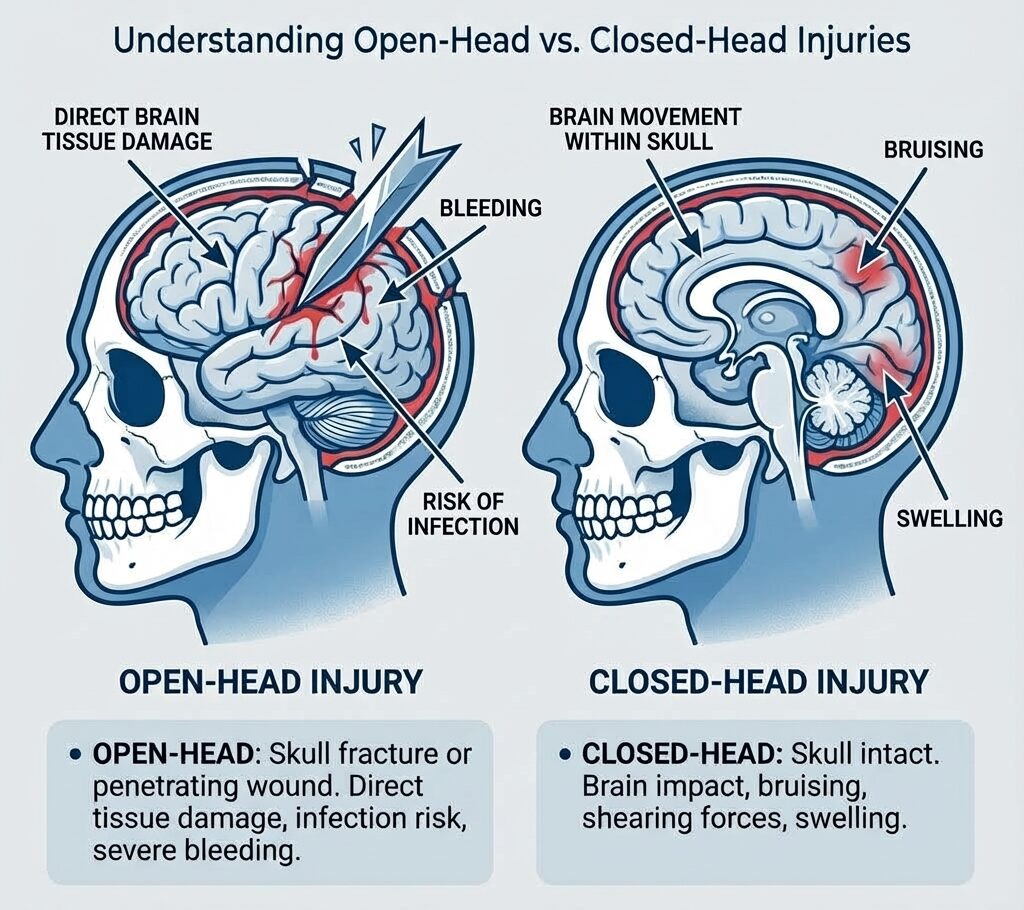
Closed-head injuries occur when the brain strikes the skull wall due to violent impact or sudden deceleration (common in car crashes, slip-and-falls, or assaults). The brain swells, hemorrhages, or bruises (contusions), disrupting neurological function. Coup-contrecoup injuries occur when the brain impacts the skull at the point of impact (coup) and then rebounds to strike the opposite side (contrecoup).
Open-head injuries involve skull fractures or penetrating wounds (from falling objects, gunshots, or sharp implements). Brain tissue is directly damaged, leading to infections, severe bleeding, and permanent disability. These injuries have higher mortality rates and often require emergency neurosurgery.
Common TBI Types Our NYC Attorneys Handle
- Concussions: “Mild” TBIs caused by shaking or blunt trauma. Symptoms include headaches, dizziness, memory loss, confusion, nausea, sensitivity to light and noise, and difficulty concentrating. Repeated concussions (common in construction workers, athletes, or domestic violence victims) cause chronic traumatic encephalopathy (CTE), a progressive degenerative brain disease.
- Contusions: Bruising of brain tissue from direct impact. Large contusions may require surgical removal of damaged tissue (lobectomy or craniectomy). Contusions can cause localized swelling, increased intracranial pressure, and secondary brain damage.
- Penetrating injuries: Objects piercing the skull (e.g., rebar, bullets, metal shards, glass). Causes extensive neurological damage, high infection risk, and high mortality rates. Survivors often face permanent paralysis, speech deficits, or cognitive impairments.
- Anoxic/Hypoxic injuries: Oxygen deprivation (from drowning, medical malpractice during surgery, carbon monoxide poisoning, strangulation, or cardiac arrest). Brain cells die within 4-6 minutes without oxygen, resulting in permanent cognitive deficits, vegetative states, or death.
- Diffuse axonal injuries (DAI): Severe rotational forces (whiplash in high-speed crashes, shaken baby syndrome) tear nerve fibers (axons) throughout the brain. Most DAI victims remain unconscious or in comas. Survivors face severe cognitive impairments, motor deficits, and behavioral changes.
- Subdural hematomas: Blood accumulates between the brain and dura mater (outer membrane). Can be acute (symptoms within hours) or chronic (symptoms develop over weeks). Requires emergency surgical drainage (burr holes or craniotomy) to prevent brain herniation and death.
- Epidural hematomas: Blood accumulates between the skull and dura mater, typically from skull fractures damaging the middle meningeal artery. Classic presentation: brief loss of consciousness, lucid interval, then rapid deterioration. Requires immediate neurosurgery.
- Subarachnoid hemorrhages: Bleeding in the space between the brain and arachnoid membrane. Causes severe headaches (“worst headache of my life”), neck stiffness, photophobia, and altered consciousness. Can lead to vasospasm, stroke, and death.
Attorney Insight: Why “Mild” TBIs Are Anything But Mild

Common TBI Types Our NYC Attorneys Handle
- Concussions: “Mild” TBIs caused by shaking or blunt trauma. Symptoms include headaches, dizziness, memory loss, confusion, nausea, sensitivity to light and noise, and difficulty concentrating. Repeated concussions (common in construction workers, athletes, or domestic violence victims) cause chronic traumatic encephalopathy (CTE), a progressive degenerative brain disease.
- Contusions: Bruising of brain tissue from direct impact. Large contusions may require surgical removal of damaged tissue (lobectomy or craniectomy). Contusions can cause localized swelling, increased intracranial pressure, and secondary brain damage.
- Penetrating injuries: Objects piercing the skull (e.g., rebar, bullets, metal shards, glass). Causes extensive neurological damage, high infection risk, and high mortality rates. Survivors often face permanent paralysis, speech deficits, or cognitive impairments.
- Anoxic/Hypoxic injuries: Oxygen deprivation (from drowning, medical malpractice during surgery, carbon monoxide poisoning, strangulation, or cardiac arrest). Brain cells die within 4-6 minutes without oxygen, resulting in permanent cognitive deficits, vegetative states, or death.
- Diffuse axonal injuries (DAI): Severe rotational forces (whiplash in high-speed crashes, shaken baby syndrome) tear nerve fibers (axons) throughout the brain. Most DAI victims remain unconscious or in comas. Survivors face severe cognitive impairments, motor deficits, and behavioral changes.
- Subdural hematomas: Blood accumulates between the brain and dura mater (outer membrane). Can be acute (symptoms within hours) or chronic (symptoms develop over weeks). Requires emergency surgical drainage (burr holes or craniotomy) to prevent brain herniation and death.
- Epidural hematomas: Blood accumulates between the skull and dura mater, typically from skull fractures damaging the middle meningeal artery. Classic presentation: brief loss of consciousness, lucid interval, then rapid deterioration. Requires immediate neurosurgery.
- Subarachnoid hemorrhages: Bleeding in the space between the brain and arachnoid membrane. Causes severe headaches (“worst headache of my life”), neck stiffness, photophobia, and altered consciousness. Can lead to vasospasm, stroke, and death.
Attorney Insight: Why “Mild” TBIs Are Anything But Mild
Stage
What Happens
Neuropsychological testing
Objective cognitive assessments (WAIS-IV, WMS-IV, Trail Making Test) documenting memory, attention, processing speed, and executive function deficits
Vocational assessments
Expert opinions on diminished earning capacity and inability to perform pre-injury job duties Treating physician testimony – Neurologists and physiatrists testify to permanence of impairments
Life care plans
Certified life care planners calculate lifetime costs of ongoing treatment, therapy, and attendant care
Day-in-the-life videos
Documentary evidence showing how TBI affects daily functioning
Key takeaway:
Even “mild” traumatic brain injuries can cause permanent cognitive and physical impairments that justify substantial compensation for medical care, lost wages, and diminished quality of life.
How Traumatic Brain Injury Disrupts Every Aspect of Life
Cognitive Impairments
- Memory loss (short-term and long-term)
- Difficulty concentrating and maintaining attention
- Slowed processing speed
- Inability to learn new information
- Impaired judgment and decision-making
- Executive function deficits (planning, organizing, problem-solving)
- Confusion and disorientation
Physical Disabilities
- Paralysis (hemiplegia, quadriplegia)
- Mobility impairment and balance problems
- Tremors and involuntary movements
- Seizures and epilepsy
- Chronic headaches and migraines
- Vision loss or double vision
- Hearing loss or tinnitus
- Loss of smell or taste
- Chronic pain
Communication Challenges
- Aphasia (inability to speak or understand language)
- Dysarthria (slurred speech)
- Difficulty reading or writing
- Word-finding difficulties
- Inability to follow conversations
Emotional and Behavioral Changes
- Depression and suicidal ideation
- Anxiety and panic attacks
- Post-traumatic stress disorder (PTSD)
- Irritability and aggression
- Personality shifts
- Loss of impulse control
- Emotional lability (uncontrollable crying or laughing)
- Social withdrawal and isolation
Loss of Independence
- Inability to work or return to pre-injury occupation
- Loss of driver’s license
- Inability to manage finances
- Inability to perform daily self-care tasks (bathing, dressing, eating)
- Need for 24/7 attendant care or nursing home placement

New York State TBI Statistics
New York State data: About 150 traumatic brain injury incidents occur every day in New York, leading to more than 2,000 deaths, approximately 17,000 hospitalizations, and 38,000 emergency department visits each year. Men are nearly twice as likely as women to be hospitalized with a TBI. Source: New York State Department of Health.
Free Case Evaluation
Leading Causes of TBI in NYC
Stage
What Happens
Falls
(especially among adults 75+) – Slip-and-falls on icy sidewalks, wet floors, defective stairs, nursing home neglect
Motor vehicle crashes
Car, truck, motorcycle, bicycle, and pedestrian accidents on streets and highways
Pedestrian accidents
Crosswalk accidents, hit-and-runs, vehicles striking sidewalk cafes
Construction site incidents
Falls from scaffolding and ladders, struck by falling objects, scaffold and trench collapses, uncovered floor openings
Subway/bus accidents
MTA train derailments, platform falls, bus crashes, slip-and-falls in stations
Assaults
Bar fights, domestic violence, road rage, police brutality
Medical malpractice
Surgical errors, anesthesia mistakes, birth injuries (oxygen deprivation)
Key takeaway:
Traumatic brain injuries affect every aspect of life—from cognitive function to emotional health to financial stability—making comprehensive legal representation essential for recovering full compensation.
The Long Road to Recovery: Treatment and Rehabilitation
Emergency Medical Care
Immediate stabilization to control bleeding, ensure oxygen supply, and reduce intracranial pressure. CT scans or MRIs assess injury extent. Glasgow Coma Scale (GCS) scoring determines severity. Intubation and mechanical ventilation for severe cases. Intracranial pressure (ICP) monitoring.
Medication
- Pain relievers: Acetaminophen, opioids (used cautiously due to sedation effects)
- Anti-seizure drugs: Levetiracetam (Keppra), phenytoin (Dilantin), valproic acid
- Medications to reduce brain swelling: Mannitol, hypertonic saline
- Antidepressants: SSRIs for mood disorders and emotional lability
- Stimulants: Methylphenidate (Ritalin) for attention and concentration deficits
Surgery
- Removal of blood clots (hematomas): Craniotomy or burr hole drainage
- Repair of skull fractures: Cranioplasty with titanium plates or bone grafts
- Craniectomy: Removing part of the skull to relieve pressure (bone flap stored in abdomen or freezer for later replacement)
- Decompressive surgery: Relieving intracranial pressure to prevent brain herniation
- Ventriculostomy: Draining cerebrospinal fluid to reduce pressure
Rehabilitation Therapy
Physical Therapy
Restores strength, balance, coordination, and mobility. Critical for patients with hemiparesis (one-sided weakness), gait disturbances, or spasticity. Includes
- Range of motion exercises
- Strengthening exercises
- Gait training and balance exercises
- Transfer training (bed to wheelchair, wheelchair to toilet)
- Assistive device training (walkers, canes, wheelchairs)
Occupational Therapy
Relearns daily tasks (dressing, cooking, bathing, writing). Adaptive equipment training. Includes:
- Activities of daily living (ADL) training
- Fine motor skill exercises
- Cognitive retraining for task sequencing
- Home safety assessments and modifications
- Adaptive equipment (button hooks, sock aids, reachers)
Speech and Language Therapy
Addresses aphasia, dysarthria (slurred speech), and swallowing difficulties (dysphagia). Includes:
- Language comprehension exercises
- Word-finding strategies
- Articulation exercises
- Swallowing therapy and diet modifications
- Communication device training (speech-generating devices)
Cognitive Rehabilitation
Improves memory, attention, problem-solving, and executive function through structured exercises. Includes:
- Memory compensation strategies (calendars, alarms, checklists)
- Attention training exercises
- Problem-solving and reasoning tasks
- Computer-based cognitive training programs
Psychological Therapy
Treats depression, anxiety, PTSD, and adjustment to disability. Family counseling helps caregivers cope. Includes:
- Cognitive-behavioral therapy (CBT)
- Individual and group counseling
- Family therapy and caregiver support
- Medication management for mood disorders
Assistive Devices and Long-Term Monitoring
- Wheelchairs (manual and power)
- Communication boards and speech-generating devices
- Memory aids (smartphones, alarms, pill organizers)
- Home modifications (ramps, grab bars, accessible bathrooms)
- Vehicle modifications (hand controls, wheelchair lifts)
- Regular medical follow-ups to adjust treatment plans
- Support groups and peer counseling
- Vocational rehabilitation programs
Cost of TBI Care
- Emergency medical care and hospitalization ($100,000-$500,000+)
- Neurosurgery and follow-up procedures ($200,000-$1,000,000+)
- Inpatient rehabilitation (3-6 months at $1,500-$3,000/day)
- Outpatient therapy (years of PT, OT, speech therapy at $150-$300/session)
- Medications ($500-$2,000/month for life)
- Attendant care ($50,000-$150,000/year for 24/7 care)
- Home modifications ($50,000-$200,000)
- Lost wages and earning capacity ($1,000,000-$5,000,000+ over lifetime)
- Assistive devices and equipment ($20,000-$100,000)
- Insurers routinely undervalue these claims by:
- Using low-cost life care plans
- Arguing injuries are “mild” or “pre-existing”
- Outpatient therapy (years of PT, OT, speech therapy at $150-$300/session)
- Medications ($500-$2,000/month for life)
- Disputing permanence of impairments
- Offering quick settlements before full extent of injuries is known
Aggressive legal representation is essential to secure fair compensation that covers decades of care.
Key takeaway: Comprehensive TBI treatment requires coordination across multiple medical specialties and can cost millions over a lifetime, making it critical to calculate future needs accurately in any legal claim.
Need Treatment Covered? Call for a Case Review
Our NYC brain injury attorneys recover costs for lifetime medical care, lost wages, and pain and suffering.
Free Case Evaluation
How New York City Courts Handle Traumatic Brain Injury Cases
Most TBI cases in New York City are filed in the New York Supreme Court (the state’s trial-level court for civil cases, despite its name). Each borough has its own Supreme Court location:
Stage
What Happens
New York County Supreme Court (Manhattan):
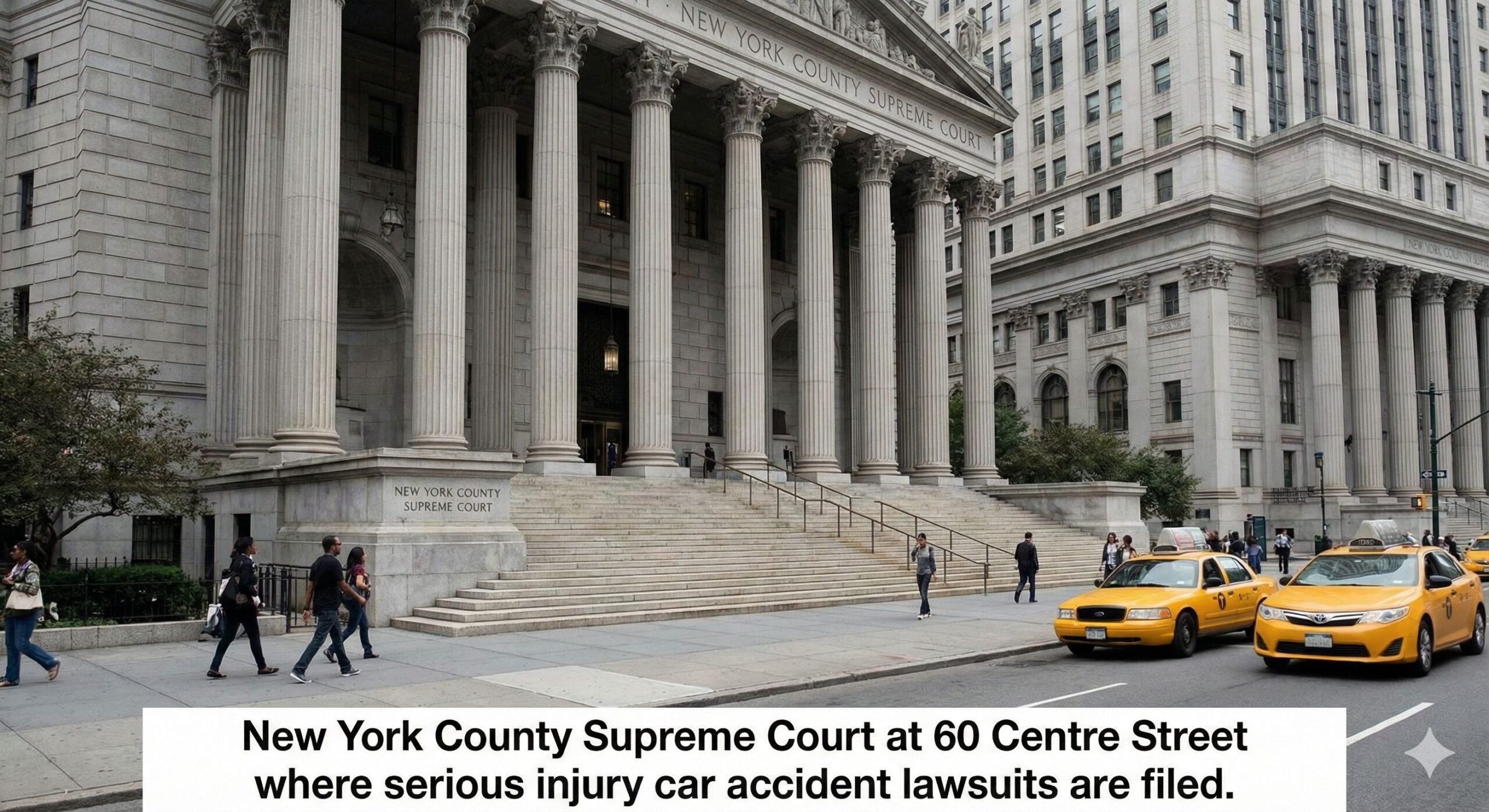
60 Centre Street, New York, NY 10007. Handles complex personal injury cases with juries drawn from Manhattan residents. Known for sophisticated juries and moderate-to-high verdicts in catastrophic injury cases.
Kings County Supreme Court (Brooklyn):
360 Adams Street, Brooklyn, NY 11201. Known for plaintiff-friendly juries and higher verdict averages. Historically yields strong results in catastrophic injury cases.
Bronx County Supreme Court:
851 Grand Concourse, Bronx, NY 10451. Historically yields the highest verdicts in catastrophic injury cases. Juries are sympathetic to injured plaintiffs and skeptical of corporate defendants.
Queens County Supreme Court:
88-11 Sutphin Boulevard, Jamaica, NY 11435. More conservative juries compared to Bronx and Brooklyn.
Richmond County Supreme Court (Staten Island):
18 Richmond Terrace, Staten Island, NY 10301. Smallest jury pool. Verdicts vary widely. More conservative than other boroughs.
Cases under $25,000 are heard in the NYC Civil Court, but traumatic brain injuries typically exceed this threshold due to extensive medical costs, lost wages, and pain and suffering damages.
Attorney Insight: Choosing the Right Venue
If your injury occurred in one borough but the defendant resides or does business in another, you may have venue options under CPLR § 503. Historically, Bronx and Brooklyn juries have returned some of the highest verdicts in catastrophic injury cases, while verdicts in Queens and Staten Island have tended to be more conservative.
Our attorneys analyze:
- Jury demographics and socioeconomic factors
- Recent verdict trends in each borough
- Judicial assignments and individual judges’ track records
- Defendant’s business locations and registered agent addresses
- Where the injury occurred (CPLR § 503 venue rules)
Government Entity Claims Require Faster Action
If a New York City agency, the MTA, NYPD, public schools, or other government entity caused your injury, you must file a Notice of Claim within 90 days under General Municipal Law § 50-e.
Government entities that require Notice of Claim:
- City of New York (all agencies and departments)
- Metropolitan Transportation Authority (MTA) – subways, buses, commuter rail
- New York City Police Department (NYPD)
- NYC Department of Education (public schools)
- NYC Health + Hospitals (public hospitals)
- NYC Housing Authority (NYCHA)
- NYC Department of Transportation (DOT)
- NYC Department of Sanitation (DSNY)
- NYC Parks Department
- Port Authority of New York and New Jersey
Notice of Claim process:
- File within 90 days of the injury (strict deadline)
- Include required information: Claimant’s name and address, nature of claim, time/place/manner of injury, amount of damages sought
- Government schedules 50-h hearing within 90 days (sworn testimony under oath)
- File lawsuit within 1 year and 90 days of the injury (GML § 50-i)
Critical deadline warning: The 90-day Notice of Claim deadline for government facilities is shorter than standard time to bring negligence claims. Missing this deadline often bars your case permanently, even if the regular 1 year 90 day statute of limitations hasn’t expired. Courts rarely grant extensions except in some cases of infancy (minors under 18), mental incapacity, fraudulent concealment or in cases where the government entity had sufficient notice despite a notice of claim not being timely filed.
For more on MTA and transit-related TBIs, see our pages on New York Subway Accidents and New York Bus Accidents. For construction-related TBIs involving government contractors, see our New York Construction Accident Lawyer page.
Key takeaway: Government entity claims in New York City require strict adherence to shortened deadlines—missing the 90-day Notice of Claim can permanently bar your case, regardless of how strong your evidence.
What Happens Next – How Long Do Brain Injury Cases Take To Resolve
Quick Summary: NYC traumatic brain injury lawsuits can take as little as months to complete or may need to progress to trial which could take several years to conclude depending on many factors including the severity of the injury, the target defendants, the amount of primary, secondary and umbrella insurance coverage, the cause of the accident and necessary proof and other factors particular the individual case.
Typical Case Stages for a NYC Traumatic Brain Injury Lawsuit
Phase
Key Actions
1. Free Consultation
Meet with the attorney to review your case. Bring medical records, police reports, photos, and witness statements. Attorney evaluates liability, damages, and available insurance coverage. Your legal rights, potential recovery, and strategy are explained. No obligation—consultation is free and confidential.
2. Investigation & Evidence Gathering
Obtain accident reports, medical records, surveillance footage, and sworn witness statements. Send spoliation letters to preserve evidence. Retain experts (neurology, neuropsychology, life-care planning, vocational economics, reconstruction). File a Notice of Claim within 90 days for government defendants. Photograph injury sites before conditions change.
3. Filing Lawsuit (Summons & Complaint)
File a lawsuit in the appropriate NYC Supreme Court. Court issues an index number. Serve the Summons and Complaint on defendants. Defendant files an Answer. Discovery begins.
4. Discovery Phase
Exchange documents (medical, employment, tax, insurance). Conduct depositions of the plaintiff, defendants, eyewitnesses, and experts. Defendant schedules an independent medical exam (IME); attorney prepares you and challenges biased findings. Strengthen medical proof with treating physician affidavits and neuropsychological evaluations.
5. Mediation or Settlement Negotiations
Participate in judge-ordered mediation or negotiate directly with insurers. Attorney presents a demand package with life-care plan, economic loss analysis, and similar NYC verdicts. Many cases settle at this stage; if not, proceed to trial.
6. Trial
Present medical experts, fact witnesses, and your testimony to a jury. Use demonstrative evidence (day-in-the-life video, medical illustrations, economic charts). Jury deliberates and issues a verdict. Defendant may appeal. Attorney enforces judgment through liens, garnishments, or asset seizure if necessary.
Note: Complex TBI cases involving multiple defendants, government entities, or disputed liability may take over 3 years to resolve. Our attorneys prepare every case for trial, which incentivizes insurers to settle for fair value. Most brain injury cases settle before trial, but we are fully prepared to present your case to a jury if necessary.
Key takeaway: While most TBI cases settle through negotiation, preparing for trial from day one ensures insurers take your claim seriously and make full and fair settlement offers.
Real NYC Brain Injury Scenarios
Pedestrian Struck by Police Motor Scooter (Battery Park)
Result: $7.8 Million Verdict + Interest
A Manhattan accountant was walking along the pedestrian promenade in Battery Park after work when she was violently struck by a speeding police motor scooter. The impact launched her more than thirty feet, leaving her with multiple skull fractures, intracranial bleeding, and swelling of the brain. She suffered permanent cognitive deficits, including memory loss, reduced IQ, and impairment of executive functioning—the abilities responsible for planning, organizing, and multi-tasking. Her most debilitating ongoing symptom is chronic, permanent vertigo that prevents her from lying flat without severe dizziness and nausea.
Legal strategy: We established that the police officer failed to operate the scooter with the degree of care required under New York Vehicle and Traffic Law and NYPD departmental rules. Accident reconstruction evidence demonstrated excessive speed and violation of pedestrian-right-of-way standards. Our medical experts—including neurologists and neuropsychologists—presented objective evidence of traumatic brain injury through diagnostic imaging, neurocognitive test batteries, and functional impairment assessments. Treating physicians testified that the vertigo and cognitive losses were permanent and life-altering.
At trial, the jury awarded $6.3 million for pain and suffering and future medical needs. The City appealed twice and lost. Because of the appellate delay, we ultimately secured a total recovery of $7.8 million, including statutory interest—compensating our client for lifelong neurological impairment and lost quality of life.
Bicycle Deliveryman Struck by Van (Manhattan)
Result: $6.25 Million Settlement
A 26-year-old bicycle deliveryman was struck by a speeding Dollar Rent-A-Car van at a busy Manhattan intersection. He sustained multiple fractures in his neck, back, arm, and leg, as well as mild traumatic brain damage. The victim’s cognitive deficits prevented him from returning to work and required ongoing rehabilitation.
Legal strategy: Under New York negligence law, commercial vehicle operators have a duty to operate their vehicles in a safe and reasonable manner in accordance with the circumstances then and there existing. In this case we retained accident reconstruction experts who analyzed skid marks, traffic camera footage, and vehicle damage to prove the van driver was speeding and failed to yield. Neuropsychological testing documented permanent memory deficits, slowed processing speed, and executive function impairments. A vocational economist testified that the victim could no longer perform his pre-injury occupation or any substantial gainful employment.
We secured a $6.25 million settlement covering lifetime medical care, lost earning capacity, and pain and suffering. The settlement provides structured income replacement for 30+ years and funds ongoing neuropsychological treatment.
Subway Train Derailment (Manhattan/Bronx)
Result: $3.5 Million Settlement
Mrs. Y-H was a passenger on an MTA subway train that derailed. At the moment of impact, she was thrown across the subway car and struck a pole, rendering her unconscious. She suffered a traumatic brain injury resulting in persistent cognitive impairments, memory deficits, and an inability to work.
Legal strategy: We filed a Notice of Claim with the NYCTA within 90 days, then sued the claiming a negligent departure from common carrier duty and care. Discovery revealed the NYCTA had prior notice of track defects and failed to perform required maintenance. We retained engineering experts who testified that the derailment was preventable with proper track inspection and repair.
Our medical experts demonstrated the permanence of her brain injury through serial MRI scans showing brain atrophy, neuropsychological testing documenting cognitive decline, and treating physician testimony. The case settled for $3.5 million after our medical experts demonstrated the permanence of her brain injury. The settlement funds ongoing neurological treatment and replaces lost income from her professional career.
Key takeaway: Real case results demonstrate that skilled legal representation can secure millions in compensation for TBI victims, ensuring access to necessary medical care and financial security for decades.
- Testimonials
What Our Clients Say
Why NYC Brain Injury Victims Choose Dansker & Aspromonte

NYC Brain Injury Lawyers: Nearly a Billion Recovered Since 1986
Proven results:
Nearly 1 billion recovered for injury victims since 1986. $50 million brain damage verdict. $31 million for an NYPD officer. $7.8 million for a pedestrian. $6.25 million for a bicycle deliveryman. $5 million for an elevator fall. $4.3 million for a busboy struck by car.
Decades of experience:
Representing NYC injury victims since 1986. 100+ years of combined legal experience across our attorney team.
Trial reputation:
We prepare every case for trial. Defendants know we mean business. Our track record speaks for itself.
Personal attention:
Small enough to treat you like family, aggressive enough to take on insurance giants and corporate defendants.
No upfront fees:
You pay nothing unless we win. All case expenses (expert fees, court costs, medical records, depositions) are advanced by our firm.
Local knowledge:
Deep familiarity with NYC courts, judges, jury pools, and defendant tactics. We know which venues yield the highest verdicts.
Comprehensive representation:
We handle all case aspects—investigation, medical coordination, expert retention, discovery, negotiations, and trial.
Compassionate advocacy:
We understand the devastating impact of brain injuries on victims and families. We fight for justice while treating you with dignity and respect.
Related NYC Personal Injury Services
If your traumatic brain injury occurred in another type of accident, explore these related practice areas:
- New York Car Accident Lawyer – Motor vehicle crashes are a leading cause of TBI. We handle auto, truck, motorcycle, and rideshare accidents throughout NYC.
- New York Construction Accident Lawyer – Falls from heights, struck-by accidents, and electrocutions frequently cause head injuries on NYC job sites. We handle Labor Law § 240(1) scaffold law claims.
- New York Slip and Fall Lawyer – Premises liability claims for dangerous sidewalks, wet floors, inadequate lighting, or unguarded stairwells causing TBI.
- New York Subway Accident Lawyer – MTA and NYCTA negligence, platform falls, train derailments, and slip-and-falls in subway stations causing head injuries.
- New York Pedestrian Accident Lawyer – Pedestrians struck by vehicles, buses, or bicycles suffer severe head trauma. We handle crosswalk accidents and hit-and-runs.
- New York Bus Accident Lawyer – MTA, MTA BUS, NYCTA and MABSTOA bus crashes, tour bus accidents, and school bus accidents causing TBI.
- New York Medical Malpractice Lawyer – Surgical errors, anesthesia mistakes, and birth injuries causing brain damage.
- New York Nursing Home Abuse Lawyer – Falls, inadequate supervision, and neglect causing TBI in elderly residents.
- New York Wrongful Death Lawyer – When TBI causes death, we represent families in wrongful death and survival claims.
Frequently Asked Questions: NYC Traumatic Brain Injury Cases
How long do I have to file a brain injury lawsuit in NYC?
Three years from the injury date under CPLR § 214(5) for private defendants (individuals, corporations, property owners).
Exception for government entities: Claims against NYC, MTA, NYPD, public schools, or other government entities require a Notice of Claim within 90 days (General Municipal Law § 50-e), then a lawsuit within one year and 90 days (GML § 50-i).
Do not delay. Evidence deteriorates quickly:
- Surveillance footage is deleted after 30-90 days
- Witnesses forget details or move away
- Defendants destroy or alter records
- Medical records are lost or archived
- Physical evidence (helmets, clothing, equipment) is discarded
Contact a NYC brain injury attorney immediately to preserve your rights.
How much is my NYC brain injury case worth?
Every case is unique. Factors that determine value include:
- Severity of injury: Mild vs. moderate vs. severe TBI (Glasgow Coma Scale score)
- Permanence of impairment: Temporary vs. permanent cognitive, physical, or emotional deficits
- Age and occupation: Younger victims with high earning potential receive higher awards
- Medical costs: Past and future medical expenses, rehabilitation, attendant care
- Lost wages and earning capacity: Inability to work or reduced earning potential
- Degree of defendant’s fault: Gross negligence or recklessness increases damages
- Insurance policy limits: Available coverage from defendant’s insurance
- Venue: Bronx and Brooklyn juries historically award higher verdicts than Queens or Staten Island
Our firm has recovered:
- $50 million (brain-damaged child from medical malpractice)
- $31 million (NYPD officer with head injuries)
- $7.8 million (pedestrian struck by police scooter)
- $6.25 million (bicycle deliveryman struck by van)
- $5 million (elevator fall victim with severe head injury)
- $4.3 million (busboy struck by car)
- $3.5 million (subway derailment victim)
- For more case results, see our Verdicts and Settlement Page
Contact us at (212) 732-2929 for a free case evaluation based on your specific circumstances.
What if I can’t afford an attorney?
We work on contingency. You pay nothing up front. We only get paid if we win your case (typically 33.3% of the recovery).
If we lose, you owe nothing. All case expenses (expert fees, court costs, medical record retrieval, deposition transcripts, filing fees) are advanced by our firm and deducted from your settlement or verdict.
This allows injured victims to pursue justice without financial risk. You get access to top-tier legal representation regardless of your financial situation.
What if the TBI was partially my fault?
New York follows pure comparative negligence under CPLR § 1411. Even if you were partially at fault, you can still recover—your damages are reduced by your percentage of fault.
Example: If your total damages are $1 million and you were 30% at fault, you recover $700,000. Note: This is an example only; a judge or jury decides the actual fault percentages based on evidence presented at trial.
Insurers will try to inflate your fault percentage to reduce their payout. Our attorneys counter with:
- Accident reconstruction analysis
- Traffic camera footage and surveillance video
- Witness testimony
- Expert opinions on causation
- Vehicle data recorders (black boxes)
- Cell phone records (proving defendant was distracted)
Can I sue if my loved one died from a traumatic brain injury?
Yes. Under New York Estates, Powers and Trusts Law § 5-4.1, the estate’s personal representative (appointed by Surrogate’s Court) can file a wrongful death lawsuit for pecuniary losses:
- Lost financial support and earnings
- Funeral and burial costs
- Loss of services (household tasks, childcare, guidance)
- Loss of inheritance (assets deceased would have accumulated)
Separately, the estate can bring a survival claim for the decedent’s conscious pain and suffering experienced before death, as well as medical expenses incurred between injury and death.
Statute of limitations for wrongful death: Two years from the date of death (not the date of injury).
For comprehensive information on wrongful death claims, see our New York Wrongful Death Lawyer page.
What if the at-fault party has no insurance or limited assets?
Our attorneys identify all potential sources of recovery:
- Homeowner’s insurance: For slip-and-falls, premises liability, or dog bites
- Commercial general liability policies: For businesses, property owners, contractors
- Umbrella policies: Additional coverage above primary policies ($1M-$5M+)
- Auto insurance: Defendant’s insurance – Uninsured/underinsured motorist coverage (UM/UIM) from your own policy
- Workers’ compensation: For on-the-job injuries, with third-party liability claims against non-employer defendants
- Municipal liability: For dangerous sidewalks, roadways, or transit accidents (NYC, MTA)
- Product liability: For defective helmets, airbags, medical devices, or safety equipment
- Dram shop liability: For bars or restaurants that over-served alcohol to intoxicated patrons
- Vicarious liability: Employers are liable for employees’ negligence (respondeat superior)
We maximize your recovery from every available source.
Will I have to go to court?
Most brain injury cases settle before or during trial. Our attorneys prepare every case for trial, which pressures insurers to offer fair settlements. Defendants know we have the resources, experience, and willingness to try cases—and our track record speaks for itself.
If settlement negotiations fail, we are fully prepared to present your case to a NYC jury.
You will need to attend:
- Depositions: Sworn testimony where defense attorneys ask questions (we prepare you extensively)
- Independent medical exams (IMEs): Defense doctor examinations (we attend and challenge biased reports)
- Mediation: Settlement conference with a neutral mediator
- Trial: If necessary, you testify about your injuries and how they’ve affected your life
We guide you through every step and ensure you’re fully prepared.
How do I pay for medical treatment while my case is pending?
Options include:
- Health insurance: Private or employer provided insurance
- Auto no-fault insurance: Covers up to $50,000 in medical bills for car accident victims (regardless of fault)
- Workers’ compensation: For on-the-job injuries, covers all medical treatment and partial wage replacement
- Hospital liens: Hospitals may defer payment until the case settles (lien placed on settlement proceeds)
- Medical funding companies: Advance treatment costs in exchange for a portion of your settlement (use cautiously—high interest rates)
- Medicare/Medicaid: Government health insurance for eligible individuals
Our attorneys help you access necessary treatment without upfront payment. We coordinate with medical providers to ensure you receive care while your case proceeds.
What types of damages can I recover in a NYC brain injury case?
Economic Damages (Compensatory)
- Past and future medical expenses (emergency care, surgery, hospitalization, rehabilitation, therapy, medications)
- Lost wages and earning capacity (inability to work or reduced earning potential)
- Home modifications (wheelchair ramps, accessible bathrooms, widened doorways, stairlifts)
- Attendant care costs (24/7 nursing care, home health aides)
- Vocational rehabilitation and job retraining
- Assistive devices (wheelchairs, communication devices, memory aids)
- Transportation costs (accessible vehicles, medical appointments)
Non-Economic Damages (Compensatory)
- Pain and suffering (physical pain, discomfort, chronic headaches)
- Loss of enjoyment of life (inability to participate in hobbies, sports, social activities)
- Emotional distress (depression, anxiety, PTSD, fear)
- Loss of consortium (spouse’s claim for loss of companionship, affection, sexual relations)
- Disfigurement and scarring
Punitive Damages (Rare)
In rare cases involving reckless or intentional conduct (e.g., drunk driving, gross negligence, assault), courts may award punitive damages to punish the defendant and deter similar conduct. These are uncommon in New York and require clear and convincing evidence of egregious behavior.
Can I still sue if the injury happened years ago, but the symptoms appeared after the usual time to sue has expired?
Possibly, but these exceptions are narrow.
New York law recognizes the “discovery rule” in very limited circumstances:
- Foreign objects left during surgery (surgical instruments, sponges)
- Toxic exposure with delayed onset (asbestos, lead poisoning)
- Fraudulent concealment by the defendant
- Tolling of the Statute of Limitations – For example: Infancy where the limit on the time to sue does not begin to run until the 18th birthday
However, this does not generally apply to traumatic brain injuries caused by known accidents. The three-year statute of limitations typically begins on the injury date, not when symptoms manifest or worsen.
Exception for minors: If the victim was under 18 at the time of injury, the statute of limitations is tolled (paused) until they turn 18, then they have three years from their 18th birthday to file suit.
Consult an attorney immediately to assess whether any exceptions apply. Do not assume you have more time—missing the deadline permanently bars your claim.
Take the First Step: Free Consultation with a NYC Brain Injury Attorney
If you or a loved one suffered a traumatic brain injury in New York City, time is critical. Evidence disappears. Witnesses forget. Insurance companies pressure you to settle quickly for pennies. Don’t navigate this alone.
Call Dansker & Aspromonte Associates LLP at (212) 732-2929 for a free, no-obligation case evaluation. We will:
- Review your medical records and accident details
- Explain your legal rights under New York law
- Identify all liable parties and insurance coverage
- Outline a strategy to maximize your recovery
- Answer all your questions
You pay nothing unless we win. The consultation is completely free and confidential.
Dansker & Aspromonte Associates LLP
30 Vesey Street, 16th Floor
New York, NY 10007
(212) 732-2929
Serving Manhattan, Brooklyn, Queens, Bronx, Staten Island
Free Consultation | No Fees Unless We Win
Office Hours:
Monday – Friday: 9:00 AM – 6:00 PM
After Hours and Weekends – Chat lines – Answering Services – Immediate Call-Backs
Emergency consultations available 24/7
Attorney advertising. Prior results do not guarantee a similar outcome. The information on this website is for general informational purposes only and does not constitute legal advice. Consult an attorney for advice regarding your individual situation. This website is not intended to create, and viewing it does not constitute, an attorney-client relationship.
Lorem ipsum dolor sit amet, consectetur adipiscing elit. Ut elit tellus, luctus nec ullamcorper mattis, pulvinar dapibus leo.