
New York Subway Accident Lawyer
Written by: Sal Aspromonte, Esq. (NY Bar #1234567) & Douglas Hoffer, Esq. (NY Bar #2345678)
Experience: 35+ years litigating NYCTA subway accident claims
Last Updated: December 11, 2025
Reviewed by: Senior litigation team at Dansker & Aspromonte Associates LLP
Dansker & Aspromonte Associates LLP represents victims of subway accidents throughout Manhattan, Brooklyn, Queens, the Bronx, and Staten Island. Our New York City attorneys have recovered over $750 million for clients injured in derailments, platform falls, train malfunctions, and operator negligence cases. We handle New York City Transit Authority (NYCTA) claims on a contingency basis—no fees unless we win.
Injured in a Subway Accident?
Free consultation with experienced NYCTA litigation attorneys. Call (212) 732-2929 or contact us online.
What To Do Right After a Subway Accident in New York City
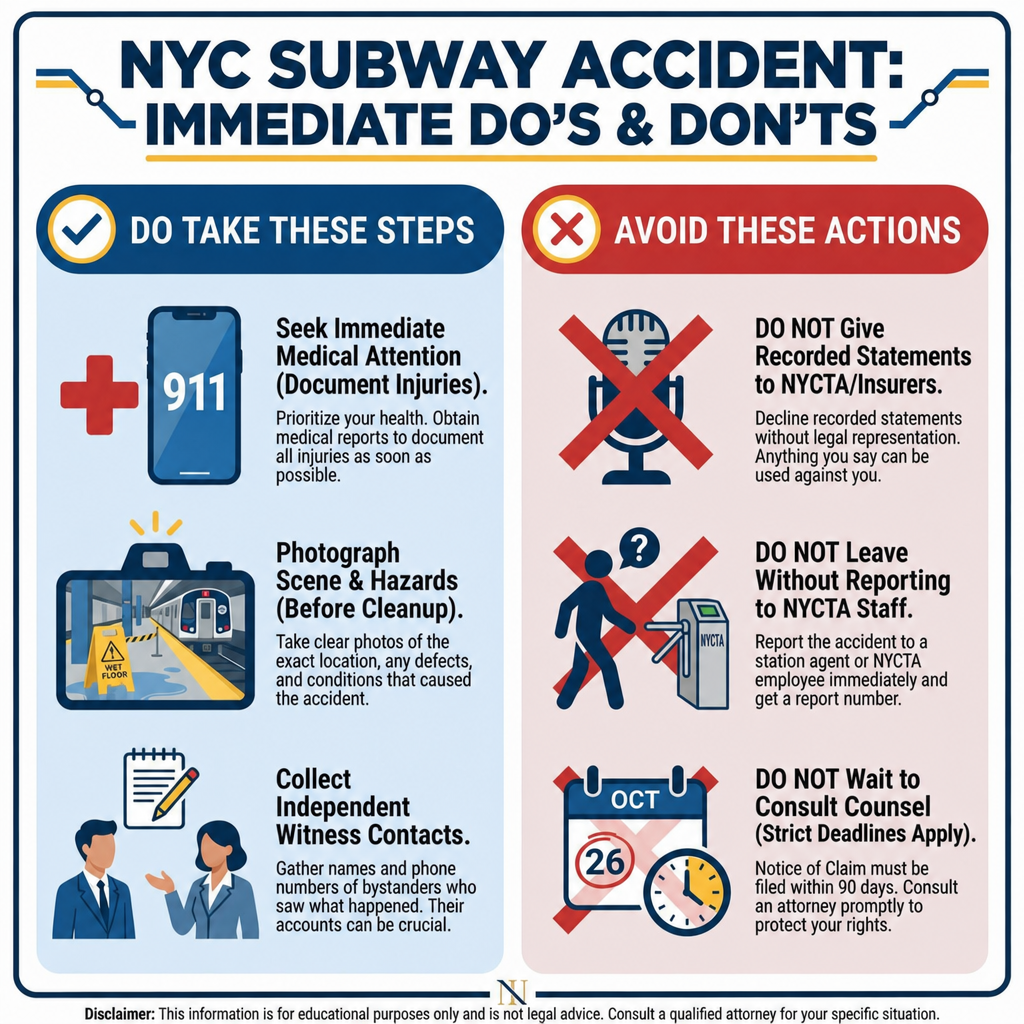
Even if injuries seem minor, get examined by emergency medical personnel or visit an emergency room. Internal injuries, concussions, and soft tissue damage may not be immediately apparent.
Time is critical in NYCTA cases. Evidence disappears, surveillance footage is overwritten, and witnesses’ memories fade. Our attorneys begin investigating within 24-48 hours of being retained.
Don’t Wait — NYCTA Claims Have Strict Deadlines
Call (212) 732-2929 for immediate legal assistance.
Key Legal Terms in Subway Accident Cases
The NYCTA operates as a common carrier, meaning it owes passengers the highest degree of care consistent with the practical operation of the subway system. This elevated duty of care requires the NYCTA to take all reasonable precautions to ensure passenger safety. Learn more about common carrier duties from the Cornell Legal Information Institute.
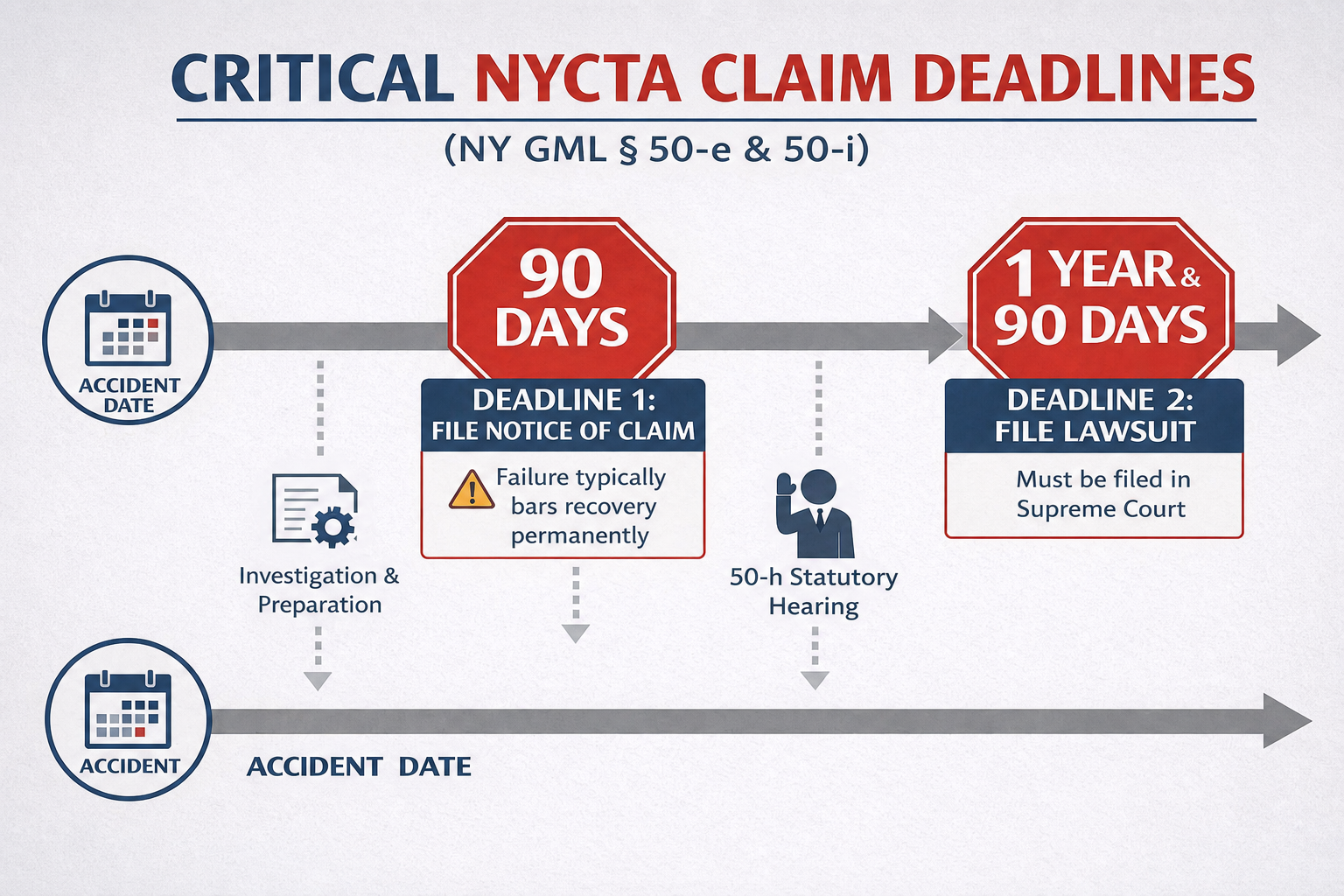
A formal legal document that must be filed with the NYCTA within 90 days of a subway accident under General Municipal Law § 50-e. The Notice of Claim describes the accident, injuries, and legal basis for the claim. Failure to file within 90 days typically bars your lawsuit. After filing the Notice of Claim, you must file a lawsuit within 1 year and 90 days from the date of the accident under General Municipal Law § 50-i.
Legal responsibility for injuries caused by dangerous conditions on NYCTA property, including subway stations, platforms, stairways, escalators, and elevators. The NYCTA must maintain these areas in a reasonably safe condition and warn passengers of known hazards.
New York follows a pure comparative negligence rule under CPLR § 1411. If you are partially at fault for your subway accident, your compensation is reduced by your percentage of fault. For example, if you are found 20% at fault, your recovery is reduced by 20%. However, you can still recover damages even if you are 99% at fault.
THE TIME TO SUE CAN VARY FROM CASE TO CASE – ALWAYS CONSULT AN EXPERIENCED ATTORNEY TO DETERMINE THE TIME FRAME THAT APPLIES TO YOUR CASE AS SOON AS POSSIBLE AFTER THE ACCIDENT
Any statute of limitation or condition precedent such as a notice of claim cited herein may not apply to your particular case. The time to bring a lawsuit and the conditions upon which it may be brought depend upon many factors including the age and mental capacity of the injured person, whether the party to be sued is a private person, partnership, corporation, government entity or other legal entity, the substance and type of claim that is being made, the place of the accident and other possible factors that may apply at the time of the accident or injury. You are advised to call to confirm the time limits and conditions that apply to your case as soon as possible.
NYC Subway Accident Statistics (2024-2025)
Understanding the scope of subway safety issues in New York City helps contextualize the risks passengers face daily. According to NYCTA transparency reports and NYC Open Data, subway accidents remain a persistent concern despite safety improvements:
- Annual subway ridership: Approximately 1.7 billion rides in 2024, making the NYC subway the busiest transit system in North America
- Reported passenger injuries: The NYCTA reports hundreds of passenger injury claims annually, ranging from minor slip-and-falls to catastrophic derailment injuries
- Platform accidents: Platform-edge incidents account for a significant portion of serious injuries, prompting ongoing discussions about platform screen doors
- Settlement payouts: The NYCTA pays millions annually in subway accident settlements and verdicts
- Common accident types: Slip and falls (wet platforms, uneven surfaces), door-related injuries, and derailments remain the most frequent causes of passenger injuries
These statistics underscore the importance of immediate legal representation when injuries occur. The NYCTA’s extensive resources and legal teams mean that unrepresented victims often receive inadequate compensation or miss critical deadlines entirely.
Data Source Transparency: Statistics compiled from NYCTA annual reports and NYC Open Data portal settlement records. Specific claim numbers vary year-to-year based on reporting methodology and case settlement timing.
Common Causes of NYC Subway Accidents
Subway accidents in New York City occur due to various factors involving mechanical failures, operator errors, maintenance deficiencies, and unsafe conditions. Understanding the cause of your accident is essential to identifying liable parties and building a strong claim.
Operator Error and Negligence in Manhattan and Brooklyn Subway Crashes
Despite automation in many parts of the subway system, human operators still control critical functions and monitor safety systems. Operator negligence can cause catastrophic accidents, particularly during rush hour when trains operate at high frequencies through Manhattan and Brooklyn’s busiest stations. Common examples include:
- Excessive speed — Operating trains above safe speeds for track conditions or station approaches
- Failure to stop at designated stations — Missing stop signals or failing to align trains properly with platforms
- Inattention to control systems — Failing to monitor automated systems, signal warnings, or track ahead
- Improper door operation — Closing doors on passengers or allowing trains to move with doors unsecured
- Failure to sound warnings — Not alerting passengers to stops, closures, or emergency situations
- Fatigue — Operating trains while drowsy due to inadequate rest breaks or excessive overtime
The NYCTA is responsible for properly training, supervising, and monitoring subway operators. When operator negligence causes injuries, both the individual operator and the NYCTA may be held liable. The Federal Transit Administration sets national safety standards for public transportation systems.
Mechanical Failures and Defective Equipment on Queens and Bronx Lines
Subway cars contain complex mechanical and electrical systems that require regular maintenance and inspection. Aging infrastructure on Queens and Bronx lines can contribute to higher mechanical failure rates. Mechanical failures that commonly cause accidents include:
- Brake failures — Defective or poorly maintained braking systems that prevent trains from stopping safely
- Door malfunctions — Doors that open between stations, fail to close properly, or close on passengers
- Electrical system failures — Power surges, electrical fires, or loss of lighting and ventilation
- Derailment due to mechanical defects — Wheel failures, axle breaks, or suspension system defects
- Signal system failures — Malfunctioning signals that fail to warn operators of track conditions or other trains
The NYCTA has a duty to inspect, maintain, and repair subway cars regularly. Manufacturers of defective subway car components may also be held liable under product liability laws.
Track and Infrastructure Defects Across All Five Boroughs
The physical infrastructure of New York City’s subway system is aging and requires constant maintenance across Manhattan, Brooklyn, Queens, the Bronx, and Staten Island. Track-related accidents occur when the NYCTA fails to adequately maintain or repair:
- Broken or misaligned tracks — Track defects that cause derailments or sudden stops
- Switch point failures — Malfunctioning switches that direct trains onto the wrong tracks
- Signal equipment defects — Broken signals, crossing gates, or warning systems
- Third rail issues — Exposed or improperly maintained electrical third rails
- Tunnel structural problems — Water leaks, crumbling concrete, or collapsing tunnel sections
Track inspections are required regularly under NYCTA oversight protocols. When the NYCTA has notice of dangerous track conditions but fails to repair them, liability for resulting accidents follows.
Platform and Station Hazards in High-Traffic NYC Stations
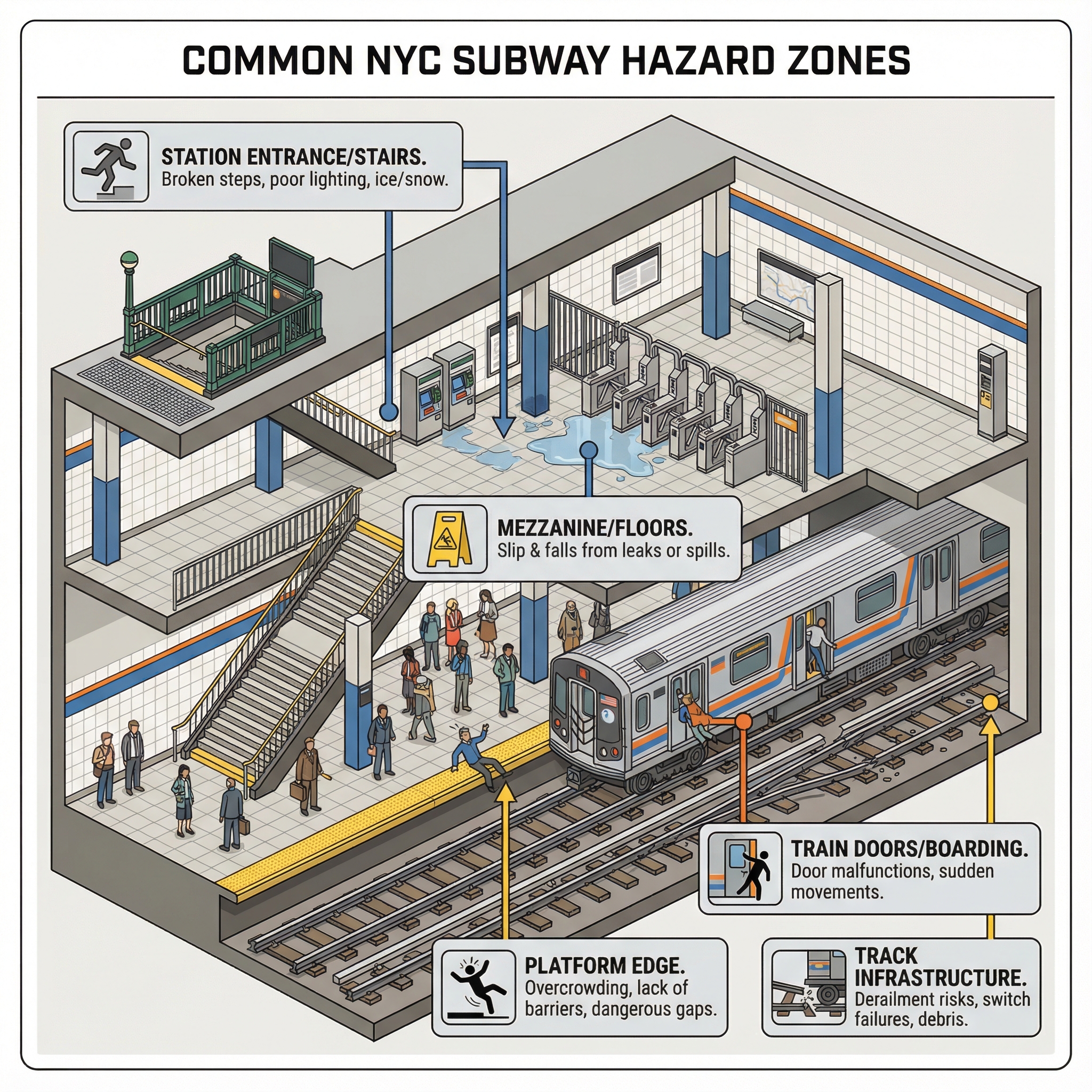
Subway stations and platforms present numerous hazards to passengers, particularly in high-traffic hubs like Times Square-42nd Street, Grand Central-42nd Street, Herald Square, and Atlantic Terminal. The NYCTA’s duty as a common carrier requires it to maintain stations in reasonably safe condition and warn of known dangers. Common station-related accidents include:
- Slip and fall accidents — Wet floors from leaks, spills, cleaning, or weather conditions
- Trip and fall accidents — Broken tiles, uneven surfaces, raised platform edges, debris, or poor lighting
- Platform edge accidents — Passengers falling onto tracks due to inadequate barriers, overcrowding, or inadequate platform width
- Escalator and elevator accidents — Malfunctioning or poorly maintained escalators and elevators cause falls or entrapment
- Stairway accidents — Broken or missing handrails, worn treads, poor lighting, or inadequate warning of hazards
The NYCTA has a duty to inspect stations regularly, address hazards promptly, and provide adequate warnings when immediate repairs are not possible. Inspection records, maintenance logs, and prior incident reports often prove the NYCTA had notice of dangerous conditions.
Your Accident May Involve Multiple Causes
Subway accidents often result from combinations of operator error, mechanical failure, and maintenance negligence. Our attorneys conduct thorough investigations to identify all contributing factors and liable parties.
Call (212) 732-2929 to discuss your case.
How New York Courts Handle Subway Accident Cases
Subway accident cases against the NYCTA follow specific procedural rules that differ from standard personal injury lawsuits. Understanding the process helps set realistic expectations and prepare for each stage of litigation.
Notice of Claim Requirement
Before filing a lawsuit against the NYCTA, you must first file a Notice of Claim within 90 days of the accident date under General Municipal Law § 50-e. This requirement applies to all claims against New York City transit authorities, including subway accidents. The Notice of Claim must include:
- The date, time, and location of the accident
- A description of how the accident occurred
- The nature and extent of injuries sustained
- The legal theory supporting your claim (negligence, premises liability, etc.)
- The amount of compensation sought
The NYCTA reviews the Notice of Claim and may schedule a 50-h hearing—a sworn examination where you answer questions about the accident under oath. This hearing typically occurs within months of filing the Notice of Claim. Your attorney will prepare you thoroughly for this examination.
THE TIME TO SUE CAN VARY FROM CASE TO CASE – ALWAYS CONSULT AN EXPERIENCED ATTORNEY TO DETERMINE THE TIME FRAME THAT APPLIES TO YOUR CASE AS SOON AS POSSIBLE AFTER THE ACCIDENT
Any statute of limitation or condition precedent, such as a notice of claim cited herein, may not apply to your particular case. The time to bring a lawsuit and the conditions upon which it may be brought depend upon many factors including the age and mental capacity of the injured person, whether the party to be sued is a private person, partnership, corporation, government entity or other legal entity, the substance and type of claim that is being made, the place of the accident and other possible factors that may apply at the time of the accident or injury. You are advised to call to confirm the time limits and conditions that apply to your case as soon as possible.
Filing the Lawsuit
After filing the Notice of Claim, you have 1 year and 90 days from the accident date to file a lawsuit in the appropriate New York County Supreme Court under General Municipal Law § 50-i. Missing this deadline typically results in permanent dismissal of your claim.
Subway accident lawsuits are usually filed in the Supreme Court of the county where the accident occurred:
- New York County Supreme Court (Manhattan accidents) — Civil Term information
- Kings County Supreme Court (Brooklyn accidents)
- Queens County Supreme Court (Queens accidents)
- Bronx County Supreme Court (Bronx accidents)
- Richmond County Supreme Court (Staten Island accidents)
Discovery and Evidence Gathering
Once the lawsuit is filed, both sides engage in discovery—the formal exchange of information and evidence. In NYCTA cases, critical evidence includes:
- NYCTA incident reports — Internal reports created by conductors, operators, or station agents
- Surveillance footage — Video from platform cameras, train cameras, or station security systems (often automatically deleted after 30-90 days if not preserved)
- Maintenance and inspection records — Documentation showing when tracks, trains, or stations were last inspected or repaired
- Train operator logs — Records of the operator’s actions and compliance with protocols
- Medical records — Complete documentation of injuries, treatment, and prognosis
- Expert reports — Analysis from engineers, accident reconstruction specialists and medical experts
The NYCTA often has sophisticated legal teams defending these cases. Our attorneys use aggressive discovery tactics to obtain critical evidence, including filing motions to compel production of documents the NYCTA attempts to withhold.
Attorney Insight: Preserving Critical Evidence
Surveillance footage disappears quickly. Many subway accidents involve critical video evidence from platform cameras or train-mounted cameras. The NYCTA’s surveillance systems automatically overwrite footage after 30-90 days unless a preservation request is filed.
We send litigation hold letters to the NYCTA demanding preservation of all surveillance footage, train operator logs, maintenance records, and incident reports related to your accident. When appropriate, we file emergency applications with the court seeking orders to preserve evidence before the NYCTA can claim it was lost or overwritten.
In many cases, obtaining surveillance footage early reveals details that contradict the NYCTA’s initial account of the accident—showing that hazards existed longer than claimed, that warnings were inadequate, or that operator negligence contributed to injuries.
Settlement Negotiations and Trial
Most subway accident cases settle before trial, but the NYCTA often takes a hard-line position in negotiations, particularly in cases involving serious injuries or significant damages. Our attorneys prepare every case as if it will go to trial, which gives us leverage in settlement negotiations.
If settlement negotiations fail, the case proceeds to trial before a New York County Supreme Court jury. At trial, we present evidence demonstrating:
- The NYCTA’s duty of care as a common carrier
- How the NYCTA, its employees, or contractors breached that duty
- The direct causal connection between the breach and your injuries
- The full extent of your damages (medical bills, lost wages, pain and suffering, future care needs)
Jury verdicts in subway accident cases can be substantial, particularly when permanent injuries result from clear NYCTA negligence.
Case Results: Significant Subway Accident Recoveries
Our attorneys have successfully represented subway accident victims in cases involving catastrophic injuries and complex liability issues. The following examples demonstrate our experience handling high-stakes NYCTA litigation:
$3.5 Million — 7 Train Derailment in Queens
A passenger on a subway train was injured when the train derailed. At the moment of impact, she was thrown across the subway car and into a pole, rendering her unconscious. Shortly after the accident, her family noticed she was not acting normally. Medical examinations confirmed she had sustained permanent brain damage. The NYCTA contended that she did not sustain brain damage or, if she did, that it was not permanent. At trial, qualified experts in brain injury and cognitive dysfunction testified, presenting persuasive medical documentation. The case settled at the end of trial for $3.5 million prior to jury deliberation.
$2.8 Million — Platform Fall and Train Strike in Brooklyn
A pedestrian was walking across a busy Brooklyn intersection when she was struck by a school bus and thrown over 25 feet. She sustained severe injuries, including multiple fractures. The bus driver claimed he had a green light and was traveling at a safe speed. Unfortunately, the victim could not recall the facts of the accident. Our investigator located a witness who saw the victim’s body in the roadway. Using this testimony, our accident reconstruction expert proved the bus had to be speeding to knock the victim that far from the crosswalk. The case settled immediately after that testimony was presented for $2.8 million.
$1.3 Million — Escalator Malfunction at Manhattan Subway Station
A construction worker fell through a hole in scaffolding where he was working and sustained small fractures of the spinous process and mild cognitive deficits. Despite the relatively moderate nature of the injuries compared to other construction accidents, the case settled for $1.3 million due to clear liability and the permanent nature of the cognitive impairments.
Prior results do not guarantee a similar outcome. Each case is unique and must be evaluated on its own facts and circumstances.
Your Case May Be Worth Significant Compensation
The value of your subway accident claim depends on the severity of your injuries, the clarity of liability, and the quality of evidence available. Contact us for a free case evaluation.
Call (212) 732-2929 to discuss your potential recovery.
Common Injuries in Subway Accidents
Subway accidents can cause a wide range of injuries, from minor bruises to life-altering, catastrophic trauma. The severity of injuries often depends on the type of accident, speed of the train, and location of impact. Common injuries include:
Traumatic Brain Injuries (TBI)
Derailments, sudden stops, and platform falls frequently cause head trauma. Traumatic brain injuries range from mild concussions to severe brain damage requiring lifelong care. Symptoms include headaches, dizziness, memory loss, cognitive impairment, personality changes, and loss of consciousness. According to the CDC, even “mild” TBIs can result in permanent cognitive deficits that affect work capacity and quality of life.
Spinal Cord Injuries and Paralysis
High-impact subway accidents can cause spinal cord injuries resulting in partial or complete paralysis. Spinal cord damage may cause paraplegia (paralysis of the lower body) or quadriplegia (paralysis of all four limbs). These injuries typically require extensive medical care, rehabilitation, assistive devices, and home modifications. The National Institute of Neurological Disorders and Stroke notes that spinal cord injuries are often permanent and life-changing.
Broken Bones and Fractures
The force of subway accidents frequently causes bone fractures, including:
- Skull fractures
- Facial fractures (jaw, cheekbone, eye socket)
- Rib fractures (which may puncture lungs or other organs)
- Spinal vertebrae fractures
- Pelvic fractures
- Hip fractures (particularly in elderly passengers)
- Ankle and leg fractures
- Wrist and arm fractures
Complex fractures may require surgery, metal implants, and months of rehabilitation. Some fractures result in permanent limitations on mobility and function.
Lacerations and Scarring
Broken glass, sharp metal edges, and contact with subway car interiors cause deep lacerations requiring stitches, plastic surgery, or skin grafts. Facial lacerations can result in permanent disfiguring scars affecting appearance and self-esteem.
Internal Injuries and Organ Damage
Blunt force trauma from subway accidents can cause internal bleeding and organ damage, including:
- Internal bleeding (abdominal, chest, brain)
- Ruptured spleen or liver
- Punctured lungs
- Kidney damage
- Bowel perforation
Internal injuries may not be immediately apparent and can be life-threatening if not diagnosed and treated promptly.
Psychological Trauma and PTSD
Subway accidents cause significant psychological trauma even when physical injuries are minor. Victims often develop:
- Post-Traumatic Stress Disorder (PTSD)
- Anxiety disorders and panic attacks
- Depression
- Fear of public transportation
- Sleep disturbances and nightmares
The National Institute of Mental Health recognizes PTSD as a serious condition requiring professional treatment. New York law allows recovery for psychological injuries even without accompanying physical trauma when caused by another’s negligence.
Wrongful Death
The most tragic subway accidents result in death. Surviving family members may file wrongful death claims under New York Estates, Powers and Trusts Law § 5-4.1, seeking compensation for funeral expenses, loss of financial support, loss of services, and other pecuniary losses. Wrongful death claims must be filed within 2 years of the date of death.
If you or a loved one has suffered any of these injuries in a subway accident, immediate medical attention is critical—both for your health and for documenting your injuries for a legal claim.
Client Testimonials
Frequently Asked Questions About Subway Accidents
How long do I have to file a subway accident claim in New York?
You must file a Notice of Claim with the NYCTA within 90 days of your subway accident under General Municipal Law § 50-e. After filing the Notice of Claim, you have 1 year and 90 days from the accident date to file a lawsuit under General Municipal Law § 50-i. These deadlines are strictly enforced. Missing the 90-day Notice of Claim deadline typically bars your lawsuit permanently. Courts rarely grant extensions except in very limited circumstances.
THE TIME TO SUE CAN VARY FROM CASE TO CASE – ALWAYS CONSULT AN EXPERIENCED ATTORNEY TO DETERMINE THE TIME FRAME THAT APPLIES TO YOUR CASE AS SOON AS POSSIBLE AFTER THE ACCIDENT
Any statute of limitation or condition precedent, such as a notice of claim cited herein, may not apply to your particular case. The time to bring a lawsuit and the conditions upon which it may be brought depend upon many factors including the age and mental capacity of the injured person, whether the party to be sued is a private person, partnership, corporation, government entity or other legal entity, the substance and type of claim that is being made, the place of the accident and other possible factors that may apply at the time of the accident or injury. You are advised to call to confirm the time limits and conditions that apply to your case as soon as possible.
Can I sue the NYCTA for a subway accident?
Yes, you can sue the NYCTA for subway accidents caused by negligence, improper maintenance, operator error, or dangerous conditions. However, you must first file a Notice of Claim within 90 days and follow specific procedural rules for claims against government entities. The NYCTA operates as a common carrier and owes passengers the highest degree of care—a stricter standard than ordinary negligence.
What if I were partially at fault for my subway accident?
New York follows pure comparative negligence under CPLR § 1411. This means you can recover damages even if you were partially at fault for your accident. However, your compensation is reduced by your percentage of fault. For example, if you are found 30% at fault and your damages are $100,000, you would recover $70,000 (70% of the total). You can still recover compensation even if you are 99% at fault, though your recovery would be minimal.
How much is my subway accident case worth?
The value of your case depends on the severity of your injuries, the extent of liability, and available insurance coverage. Factors include medical bills (past and future), lost wages, loss of earning capacity, pain and suffering, emotional distress, and quality of life impairment. Catastrophic injuries like brain damage, paralysis, or wrongful death can result in multi-million dollar recoveries. Each case is unique and must be evaluated individually.
What should I do if the NYCTA contacts me after my accident?
Will my case go to trial?
What evidence do I need for a subway accident claim?
Do I have to pay anything up front to hire a subway accident lawyer?
Why Choose Dansker & Aspromonte for Your Subway Accident Case?
Over 35 years of experience
representing subway accident victims in New York City
Over $750 million recovered
Proven trial experience
in New York State Supreme Court across the five boroughs and other venues
Deep understanding of NYCTA procedures
including Notice of Claim requirements, 50-h hearings, and government claim litigation
Network of expert witnesses
including accident reconstruction specialists, engineers, medical experts, and economists
Aggressive investigation tactics
Personal attention
No fees unless we win
We understand that subway accidents disrupt your life, cause financial stress, and create uncertainty about the future. Our goal is to handle the legal complexities so you can focus on recovery while we fight for the compensation you deserve.
Get Started with a Free Consultation
Speak with an experienced NYC subway accident attorney today
Available 24/7 • No fees unless we recover compensation
Summary: Your Rights After a NYC Subway Accident
If you’ve been injured in a New York City subway accident, understanding your legal rights and the strict deadlines imposed by law is critical to protecting your ability to recover compensation. The NYCTA operates under special rules that differ from standard personal injury claims, most notably the 90-day Notice of Claim requirement under General Municipal Law § 50-e and the 1 year + 90-day lawsuit filing deadline under General Municipal Law § 50-i.
Subway accidents occur due to operator negligence, mechanical failures, track defects, platform hazards, and inadequate maintenance across all five boroughs. The NYCTA owes passengers the highest degree of care as a common carrier, meaning they must take all reasonable precautions to ensure safety. When they fail in this duty, injured passengers have the right to seek compensation for medical bills, lost wages, pain and suffering, and other damages.
Critical evidence like surveillance footage and incident reports often disappears within weeks if not preserved through immediate legal action. The NYCTA has sophisticated legal teams defending these cases, making experienced representation essential. New York’s comparative negligence rule allows you to recover damages even if partially at fault, though your compensation will be reduced proportionally.
Dansker & Aspromonte Associates LLP has over 35 years of experience litigating NYCTA claims and has recovered over $750 million for injured clients. We handle all subway accident cases on a contingency basis—no fees unless we win. If you’ve been injured in a subway accident in Manhattan, Brooklyn, Queens, the Bronx, or Staten Island, contact us immediately for a free consultation at (212) 732-2929.
Contact Dansker & Aspromonte Associates LLP
Office Location:
30 Vesey Street, 16th Floor
New York, NY 10007
Phone: (212) 732-2929
Available 24/7 for emergency consultations
Email: Contact us through our secure online form
Serving: Manhattan, Brooklyn, Queens, Bronx, Staten Island, and all of New York City
Our Office Location
Sources and References
This article references authoritative legal and medical sources to ensure accuracy:
- Cornell Legal Information Institute – Common Carrier Definition
- New York General Municipal Law § 50-e (Notice of Claim)
- New York General Municipal Law § 50-i (Statute of Limitations)
- New York CPLR § 1411 (Comparative Negligence)
- NYCTA Transparency Reports
- NYC Open Data Portal
- NYC Comptroller’s Office
- Federal Transit Administration – Transit Safety Oversight
- CDC – Traumatic Brain Injury Information
- National Institute of Neurological Disorders and Stroke – Spinal Cord Injury
- National Institute of Mental Health – PTSD
- New York County Supreme Court – Civil Term
Disclaimer: Prior results do not guarantee a similar outcome. Attorney advertising. This website is for informational purposes only and does not constitute legal advice. Consult a qualified attorney for advice regarding your individual situation. This website is not intended to create, and viewing it does not constitute, an attorney-client relationship.