
New York Dog Bite Lawyer
Dansker & Aspromonte Associates LLP represents dog bite victims throughout Manhattan, Brooklyn, Queens, the Bronx, and Staten Island. On April 17, 2025, the New York Court of Appeals held in Flanders v. Goodfellow that victims can now sue for negligence—expanding legal options beyond the traditional “one-bite rule.” We’ve recovered over $750 million for injured clients and handle cases on contingency.
New 2025 Laws May Increase Your Settlement
Injured by a dog in NYC? Get a free case review today.
Call (212) 732-2929 or contact us online.
What To Do Right After a Dog Attack in New York City
If you or a family member has been bitten by a dog in Manhattan, Brooklyn, Queens, the Bronx, or Staten Island, take these immediate steps to protect your health and legal rights:
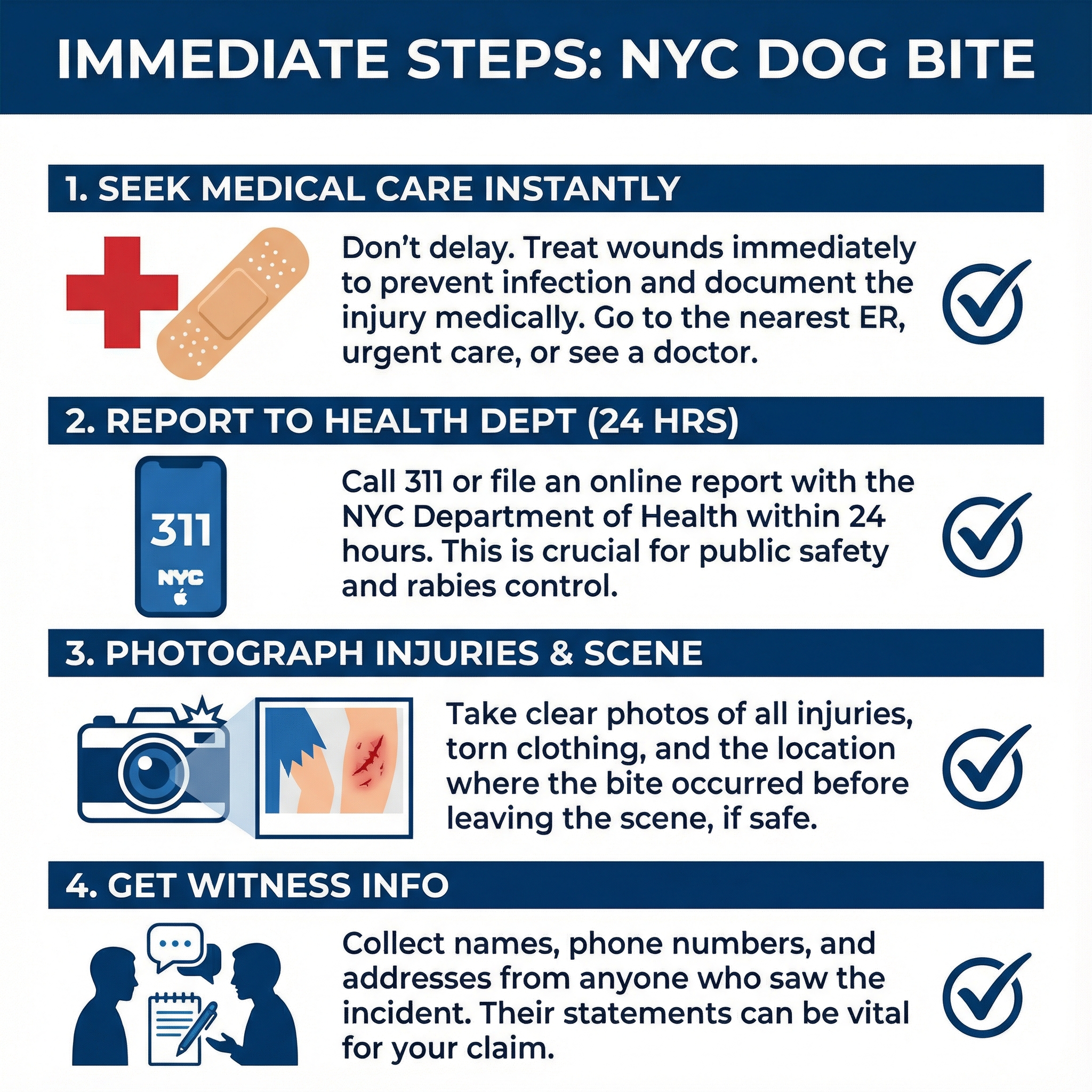
Seek medical attention immediately
Even minor-looking bites can cause serious infections, nerve damage, or require reconstructive surgery. Go to an NYC emergency room or urgent care clinic.
Report the bite to NYC Health Department
Document everything
Identify witnesses
Preserve evidence of the dog’s vicious propensities
Do not sign anything from the dog owner or their insurance company
Contact a New York dog bite attorney
Legal deadlines apply. Call (212) 732-2929 for a free consultation before evidence disappears.
Understanding New York Dog Bite Law
Vicious Propensities
A dog’s tendency to act in a dangerous manner, shown by prior incidents of growling, snapping, baring teeth, lunging at people, or previous bites. Under New York law, if an owner knew or should have known about these tendencies, they can be held strictly liable for all damages.
Dangerous Dog Law
Negligence Liability (Since April 17, 2025)
Statute of Limitations
The deadline to file a lawsuit. In New York, dog bite victims generally have a standard filing period, measured from the date of the attack, to file a personal injury lawsuit. However, this deadline can vary based on factors including the victim’s age, mental capacity, and whether a government entity owns the dog.
Important Notice: The time to sue varies case-by-case based on victim age, defendant type, and claim specifics. Do not rely solely on general deadlines—consult an attorney immediately at (212) 732-2929 to confirm your specific deadline.
Any statute of limitation or condition precedent such as a notice of claim cited herein may not apply to your particular case. The time to bring a lawsuit and the conditions upon which it may be brought depend upon many factors including the age and mental capacity of the injured person, whether the party to be sued is a private person, partnership, corporation, government entity or other legal entity, the substance and type of claim that is being made, the place of the accident and other possible factors that may apply at the time of the accident or injury. You are advised to call to confirm the time limits and conditions that apply to your case as soon as possible.
New York’s 2025 Dog Bite Law Change
In 2025, the New York Court of Appeals decided Flanders v. Goodfellow, changing dog bite law in New York. Before that decision, the Bard v. Jahnke precedent barred negligence claims against dog owners—victims could only sue under strict liability by proving the owner knew the dog was dangerous.
Flanders removed this restriction. New York dog bite claims may involve two primary civil liability theories, plus a separate dangerous dog statute that can support limited statutory remedies in qualifying cases.
Strict Liability (Vicious Propensities)
The traditional standard. If you prove the owner knew or should have known the dog had dangerous tendencies (prior aggression, complaints, prior bites), they may be liable for damages such as medical bills, lost wages, pain and suffering, scarring, and permanent injuries—regardless of whether they exercised reasonable care.
Negligence (The Flanders Standard)
The pathway recognized in Flanders (2025). You may be able to sue for damages if you prove the owner failed to exercise reasonable care in controlling or supervising their dog, even without prior aggressive history. Examples include violating NYC leash laws, leaving a large dog unsecured near children, or allowing a dog to roam free in common areas.
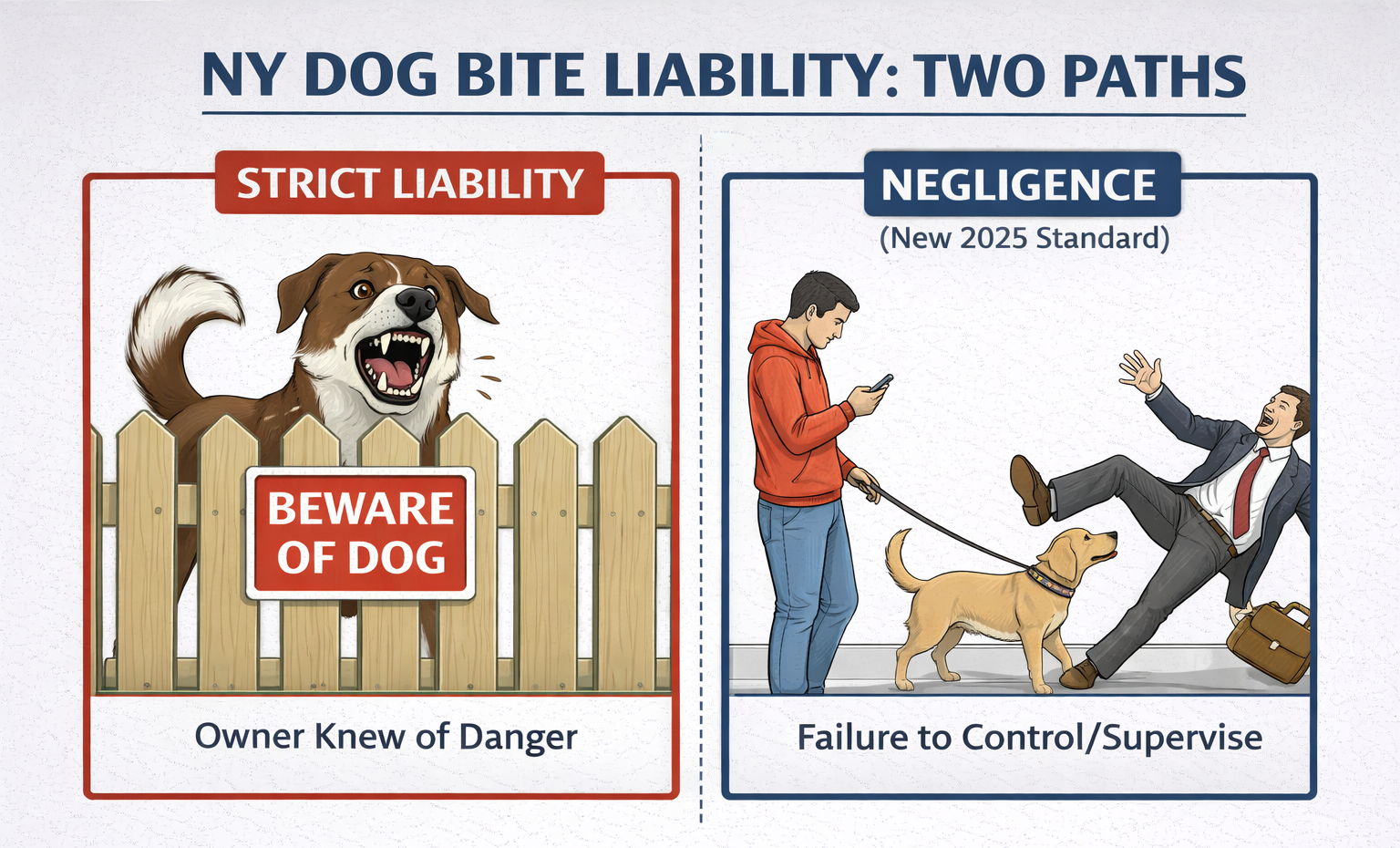
This expansion gives victims significantly more legal options, particularly in cases involving leash law violations, unsecured dogs in apartment buildings, or failure to properly restrain animals around vulnerable individuals.
Questions About Your Dog Bite Case? Free consultation with experienced NYC dog bite attorneys. Call (212) 732-2929 now.
Legal Options After a New York Dog Bite
New York dog bite claims may proceed under two primary civil liability theories: strict liability and negligence. New York’s dangerous-dog law is separate and may provide limited statutory remedies in qualifying cases. We analyze your case to determine which theories and remedies may apply.
Evidence Requirements for Dog Bite Claims
Strict Liability
Negligence
Dangerous Dog Statute Remedies
NYC Reporting Requirements
New York City law requires all dog bites to be reported promptly. Report by:
- Calling 311
- Filing online at the NYC Health Department portal
The NYC Department of Health uses these reports to assess rabies exposure risk and determine quarantine requirements. Dogs involved in bite incidents may need to undergo a rabies observation period. Failure to report can complicate your legal case and put public health at risk.
Who Is Liable for Dog Attacks in New York?
Dog Owners
The dog’s owner is the primary party liable under New York law. Owners are responsible when:
- They knew or should have known the dog had vicious propensities (history of aggression, prior bites, growling, snapping)
- They negligently failed to control or supervise the dog (a negligence standard recognized in 2025)
- The dog was previously adjudicated “dangerous” under New York’s dangerous-dog law
Evidence of vicious propensities includes prior incidents where the dog showed aggression toward people or other animals, complaints from neighbors or delivery workers, and the dog’s behavioral patterns combined with the owner’s failure to properly train or restrain the animal.
Landlords and Property Owners
Building owners and landlords can be held liable for dog attacks that occur on their property if they:
- Knew a tenant’s dog was dangerous but failed to take action to protect others
- Received prior complaints about the dog’s aggressive behavior
- Had actual knowledge the dog previously attacked someone
- Failed to enforce lease provisions prohibiting dangerous dogs
In New York City apartment buildings, landlords who ignore repeated complaints about a dangerous dog can face significant liability when that dog ultimately injures someone.
Dog Walkers and Pet Sitters
Veterinary Clinics
Veterinary clinics in New York may owe a duty of care to customers and can face liability for dog attacks that occur on their premises, depending on the facts.
Dog Attack Risk Factors
According to the American Veterinary Medical Association (AVMA), breed alone is not a reliable predictor of aggression. Multiple factors contribute to dog bite risk:
Dog-Related Risk Factors
- Size and bite force — Larger dogs cause more severe injuries regardless of breed
- Lack of socialization — Dogs not exposed to different people, animals, and situations during critical development periods
- Prior aggressive behavior — History of growling, lunging, snapping, or territorial guarding
- Inadequate training — Lack of obedience training or reinforcement of aggressive behavior
- Medical issues — Pain, illness, or cognitive decline can trigger defensive aggression
- Reproductive status — Unneutered male dogs show higher aggression rates
Owner-Related Risk Factors
- Failure to restrain — Not using leashes in violation of NYC leash laws
- Inadequate supervision — Leaving dogs unsecured in yards or common areas
- Encouragement of aggression — Using dogs for protection without proper training
- Ignoring warning signs — Dismissing complaints from neighbors or delivery workers
- Poor living conditions — Chaining, isolation, or confinement that increases stress
Situational Risk Factors
- Victim age — Children under 10 and adults over 65 suffer more severe injuries and are less able to defend themselves
- Unfamiliar settings — Dogs in new environments may act unpredictably
- Resource guarding — Dogs protecting food, toys, or territory
- Startling or cornering — Approaching sleeping dogs or blocking escape routes
- Maternal protection — Female dogs with puppies may be more defensive
Under New York’s Flanders decision, owners can be held liable for negligently failing to control dogs exhibiting these risk factors, even without a prior bite history. The law now recognizes that responsible dog ownership requires anticipating and managing foreseeable risks.
What To Do If Approached by an Aggressive Dog
De-Escalation Steps
If you encounter an aggressive dog in New York City, these techniques can help prevent an attack:
- Do not run — Running triggers chase instinct in most dogs
- Avoid direct eye contact — This signals aggression to dogs; keep them in peripheral vision
- Stand still and calm — Keep arms at your sides, project confidence without aggression
- Give verbal commands — Say “No,” “Stay,” or “Go home” in a firm, low voice
- Back away slowly — Move diagonally (not straight backward), keeping the dog in view
- Create barriers — Put objects (backpack, jacket, purse) between you and the dog
- Use your voice — A loud, authoritative “No!” can sometimes stop an approaching dog
If a Dog Attacks
- Call 911 immediately if you’re in immediate danger or if others are present who can call
- Protect vital areas — Cover your face, neck, and chest with arms
- If knocked down, curl into a ball — Hands protecting neck and ears, knees to chest, stay still until help arrives or the dog leaves
- Do not pull away from a biting dog — This worsens tearing injuries; instead, try to remain still
- Shout for help continuously — Alert others who may be able to intervene or call for help
After an Attack
- Seek immediate medical attention at an emergency room, even if injuries seem minor
- Report to NYC Health Department promptly — Call 311 or file online
- Document injuries with photos — Take pictures immediately and throughout the healing process
- Get witness contact information — Anyone who saw the attack or the dog’s prior behavior
- Contact an attorney at (212) 732-2929 before speaking with insurance adjusters
- Do not sign any documents from the dog owner or insurance company without legal advice
Teaching Children Safety Around Dogs
Children aged 5 to 9 are among the most common victims of dog bites in New York. Parents can reduce this risk by teaching children proper behavior around dogs and recognizing warning signs.
What Children Should NEVER Do Around Dogs
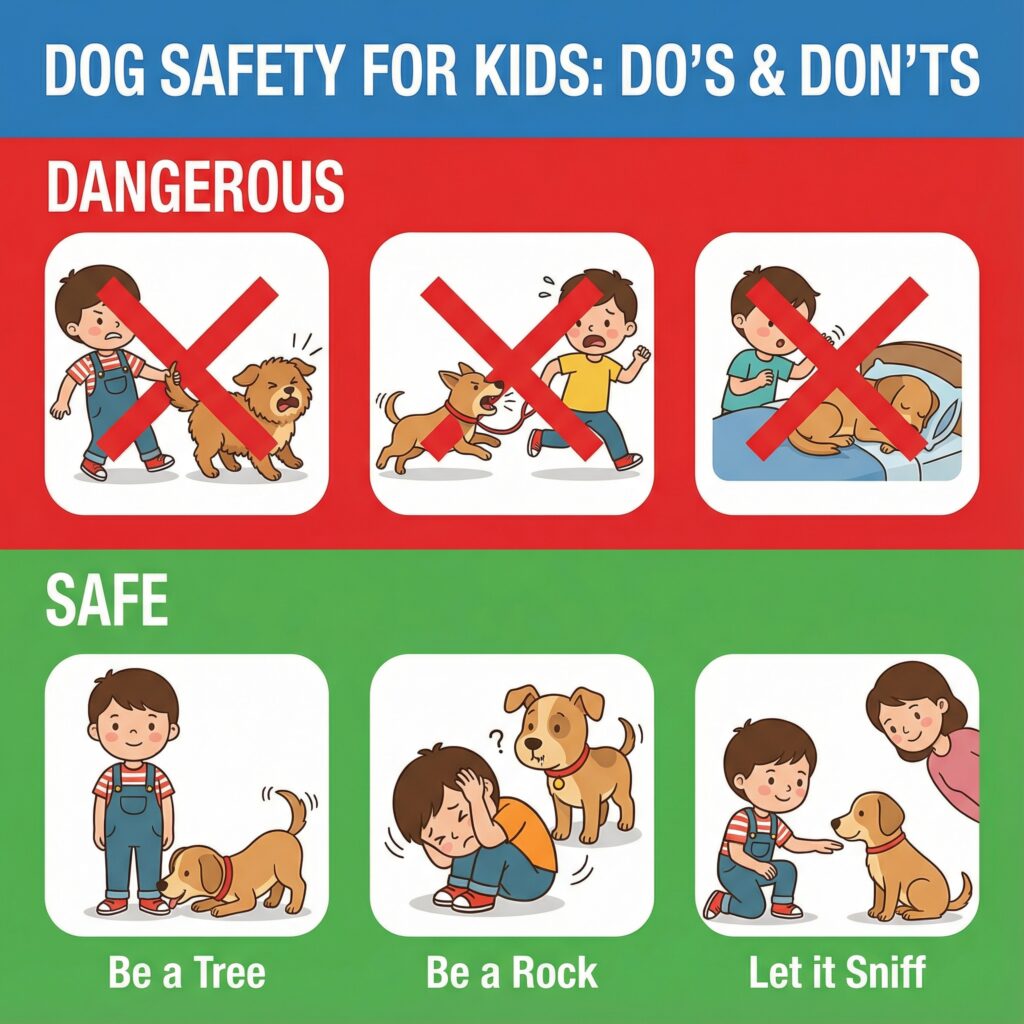
- Never approach a dog from behind — Dogs can perceive this as a threat and react defensively
- Never stare directly into a dog’s eyes — Direct eye contact is seen as aggressive behavior in dog communication
- Never pull on a dog’s ears, tail, or body — Pain provokes defensive biting
- Never kiss a dog on the face — Even friendly dogs can react unpredictably to face-to-face contact
- Never touch a dog’s food bowl while eating — Resource guarding is instinctive and can trigger aggression
- Never disturb a sleeping dog — Startling dogs can cause reflexive biting
- Never approach a dog with puppies — Maternal instinct makes dogs more protective and defensive
- Never run away from a dog — This triggers chase behavior
Safe Behavior for Children
Teach your child to:
- Always ask the owner’s permission before petting or touching any dog
- Extend their hand slowly, palm down, allowing the dog to sniff before petting
- Pet the dog’s shoulder or back, not the head or face
- Stay calm if approached by an aggressive dog — No running, screaming, or sudden movements
- Stand still like a tree with arms at their sides if a dog approaches barking
- Speak firmly yet calmly, saying “No” or “Go home”
- Slowly back away until the dog is out of sight, never turning their back and running
If a Dog Attacks a Child
Teach children that if a dog knocks them down, they should:
- Curl into a ball immediately — Knees to chest, protecting the torso
- Cover their face, neck, and head with their hands and arms
- Stay still and quiet until the dog leaves or help arrives
- Do not scream or flail — Movement can escalate the attack
Important for Parents: Adults should supervise all interactions between young children and dogs, even family pets. Never leave infants or toddlers alone with any dog, regardless of the dog’s history. Many serious attacks occur when children are left unsupervised with dogs in homes.
Compensation Available in Dog Bite Cases
Economic Damages
- Medical expenses — Emergency room treatment, hospitalization, surgery, antibiotics, rabies treatment, medications, physical therapy, psychiatric counseling for trauma
- Future medical costs — Reconstructive surgery, scar revision procedures, ongoing psychological treatment, additional surgeries as children grow
- Lost wages — Time missed from work for treatment and recovery
- Loss of earning capacity — Permanent injuries affecting your ability to work or advance in your career
- Home care costs — If injuries require assistance with daily activities
- Property damage — Torn clothing, damaged personal items, ruined belongings
Non-Economic Damages
- Pain and suffering — Physical pain during the attack and throughout recovery
- Emotional distress — Anxiety, depression, post-traumatic stress disorder (PTSD), fear of dogs
- Disfigurement — Permanent scarring, particularly on the face, neck, arms, or legs
- Loss of enjoyment of life — Inability to participate in activities you previously enjoyed
- Mental anguish — Ongoing psychological impact of the attack
Special Damages for Children
Children who suffer facial scarring or disfigurement from dog bites can recover substantial damages for:
- Impact on self-esteem and social development
- Psychological trauma and fear lasting into adulthood
- Multiple reconstructive surgeries as the child grows (facial structures change with age)
- Future counseling and therapy needs extending into adulthood
- Impact on future employment and relationships
Insurance Coverage
Many homeowners and renters insurance policies include liability coverage for dog bites. Available coverage limits vary by policy. We look for all available insurance coverage.
Pursuing Compensation for Your Injuries We work to pursue compensation for medical bills, lost wages, pain and suffering, and future care. Free consultation at (212) 732-2929.
Our Personal Injury Trial Experience
Dansker & Aspromonte Associates LLP has handled injury cases for New Yorkers since 1989. We handle dog bite cases throughout NYC. Our experience includes:
- Serious injury litigation — Cases involving permanent scarring, nerve damage, facial disfigurement, and psychological trauma requiring lifelong treatment
- Complex liability disputes — Proving owner knowledge of vicious propensities, establishing landlord liability in apartment buildings, and pursuing multiple-defendant cases
- Insurance negotiation and litigation — Pursuing recovery from homeowners policies, umbrella policies and business liability coverage
- Trial preparation — We prepare to take cases to trial when fair settlements aren’t offered
- Medical coordination — Working with reconstructive surgeons, neurologists, psychiatrists, and animal behavior consultants to document the full extent of injuries
Our attorneys have represented victims of serious dog attacks resulting in:
- Facial reconstruction and scar revision surgeries
- Permanent facial and body disfigurement
- Post-traumatic stress disorder (PTSD) requiring ongoing therapy
- Nerve damage causing permanent loss of sensation or function
- Infections requiring hospitalization and IV antibiotics
- Children requiring multiple surgeries as they grow
We understand the medical, psychological, and financial impact these cases have on families. You pay no attorney fee unless we recover money for you. Court costs and disbursements may apply regardless of outcome. Review our fee disclosure.
What Our Clients Say
Why Choose Dansker & Aspromonte for Your Dog Bite Case
Over $750 million recovered for injured clients
We have the resources and experience to handle complex cases involving permanent injuries
Trial experience
Insurance companies take us seriously because we’re prepared to go to trial when fair settlements aren’t offered
No attorney fee unless we recover
We work on contingency, meaning you pay nothing unless we recover compensation for you. No hourly charges, no retainer fees, no hidden costs
Deep experience with NYC courts
We handle cases in all five boroughs and understand local court procedures, judges, and opposing counsel
Personalized attention from senior attorneys
You’ll work directly with experienced attorneys who handle your case personally, not paralegals or junior associates
Prompt response
Dog attacks don’t happen on a schedule. We’re available around the clock to discuss your case
Multilingual staff
We communicate with clients in English, Spanish, and Mandarin Chinese
Network of medical consultants
We work with reconstructive surgeons, neurologists, psychiatrists, and animal behavior consultants to document the full extent of your injuries
Our attorneys understand that dog attacks cause both physical injuries and lasting psychological trauma. We take the time to understand the full impact on your life, not just your medical bills. We work to pursue compensation that reflects your actual losses, past, present, and future.
Get Your Free Dog Bite Case Review You pay no attorney fee unless we recover money for you. Court costs and disbursements may apply regardless of outcome. Review our fee disclosure.
Call (212) 732-2929 or contact us online now.
Frequently Asked Questions About Dog Bite Cases
Q: How do I prove the dog owner knew their dog was dangerous?
Q: What if I was bitten while visiting a friend’s home or apartment?
Q: Can I sue if the dog bite happened in a public park or on the street?
Q: How long do I have to file a dog bite lawsuit in New York?
Dog bite victims generally have a standard filing period, measured from the date of the attack, to file a personal injury lawsuit. However, this deadline can be shorter or longer depending on several factors. If you’re a minor, the filing period may be extended. If a government entity owns the dog (NYCHA, municipal animal control), you generally must file a Notice of Claim within a short window and start a lawsuit within a limited time. If you’re mentally incapacitated at the time of the attack, different rules may apply.
DO NOT RELY ON THESE GENERAL DEADLINES. The time to sue varies case-by-case. Call (212) 732-2929 promptly to determine your specific deadline. Waiting too long can bar your claim.
Q: What if the dog has never bitten anyone before?
Q: What if I was partially at fault for provoking the dog?
Q: Can I sue my landlord if my neighbor’s dog bit me?
Q: What if the dog owner doesn’t have insurance or assets?
We explore all potential sources of recovery. This may include: the dog owner’s homeowners or renters insurance (even if they’re unaware they have coverage), umbrella liability policies providing additional coverage, landlord or property owner liability insurance if the attack occurred on rental property, your own underinsured motorist coverage (some policies cover dog bites), and in cases involving professional dog walkers or daycare facilities, their business liability insurance. We thoroughly investigate all potential defendants and insurance policies before determining whether to pursue your case.
Related Personal Injury Practice Areas
- Children’s Injury Lawyer — Representing children injured in accidents, including dog bites
- Brain Injury Lawyer — Severe dog attacks can cause traumatic brain injuries
- Catastrophic Injury Lawyer — Permanent disfigurement and life-altering injuries
- Premises Liability Lawyer — Property owner responsibility for unsafe conditions
- Negligent Building Security — Landlord liability for dangerous conditions in buildings
Dansker & Aspromonte Associates LLP
30 Vesey Street, 16th Floor
New York, NY 10007
Phone: (212) 732-2929
Website: www.dandalaw.com
Attorney Advertising. Prior results do not guarantee a similar outcome. This website is for informational purposes only and does not constitute legal advice. Consult a qualified attorney for advice regarding your individual situation. Viewing this website does not create an attorney-client relationship. The information on this website may not reflect the most current legal developments and may be changed without notice.
© 2026 Dansker & Aspromonte Associates LLP. All rights reserved.